
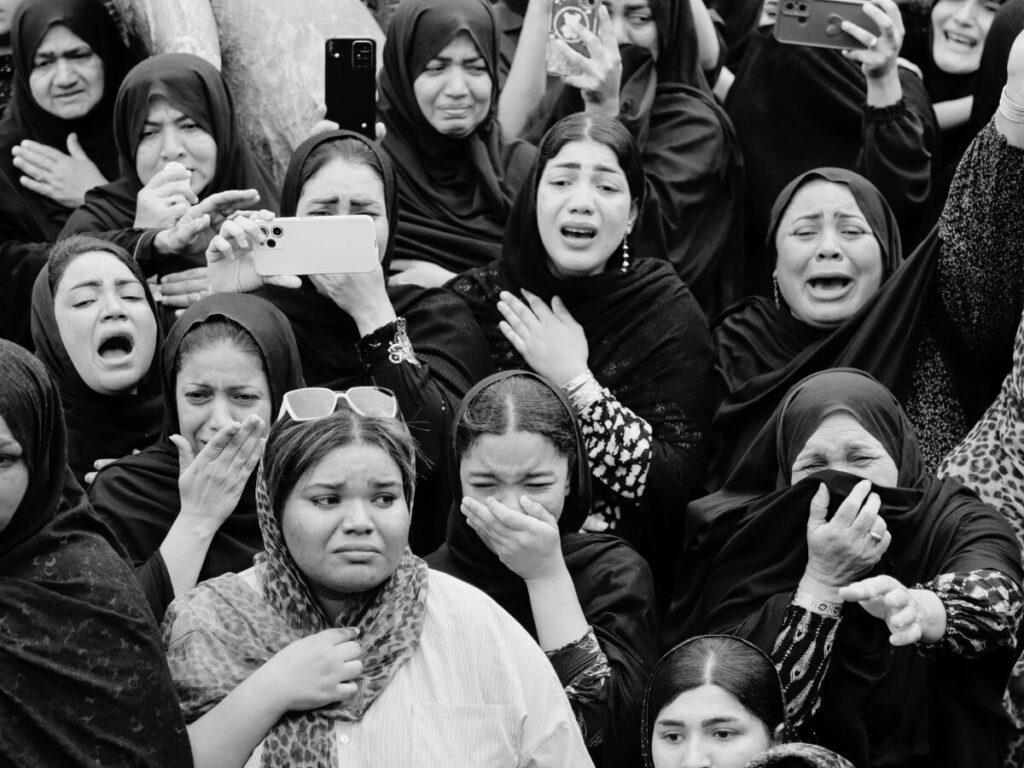
Missiles destroyed a girls’ primary school in Minab on 28 February, killing up to 175 people, most of them children aged 7 to 12. In the week since, a disinformation campaign tried to erase what happened, a CPAC chair suggested the girls were better off dead, and the US still hasn’t said a word of accountability. Human Rights Watch is now calling it a war crime.
Her name means The Good Tree. That’s what Shajareh Tayyebeh translates to. On the morning of 28 February, a Saturday and the start of Iran’s school week, the Shajareh Tayyebeh girls’ primary school in Minab, southern Iran, was struck by missiles while children sat at their desks. The roof collapsed onto them. When parents ran to the school, the building was already gone.
One mother, a midwife, told NBC News she had only just dropped her son off when she got the call to come collect him. She couldn’t leave her patients immediately. By the time she arrived, the school had been struck a second time. “By the time we arrived, the entire school had collapsed on top of the children,” she said.
The school was hit not once but three times. After the first missile struck, the principal moved surviving students to a prayer room and called parents asking them to come collect their children. The second missile hit that prayer room, killing most of those who had sheltered there. A father reached the rubble and held up his daughter’s exercise book. Her name was written on the cover: Mohanna Zari, first grade.
Iranian authorities confirmed a death toll of 165 people, the majority of them girls aged 7 to 12, with at least 95 others wounded. The Iranian Red Crescent Society has reported up to 175 dead, nearly all of them children. The school had 264 students enrolled. UNESCO called the attack “a grave violation of humanitarian law.” UN Secretary-General António Guterres condemned it. Nobel Peace Prize laureate Malala Yousafzai said she was “heartbroken and appalled.”


Within hours of the strike, a separate campaign began online. Posts, some racking up millions of views, claimed Iran had bombed its own school: that this was a failed rocket launch by the Islamic Revolutionary Guard Corps (IRGC), and that Iranian state channels had already admitted responsibility.
One post carrying that claim had been viewed 5.6 million times by the afternoon of 1 March. Another, insisting “Iran admits: it was an IRGC missile that killed 148 school-girls,” reached 2.3 million views. Both pointed to screenshots from a Telegram channel called Radio Gilan as their evidence.
Radio Gilan is not a state channel. It is an anti-regime, pro-monarchy account with no affiliation to the Iranian government. The IRGC’s own verified Telegram channel, Sepah News, published photos of the school’s destruction with a caption that translated as: “The situation of Minab Girls’ School after the crime committed by the Zionist-American enemy.” The confession being shared as fact was fiction sourced from an opposition propaganda channel.
The photo supposedly showing a rogue IRGC missile in flight was traced by investigative journalist Nilo Tabrizy, who has reported on Iran for the Washington Post and the New York Times, to Zanjan: a city roughly 800 miles north of Minab. The image showed snowcapped mountains. Minab is flat. The New York Times noted that “a single errant missile wouldn’t have caused such precise and targeted damage to several buildings across the naval base.” Snopes and PolitiFact both rated the IRGC responsibility claim false.

So who was responsible? The evidence assembled over the past week points in one direction. Satellite imagery analysis by Al Jazeera’s digital investigations unit found the school had been clearly separated from the adjacent IRGC military complex since at least 2016, walled off with its own entrance and recognised as a civilian institution for over a decade. The strike pattern made things starker: missiles hit the military base and the school, but left untouched a medical clinic positioned between the two. Someone had a map specific enough to distinguish between individual buildings on the same site. That is not a stray missile.
US officials told members of Congress in a closed-door briefing that the US military had been targeting that area, and that Israel was not responsible for the school strike. Military analysts told NPR that Minab’s location in southeastern Iran made a US operation far more likely than an Israeli one, consistent with other US strikes on the Bandar Abbas naval base nearby. The Washington Post and NBC News both concluded the evidence pointed toward a US airstrike.
The official US response: Defense Secretary Pete Hegseth told reporters the administration was “investigating.” “We, of course, never target civilian targets,” he added. Secretary of State Marco Rubio said US forces “would not deliberately target a school.” Nobody said the words: we did this.


Into that accountability vacuum walked Matt Schlapp, chair of the American Conservative Union and organiser of CPAC, on Piers Morgan Uncensored this week. When journalist Peter Beinart pointed out that the girls would be alive had the US and Israel not launched their attack, Schlapp interrupted: “They’d be alive in a burqa. This is a barbaric society.” He later elaborated that the girls would have lived without career choices, in a society he deemed not worth preserving. Fellow panellist Cenk Uygur replied: “So just kill them?”
Women in Iran are not required to wear a burqa. Under the regime’s laws they must wear a hijab, an oppressive imposition, but one that has nothing to do with Taliban-era Afghanistan, which Schlapp appeared to be conflating with a country where women make up the majority of university graduates. Journalist Yashar Ali noted on X that Iranian schoolgirls wear a headscarf and a school uniform. Not a burqa. The girls in Minab were seven years old.
The logic underneath the factual error is the part worth sitting with. The argument, that Muslim girls’ lives are so diminished by the circumstances of their birth that their deaths become at worst a wash, is not new. It has justified civilian death counts in Western military operations for decades. It doesn’t require a conspiracy. It just requires enough people to find it easier to believe that than to reckon with what actually happened.
On 7 March, Human Rights Watch formally called the Minab attack unlawful and demanded the US and Israel immediately assess their responsibility, make their findings public, and face consequences, up to and including prosecution for war crimes. The laws of war are unambiguous: attacks on civilians are prohibited when the anticipated harm to non-combatants is disproportionate to the military gain. The school had been a school, not a military facility, for a decade. The children inside it were between seven and twelve years old. There is no proportionality calculation that works here.
A second school in Tehran was struck on 6 March. Iran’s internet blackout has made independent verification of the full civilian toll difficult, but the reporting available from NBC, NPR, the Washington Post, Al Jazeera and multiple open-source investigators is consistent: the school in Minab was a civilian target. The disinformation campaign that followed existed to make that deniable. It worked well enough that millions of people on social media believe something that has been demonstrably debunked.
At The New Feminist, we have been watching what happens when girls in Muslim-majority countries become collateral in Western foreign policy for years. The information war that followed Minab is part of the same machine: seed enough doubt, and accountability feels optional.