
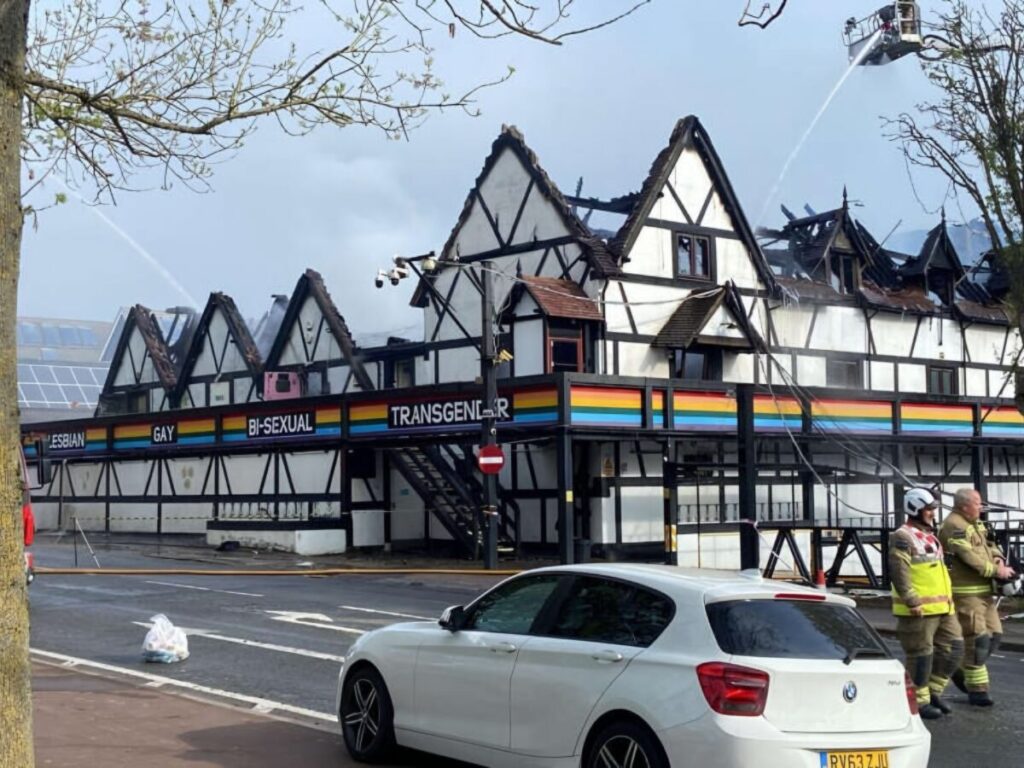
Pink Punters, an LGBTQ+ club was burnt down in a suspected arson attack in the early hours of Sunday morning.
Club goers were evacuated from the club in Milton Keynes as the blaze quickly took hold, and a 51-year-old man has been arrested on suspicion of arson with intent to endanger life.
Pink Punters was the only LGBTQ+ club in the city or any neighbouring towns and was described as a “big loss” for the local LGBTQ+ community.
After a post by CanaryUK raised awareness of the attack, one user commented: “I can find 3 articles in the entire nation’s media. I guess terrorist attacks aren’t a big deal if you can’t find a way to blame it on the Greens, Palestine or Iran.
The destruction of Pink Punters in a suspected arson attack should have been national news. It was not just another nightclub fire. It was an attack or at the very least a suspected deliberate act against an important queer social space outside London.
The BBC, ITV, The Guardian and some tabloid press reported the story, but compared to the scale and symbolism of the event, the attention seems muted.
There were no rolling debates on breakfast television about attacks on queer spaces. No national conversation about the fragility of LGBTQ+ venues. No political discussion about hate crime, or the disappearance of queer nightlife from Britain’s towns and cities.
British media is overwhelmingly London-centric and crisis-driven. Stories that gain national coverage usually involve casualties, celebrity figures, Westminster politics or incidents that can be immediately framed within existing political narratives.


Pink Punters sits outside those categories. The event was regional, nobody died, and the police have not declared it a hate crime. Newsrooms move according to metrics such as outrage and conflict.
This story lands within a larger pattern of the slow disappearance of queer public space across the UK.
For decades, LGBTQ+ venues were places where people could exist openly without fear.
Across Britain, queer pubs, bars and clubs have closed at an alarming rate.
Factors such as rising rents, post-pandemic financial pressure, dating apps replacing physical socialising and changing nightlife habits have all contributed. But, the result is that entire towns and cities now have no dedicated LGBTQ+ venues at all.
Pink Punters was one of the few major LGBTQ+ venues serving a wide regional catchment outside London.
Alongside this, over the last few years, LGBTQ+ people, particularly trans people, have become targets in Britain’s culture wars.
Newspapers and political rhetoric have increasingly framed queer identity as controversial or threatening. As a result, even if violence isn’t explicitly encouraged, constant fear changes the atmosphere around LGBTQ+ existence.
The question isn’t “why isn’t this getting coverage?” but rather “why do attacks on queer spaces seem to be treated as less significant than attacks on other communities?”
It is important not to jump ahead of the investigation. Police have explicitly stated it is too early to determine motive. Responsible commentary has to acknowledge that. But even without a confirmed motive, the destruction of Pink Punters still highlights that queer infrastructure is fragile and needs to be championed
The owner of Pink Punters said: “The building may be gone, but the family, the memories, the spirit and the love remain. Pink Punters will be back.”