
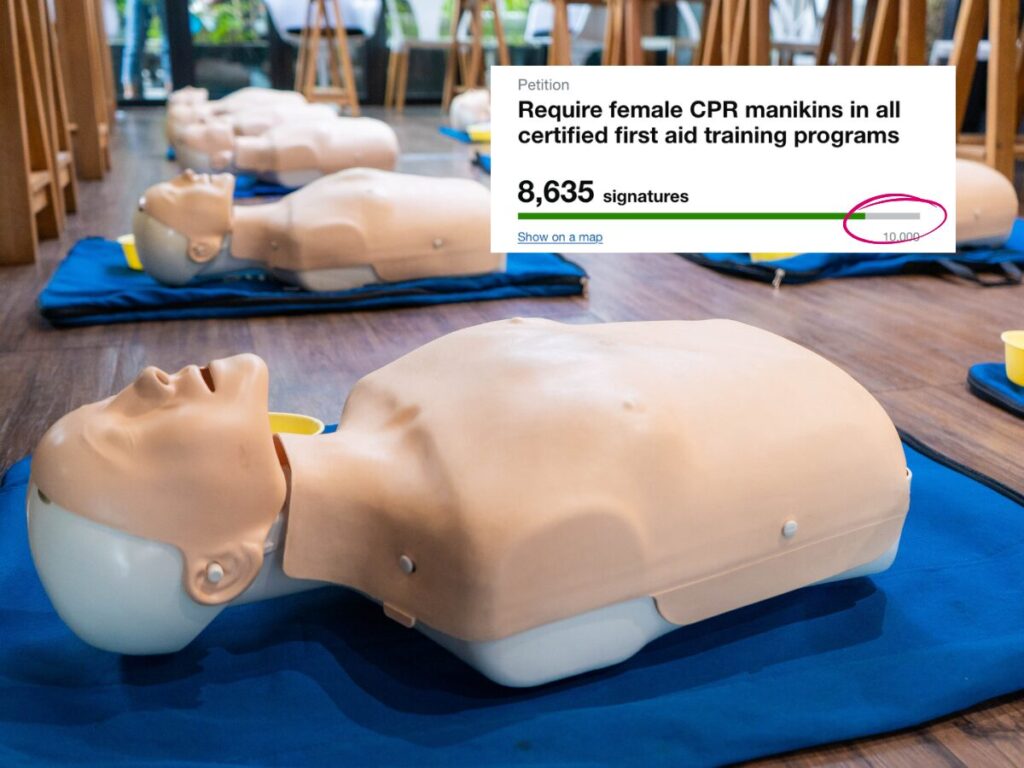
Picture the scene: someone collapses in front of you. You know CPR. You’ve done the training. And still, for a moment, you hesitate, because the person on the floor is a woman, and you’ve never practised on a manikin with breasts before. Do you put your hands in the same place?
That hesitation, fleeting as it might feel, can be fatal. Every minute without CPR reduces survival chances by up to 10%. Research published in the European Heart Journal found that only 68% of women in cardiac arrest receive bystander CPR compared to 73% of men, and women are less likely to survive to hospital admission or to discharge. The gap exists, it is consistent across countries, and it is costing lives.
Engineer and STEM educator, Chloe Lipton, wants to do something about it. She’s launched a parliamentary petition calling on the government to require all certified first aid and CPR training programmes to include manikins with female anatomy, and she’s clear about what’s driving the problem. “People often feel awkward about women’s bodies,” she says, “and even in life-or-death moments, that discomfort leads to hesitation or even walking away.” The petition currently sits at 8,634 signatures and needs 10,000 to compel a government response. The deadline is Tuesday 10 March.
“Every minute without CPR reduces survival chances by up to 10%. Women are less likely to receive it. That is not a coincidence.”
The ask is not complicated. Right now, the standard CPR training manikin is flat-chested, designed around a male body. A 2023 study found that 95% of available CPR training manikins worldwide were flat-chested, with only one of the five manikins marketed as “female” actually having breasts. People learn to save lives on a body that looks nothing like half the population. Then they encounter a real emergency, on a real woman, and their training has left them with no reference point at all.
A study published in Circulation found that fear of inappropriate touching is one of the primary reasons bystanders hesitate to perform CPR on women, alongside fear of causing injury and a tendency to misread the signs of cardiac arrest in women entirely. More than a third of men, according to separate research, either hesitate or refuse to perform CPR on a woman out of concern about being perceived as inappropriate.
This is what happens when medicine is designed around the male body as default, and women are treated as a difficult edge case. The British Heart Foundation has previously reported that University of Leeds researchers found over 8,200 women in England and Wales could have survived heart attacks had they received the same treatment as men, a figure covering a decade of data that researchers believe undersells the true toll. The CPR gap sits within this much larger pattern of women’s bodies being systematically undertreated, its consequences written in survival statistics.
The good news is that the solution here is genuinely straightforward. A 2024 pilot study presented to the American Heart Association found that after practising on a female-anatomy manikin, 81.6% of trainees felt more comfortable performing CPR on women, even among those who had initially reported discomfort. Training works. Exposure to the reality of a female chest in a safe, educational setting removes the freeze response that kills people in emergencies. A scoping review published in the British Medical Journal confirmed that manikin diversity has the potential to reduce barriers and improve outcomes for the groups most at risk of receiving poor bystander care.
The technique for CPR does not change based on the body you’re performing it on; what changes is whether the person performing it has the confidence to act. And confidence comes from practice, which requires realistic tools.
We have written before at The New Feminist about the way the gender health gap plays out across medicine, from clinical trials that historically excluded women to the persistent underfunding of conditions that predominantly affect female patients. The manikin problem is a small, fixable manifestation of a very large structural failure.
Act now! The petition closes on Tuesday 10 March 2026. It needs 1,366 more signatures to force a government response at 10,000, and 100,000 to be considered for a parliamentary debate. Click here to sign the petition to require female CPR manikins in all certified first aid training – and share it before the deadline.
Chloe Lipton’s petition does not require a major policy overhaul. It asks for a minimum standard, one where every certified first aid course in the UK includes at least one manikin that reflects the reality of female anatomy, where trainees practise placing AED pads on a chest with breasts, and where that practice happens before the emergency, not during it.