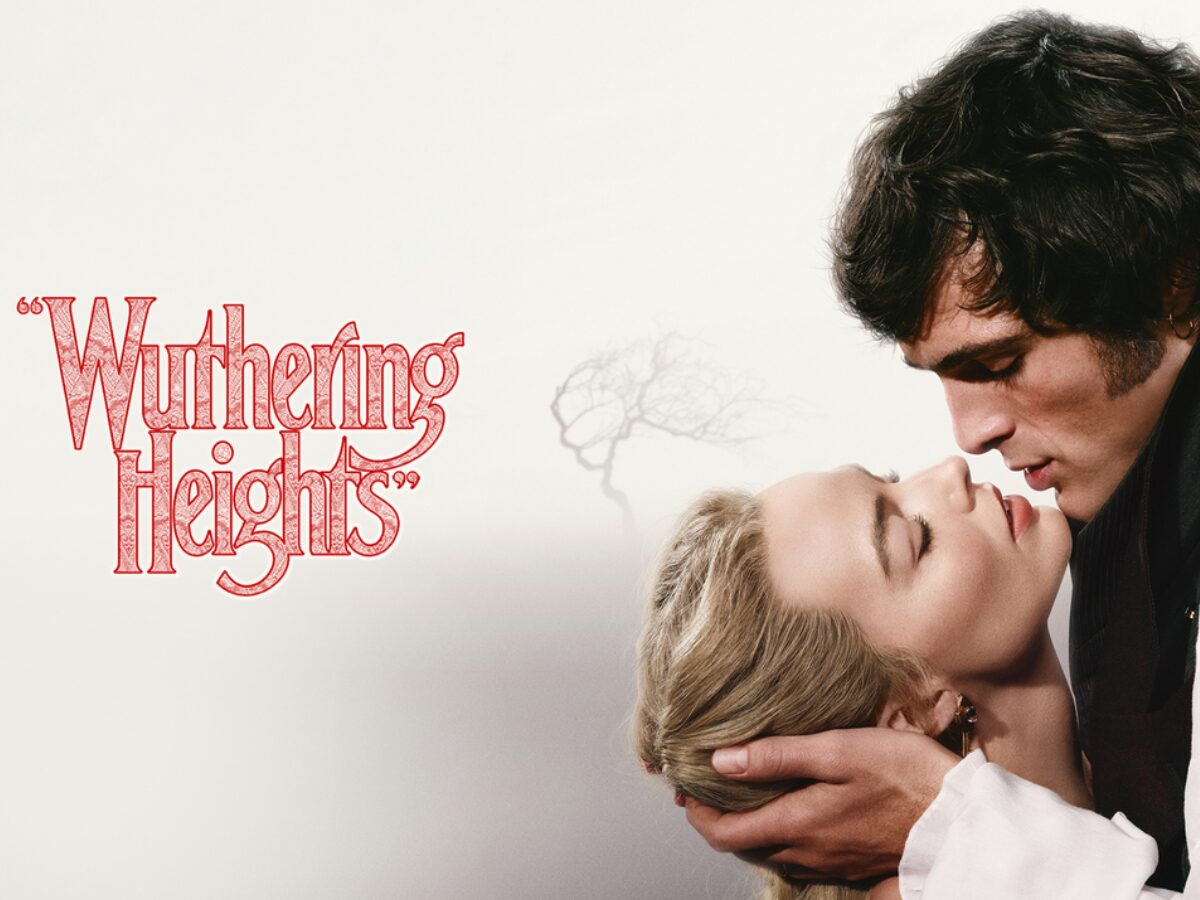
Emerald Fennell’s recent adaptation of Wuthering Heights has created a rift in pop culture; some love the off the wall adaptation, while others heavily criticise creative choices made in the film. The heavily sexual nature of the film and the retconning of key story arcs reveal truths about how the media we consume reflects the patriarchy we live under.
Emerald Fennell’s film adaptation of Emily Brontë’s novel Wuthering Heights has divided public opinion. Perhaps the most controversial change has been transforming Isabella Linton from a victim of domestic abuse to a BDSM participant. Debate has centred on whether this change increases or decreases the character’s agency. In an interview with Refinery 29, Alison Oliver, who plays Isabella, praises Fennell for giving the film’s female characters “agency in their own ways”. Meanwhile, the Guardian’s Emma Flint argues that the film actually undermines the agency Isabella has in the original novel. But what does it mean for a character to have agency, and why does it matter?
Narrative agency in Wuthering Heights
While agency can be broadly understood as the ability to make decisions and act independently, conversations about what counts as truly self-chosen action are ongoing. This speaks to questions about power, freedom and social structures.
Unlike real people, fictional characters can’t actually decide how to behave. For a character to have agency, then, usually means they are given wants and fears which motivate their actions, and that these actions impact the story. This is often called narrative agency. Screenwriter Clive Frayne criticises how female characters are often written as “stakes characters” for male protagonists to save or romance. Stakes characters lack their own motivations, and rarely act in ways that impact the plot. Instead, they are prizes to motivate protagonists to action.
Margot Robbie, who plays Catherine in Fennell’s adaptation, praises the director for the narrative agency given to the film’s female characters. She asserts that the film’s women “make all the choices. And then everything you see in the movie happens because of the choices they make.” This is true of Robbie’s character, although not necessarily moreso than in the novel. But is it true of Isabella?

In Brontë’s novel, Isabella is subjected to a lot of treatment that she doesn’t choose. The male lead, Heathcliff, marries her as part of his revenge plot to spite her brother and sister-in-law, Catherine (whom he is obsessed with). He kills Isabella’s dog, imprisons her in the house, and physically and sexually abuses her. Fennell’s Isabella experiences similar mistreatment (somewhat watered down and sexed up), but she is an active participant in his revenge plot, and in his treatment of her, which becomes a BDSM dynamic.
Does having Isabella choose this kind of marriage give her more narrative agency? For reviewer Emma Flint, the answer is no. In Flint’s view, aligning Isabella’s wishes with how Heathcliff plans to use her means that “film Isabella is a narrative tool for Heathcliff rather than developing in her own right.” It is not Isabella’s choices that are driving the plot, but Heathcliff’s. That her choices now match his doesn’t increase her agency; it just makes him more palatable. And her contentment with her fate means she never takes the actions which most affect the plot of the novel: fleeing to London and raising her son away from his abusive father.
Space for action
Other critics, though, have focused less on Isabella’s impact on the narrative and more on how much agency she has within her own life. Woman and Home’s Kate Woodward enjoys how Fennell’s Isabella “has more control”. She states, “In the book, Isabella is on the receiving end of so much of Heathcliff’s hate and abuse, but the film gives her agency.” Is it necessarily preferable to portray a woman choosing a marriage where she is unloved, isolated and degraded, rather than struggling against this treatment and ultimately escaping it?
Some of the most claustrophobic and sinister moments of Brontë’s novel are those where Heathcliff carefully plans and executes his abuse of Isabella, taking care not to cross legal lines that could make her eligible for a divorce. Brontë’s portrayal of how Heathcliff makes careful use of societal constraints, such as restrictive divorce laws, to maintain his control over Isabella speaks to a core concept used in violence research today.

“Space for action” refers to how much or little freedom someone has to make their own decisions and act on them. The term was coined by academic Liz Kelly and is mostly used in research on violence against women. Women’s space for action can be constrained by violence, but also other circumstances. Kelly argues that “agency is exercised in context, and contexts are always more or less constrained by material or other factors.” Women make choices and act, but the options they choose between are shaped by economic factors, legal frameworks, and societal expectations. Like Brontë’s Heathcliff, perpetrators often exploit external restrictions on victims’ space for action to increase their power over them. Kelly also challenges the idea that if a woman exercises any agency, this means she can’t be experiencing violence.
Brontë’s Isabella does make decisions and act, but she is choosing from a limited range of options. She can’t be free from abuse and remain close to her family, because she has no recourse to protection from her husband other than distance. She can’t ever remarry, because she is ineligible for a divorce. She can’t protect her son from his father after her eventual death, because he has legal ownership over the boy. So she does what she can: she flees to the other end of the country and raises her son singlehandedly for the duration of her life. Isabella’s agency is important to the novel, but so are the ways it is constrained.
There is value in showing how characters’ agency is constrained by violence and inequality: highlighting how systems enable abuse can be an important step in changing those systems.
Choice feminism and Emerald Fennell
While Fennell de-emphasises the constraints on Isabella’s space for action, she doesn’t do much to actually loosen them. From novel to film, Isabella’s material circumstances change very little. If film Isabella ever had enough of Heathcliff’s treatment, she would likely come up against the same obstacles as in the novel. It seems unlikely that even Fennell’s romanticised Heathcliff would put Isabella’s freedom above his revenge. Once married, then, Isabella’s control over her situation becomes little more than an illusion, which is maintained only as long as she continues to enjoy her cage. Why, then, is this portrayal more enjoyable for some viewers?

Perhaps it is because acknowledging the ways that women have been and are unfree is painful. Activist Andrea Dworkin argues that many women reject feminism in general because “it is an agony to be fully conscious of the brutal misogyny which permeates culture, society, and all personal relationships.” For many women, coping with a misogynistic world involves looking away from the power dynamics that constrain our own space for action. Conforming to gendered expectations can feel less excruciating if we avoid thinking about how limited the options we’re choosing between are. So if Isabella is going to be degraded anyway, it is more comfortable to be shown her choosing it.
But what happens when these individualised coping strategies shape the feminist movement? Lawyer Linda Hirshman coined the term “choice feminism” to criticise the idea that any choice a woman makes, however constrained her circumstances, is a feminist act. She argues that the insistence that women freely choose to deprioritise their careers hides and enables the ways husbands, governments and employers limit women’s opportunities. Choice feminism pops up everywhere that women are caught criticising patriarchal structures, and is highly marketable. Feminists may critique the cultural pressure for women to remove body hair, and the professional and social consequences some face if they refuse. But by isolating the idea of agency from women’s wider space for action, choice feminism lets brands insist that they are selling women agency by offering multiple choices of hair removal products. Veet even co-opted the abortion rights slogan “my body, my choice” for their marketing campaign “your body hair, your choice”.
Choice feminism is a mindset shift, not a movement. If women are choosing to stay in corners they’re backed into, then surely nothing is really wrong, and so nothing needs to change. Accordingly, film Isabella’s acceptance of her circumstances means there is no need for her to flee. She continues to live with her husband, who doesn’t love her, confines her to the house, isolates her from her family and subjects her to degrading treatment. Though these conditions are all Heathcliff’s idea, we are shown that Isabella has learnt to like them. Nelly’s appeal for her to come home is met with a saucy wink, and Isabella’s insistence, “I am home.” Like Gillian Flynn’s “Cool Girl”, whatever Heathcliff wants from Isabella happens to become just what she wants, too.

As video essayist Princess Weekes observes, book Heathcliff’s justifications for his abusive behaviour are all proved true in Fennell’s adaptation. In both versions, Heathcliff insists Isabella has an “innate admiration” for brutality. In the novel, his claims are undercut by Isabella’s vehement denial and multiple escape attempts. In the film, they are supported by visuals of her crawling eagerly towards him to eat from his palm. Should portraying female agency really involve reinforcing a perpetrator’s claims about a woman’s innate desire to be abused?
Choice feminism is comforting, shielding us from acknowledging the constricted spaces in which we act. It’s also non-threatening: it doesn’t require women to push for structural changes and experience potential backlash. But media that shows women grappling with their constraints does much more to advance women’s freedom than that which reframes everything women do as a free and sexy choice. Meaningfully improving life for women can’t come from learning to enjoy our constraints. If we want to expand women’s agency, we must start by coming together to address limits on our collective space for action.