
In 1976, Shere Hite asked thousands of women to describe their sex lives in forensic detail. The Hite Report sold tens of millions of copies and named female sexual dissatisfaction as a political problem. And yet, almost nothing has been written about it since.
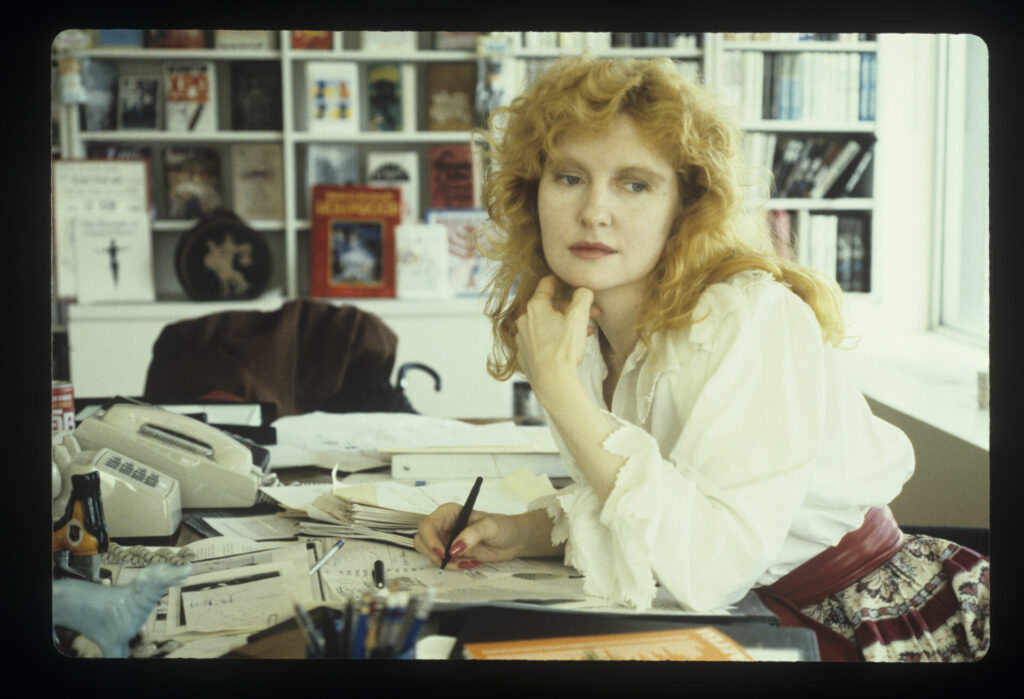
In 1972, Shere Hite, Playboy model turned feminist sex researcher, jumped on a motorbike and drove around Manhattan. With apricot curls and a vintage lace gown streaming out behind her, she handed out surveys to any woman who would take one. This was no ordinary survey. It was all about sex. Across fifty-eight questions, Shere asked women how they did it, how they felt about it, and what gave them the greatest pleasure. She asked women to describe how it felt to orgasm ‘or do a drawing’. She asked what they thought of their vaginas (‘ugly or beautiful?’), and whether they thought ‘sex was in any way political?’ She explained her rationale: ‘As women it is time we defined our own sexuality—what it feels like, how we have experienced it, what we want from it’.
Completed surveys and letters flooded into Shere, first from women in New York, then from all across the United States and around the world. Women’s responses offered granular, highly detailed personal accounts that hummed with feeling. They contained drawings of women having sex; one woman drew concentric circles approximating the ‘delicious’ feeling of an orgasm. They were written in different coloured pens, and in a great range of handwriting. As women filled it out, they pushed the pen hard into the page with anger, or added a flourish under ‘orgasm’. One woman had commandeered the work typewriter, answered it a bit at a time and ‘hurried home . . . horny, horny, horny’. Another had hidden the survey as she filled it out and quickly sent it back to Shere. She wished she could keep a copy for herself but was worried her husband would find it. This ‘would hurt him too much and I can’t do that to him, he has been good to me’.


These responses became The Hite Report: A Nationwide Study of Female Sexuality, the 1976 smash-hit bestseller and one of the most popular, important, and overlooked feminist books of the twentieth century. The great provocation of The Hite Report was that most American women were wildly sexually dissatisfied. Seventy percent of women did not reach orgasm during sex without clitoral stimulation, though most women’s sex lives did not include much of this and they didn’t ask for it.
To understand why women’s sex lives were so abysmal and why most women put up with this, and maintained their silence at great cost to themselves, Shere held sex up to feminism. Looking at it in this way, in this light, she found that sex was shot through with power and inequality. Society insisted that women, like men, should find their greatest pleasure in penetrative sex: the woman penetrated, the man penetrating. Shere declared ‘sex is sexist . . . Women’s sex lives very clearly reflect their second-class position in the society. Women, still, in 1976 make only 60% of the amount men make for the same work: men have a right to more rewards (money, services, respect) than women. Just so in sex’. But Shere knew from her own extraordinary life before The Hite Report that sex didn’t just reflect the inequalities of the world, it generated them. The bedroom was a crucial site of women’s oppression, as important as the factory floor, the court, the hospital, the kitchen, the nursery, the House of Representatives. She was one of the first to see sex in this way, and she popularized this insight and made it accessible to millions across the world. The Hite Report is the thirtieth-bestselling book of all time; other books about women that have sold as many copies include Lolita and Anne of Green Gables. Yet, compared to these storied titles, barely anything has been written about The Hite Report. The book’s impact and how it changed sex globally has not been charted.

It’s hard to imagine how a book like this could be wiped from public memory, but as opposition to feminism grew, so did opposition to Shere. Initially, the book was lauded by everyone from the New York Review of Books to Cosmopolitan. Even Penthouse was relieved that in this ‘startling’ book ‘women are finally speaking out for themselves’. But as attacks on Shere grew, her work became known as ‘The Hype Report’, ‘Sheer Hype’, and ‘Sheer Shite’. Paying close attention to Shere’s story and the story of The Hite Report helps us see how this kind of silencing works. Across the 1960s and 1970s, feminists did change society, and they faced a shadow movement of those whose power was threatened. This was not inevitable but political.
Shere’s ideas about sexual liberation and how feminism might lead us there seem so relevant today when the U.S. president is a predator, a rapist elected not once but twice. The story of Shere Hite and The Hite Report is useful because we too are facing a period of global backlash, characterised by resurgent misogyny, homophobia, transphobia, and racism. Today, the global right works to bring in a world where bodies are immutable and biologically determined by sex, and where men and women are in a ‘natural’ hierarchy.
It can seem that this particular moment in history is unprecedented, and that makes it hard to know what to do. But Shere faced something similar; indeed, some of the ideas present in today’s version of the backlash can be found in this earlier moment. We might use the original analysis of sex that Shere offered or her vision of liberation as an inspiration to take back what is ours. Perhaps she can teach us something about how we might reach millions of people unconvinced of our politics, which we certainly need to do. Shere Hite taught me that feminism is a movement for survival, for pleasure and for liberation for women, certainly, and for everyone else.
This is an edited extract from The Book That Taught the World to Orgasm and then Disappeared: Shere Hite and the Hite Report by Rosa Campbell, published by Melville House.