
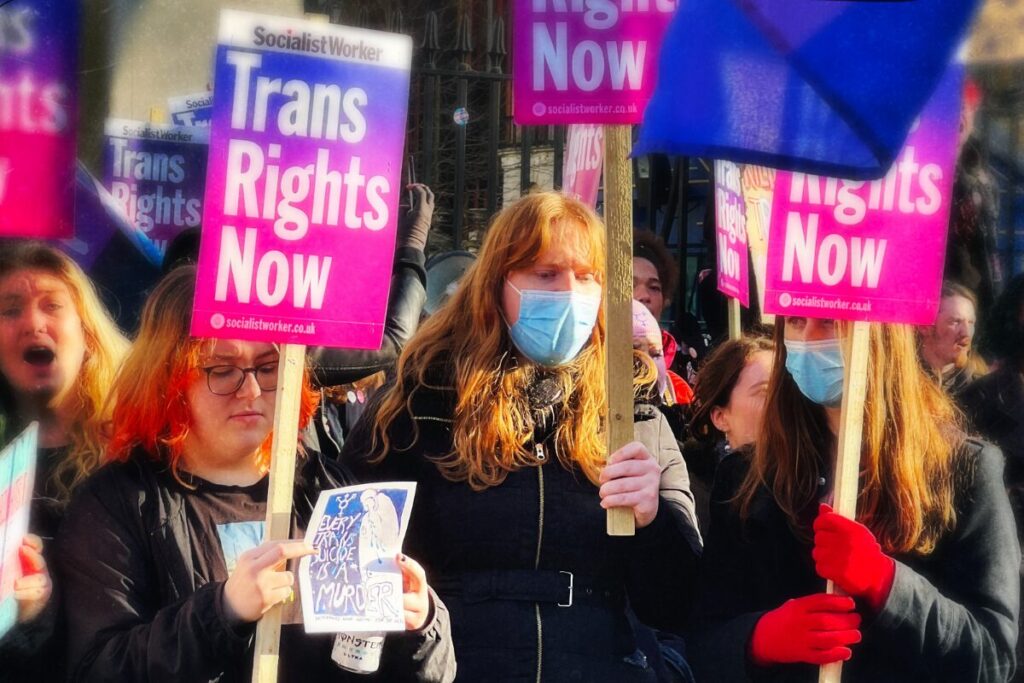
Amidst a continued degradation of transgender rights in the UK comes yet another blow – according to a new paper issued by the Equality and Human Rights Comission (EHRC), public toilets and changing rooms now must be used strictly on the basis of the biological sex you were assigned at birth.
This decision comes on the back of a ruling in Scotland last year that ruled the legal definition of a woman is to be defined on the basis of assigned biological sex, declaring transgender women as not women in the eyes of the law.
These rulings have contributed to a climate and legal system that is actively hostile to transgender people, as well as non-binary individuals and communities such as masculine presenting lesbians.
The guidance provided by the EHRC outlines that businesses can remain inclusive by offering a third restroom for transgender people. This ignores the realities that using such a facility can out transgender individuals who may be concealing their identity for safety reasons.


The government’s own equality impact assessment that accompanies the EHRC guidance has acknowledged the impact will be negative for transgender people, but show support for the third space option.
In healthcare settings where mixed-sex care is not feasible, transgender people will now be cared for on wards according to their assigned sex at birth. There was acknowledgement that it would not be proportionate to exclude transgender men from OBGYN treatment.
This guidance outlines that any businesses that allow transgender people to use facilities that align with their gender identity would now be at legal risk on the grounds of not providing a same-sex space.
Mary-Ann Stephenson, chair of the EHRC said the following: “The supreme court was very clear … if you are providing separate toilets for women and men, that has to be on the basis of biological sex.”
She also called for a wider discussion about how to practically apply this guidance.

In an earlier draft of the guidance it was recommended that birth certificates should be inspected to enforce the segregation of transgender people. This guidance has now been axed.
For Women Scotland, the TERF organisation that initially raised the case with the Supreme Court about the legal definition of a woman, have praised the decision but also criticised the length of time between the ruling in April 2025 and now to issue this guidance.
The guidance is still in draft form. MPs have 40 days to consider the document before equalities minister, Bridget Phillipson, issues a final order, making it the law of the land in England, Wales, and Scotland. It is highly unlikely that any significant challenge will be made from within parliament.
Phillipson has said that the guidance was issued with the aim of allowing people to live free of discrimination and harassment. She also told the BBC that the “focus has always been making sure organisations have clear, accessible guidance on how to implement the law”.
Costs for implementing the guidance would fall on businesses themselves. This is going to be difficult in the current economic climate to implement. Many may resort to using the option of designating disabled facilities for transgender people to use, something that takes from one marginalised community in order to accommodate another.

Transgender people were not included in the Supreme Court’s decision last April, and the EHRC only offered a very limited window of time last year for the transgender community and our allies to respond to guidance they have been issuing in the interim. The Good Law Project has reported that of the over 50,000 submissions sent to the EHRC, not all would be considered and AI would be used to determine whether or not a story was considered important enough to be heard.
The guidance, and the ruling in April last year, are nothing short of legal discrimination. Codifying a degradation in transgender rights that is unprecedented amongst Western European nations. It legitimises a social climate that is actively hostile toward anyone transgender, non-binary, or more widely exists outside of the rigid confines of traditional gender roles and presentation. The guidance also has no tangible consideration for intersex individuals, who are consistently ignored in rulings of this nature.
On a personal level, it is tiring, terrifying, and embarrassing to see my ability to do something as simple as relieve myself in public used as a political football. Transgender and non-binary people generally do not present any immediate or tangible threat to anyone in public. We just want to live our lives peacefully and with autonomy. This ruling is the latest in a litany of rollbacks on our rights that have been made without our consultation or inclusion.