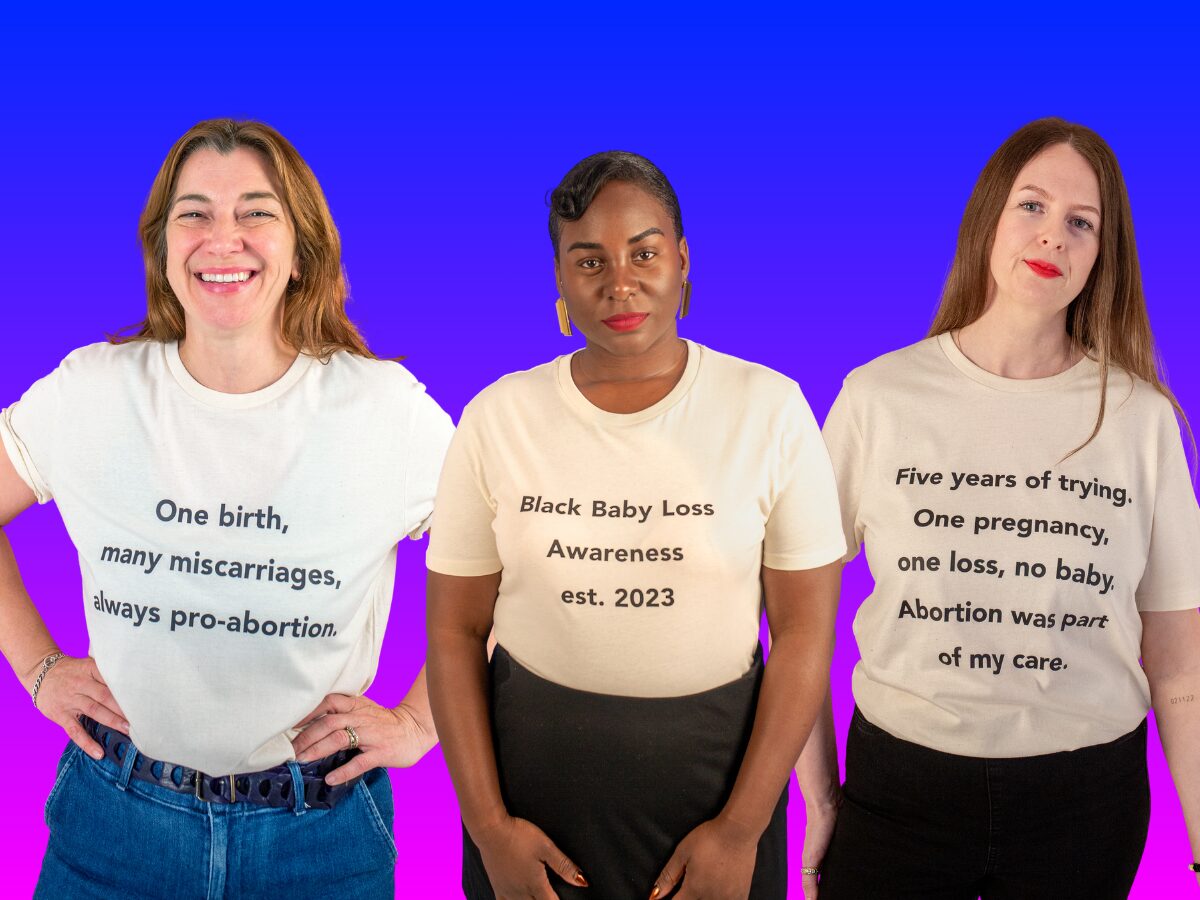
The way our culture thinks about pregnancy endings, both through abortion and miscarriage, needs a rethink – framing the complexity involved.
In the summer of 2024, Sarah De Pablos Velez was pregnant and attending prenatal appointments in Austin, Texas. At around nine weeks’ gestation, ultrasound results indicated the pregnancy was not viable. Yet physicians didn’t explain the options for miscarriage management, and De Pablos Velez was advised to just wait it out at home and return for further appointments. As the days passed, she began cramping and bleeding. Eventually, she sought help at an emergency department while actively miscarrying. She was sent home twice despite severe bleeding. No one offered her medical or surgical management. Hours after her second discharge, she collapsed at home and was rushed back to hospital, needing two blood transfusions. Doctors who later reviewed her records concluded that earlier intervention could have prevented the emergency.
It’s an appalling story. Yet since the overturning of Roe v. Wade in 2022, similar cases have risen dramatically, with women across the United States reporting delays and denials of miscarriage care because clinicians fear violating anti-abortion laws. The surgical procedure that could have prevented De Pablos Velez’s ordeal is used in both miscarriage management and abortion care, making some doctors in states with abortion bans hesitant to offer it. After Texas criminalised most abortions in 2022, the number of blood transfusions during emergency room visits for first-trimester miscarriage has increased by 54%.
These cases expose a problem at the heart of how we think about pregnancy endings. For decades, public debate, healthcare systems and advocacy organisations have treated miscarriage and abortion as fundamentally different experiences. Yet when we look closely at people’s lives, these distinctions become far less clear. Medically, physically, emotionally, legally, and politically, the boundary between abortion and miscarriage is often much more porous than we are led to believe. This is why, as feminist academics, we call for a full-spectrum approach that recognises the complexity of people’s reproductive lives and insists on support and quality care for all, regardless of how a pregnancy ends.

The Complexity of Lived Experience
There is a widespread perception that miscarriage and abortion are separate, even opposite, experiences. Miscarriage is generally understood as the involuntary loss of a wanted pregnancy and is expected to bring grief; while abortion is understood as the deliberate ending of an unwanted pregnancy and is expected to bring relief. These assumptions shape healthcare systems, workplace policies, legal systems, media reporting, and everyday social attitudes.
Yet lived experience often defies these expectations. Some people experience miscarriage as a devastating bereavement. Others feel relief, particularly when a pregnancy was unwanted or occurred at a difficult time in their lives. Many people experience a multitude of emotions, which shift over time. The beginning of a miscarriage, for instance, may initially bring shock and upset, while its ending, if protracted over days or weeks, can bring an overwhelming sense of relief. Likewise, while abortion is often framed as an exercise of personal choice, people’s experiences are frequently shaped by constraints and circumstances beyond their control, and can involve grief, sadness, relief, and happiness – all at once, or at different times.

No emotional response is straightforward or belongs exclusively to abortion or miscarriage. In our research, we’ve been struck by how often people’s experiences resist conventional categories. Consider someone who has a miscarriage just before a scheduled abortion appointment; someone who ends a wanted pregnancy because of serious health risks; or someone whose miscarriage is completed using the same procedure used in abortion care.
None of these experiences fit straightforwardly into the ‘miscarriage’ and ‘abortion’ categories, and they are not unusual exceptions. They are reminders that reproductive experiences occur on a continuum rather than within clearly defined boxes. The same is true in clinical practice, where the same drugs, procedures and healthcare professionals may be involved in both miscarriage management and abortion care.
Why, then, does public discourse continue to maintain such a sharp distinction between miscarriage and abortion?
The Loss Paradigm
For many years, advocates seeking better recognition and support for miscarriage have distinguished it from abortion in order to distance miscarriage from the stigma and political controversy surrounding abortion. They have emphasised that miscarriage is involuntary, usually unexpected, and often deeply distressing. This has helped challenge the tendency to minimise miscarriage and secured important forms of social recognition and support.
Until recently, for example, the medical term for miscarriage was ‘spontaneous abortion’; but healthcare systems have gradually moved away from this language which many patients found distressing. Today, advocacy organisations are increasingly replacing the term ‘miscarriage’ itself with ‘pregnancy loss’ in order to validate those who experience it as a significant loss.

In many ways, this has been an important and meaningful shift. Yet it can also be viewed as an over-correction. If every miscarriage is now automatically framed as ‘pregnancy loss’, what happens to those who don’t experience it that way? A person who feels relief after a miscarriage, for example, may wonder whether their response is somehow wrong. Someone who feels ambivalent may feel isolated in support communities centred entirely on loss and grief. Others may find themselves pressured into narratives of loss and bereavement that don’t quite reflect their experience. Alex, for example, began questioning her own understanding of her pregnancy tissue as medical waste when clinicians repeatedly referred to the loss of her ‘baby’. The experience made her feel ‘like an unemotional weirdo’ and ‘a bit like a monster’, as though she were failing to respond in the right way.
Our concern, to be clear, is not that we talk too much about grief. It is that grief has become the singular narrative. And when a single emotional framework dominates public understanding, people whose experiences differ may struggle to recognise themselves in available narratives and support structures, and go unsupported as a result.
We also worry that the dominant loss paradigm can reinforce the stigmatisation of abortion, even if unintentionally. In some respects, the language of pregnancy loss usefully blurs the boundary between miscarriage and abortion when it includes abortions that are experienced as losses. Many people who undergo TFMR (termination for medical reasons), for example, have deeply wanted pregnancies, and inclusion within pregnancy loss communities can be hugely meaningful for them.
At the same time, however, including TFMR under the pregnancy loss umbrella implicitly excludes abortions undertaken for other reasons, treating them as a completely different thing. This move is understandable, but it risks reinforcing familiar hierarchies and distinctions between so-called ‘good’ abortions (due to health problems or foetal anomaly and viewed as tragic and deserving of public sympathy), and ‘bad’ abortions (viewed as a lifestyle choice and less deserving of support). If abortion is publicly validated only when the circumstances appear tragic enough, the stigma remains unchallenged for everyone else.
So while recognising the unique challenges of TFMR and the vital need for support, as feminists, we urge equal commitment to supporting all kinds of pregnancy endings, whatever the circumstances. And the ‘loss’ paradigm, in this regard, is just not expansive enough. So what kind of framework is needed?
The Full-Spectrum Approach
The concept of a full-spectrum approach emerged from the reproductive justice movement, founded in the US by women of colour in the 1990s, seeking to connect abortion, miscarriage, stillbirth, infertility, birth and parenting. Its core insight is that reproductive lives do not unfold in isolated categories. Someone may experience infertility before becoming pregnant. They may later have a miscarriage, go on to have a child, and then seek an abortion years later. These events are not separate chapters belonging to different political or medical worlds. They are interconnected aspects of people’s reproductive lives.

A full-spectrum framework begins with the premise that every pregnancy ending deserves care and support, regardless of how it occurred or how the person feels about it. Someone grieving a miscarriage deserves compassion. So does someone grieving an abortion. Someone who feels relief after either experience deserves understanding and validation too. So rather than asking which category a pregnancy ending belongs to, a full-spectrum approach focuses instead on what support a particular person actually needs. Do they require medical treatment? Emotional support? Time away from work? Something else?
This expansive approach has never been more necessary. For many years, miscarriage advocacy and abortion advocacy have operated in separate spheres. One has focused on recognition of loss; the other on reproductive rights. Yet maintaining this separation becomes increasingly difficult when both forms of care rely on many of the same medications, procedures and clinical expertise. As cases such as Sarah De Pablos Velez’s show us, the systems that regulate and restrict abortion affect everyone who experiences pregnancy, regardless of how that pregnancy ends. Meaningful support for miscarriage cannot be fully achieved while abortion remains stigmatised and criminalised.
At the same time, abortion advocacy can sometimes struggle to accommodate experiences of grief or loss, fearing that doing so may strengthen anti-abortion arguments. We believe this is mistaken. If we adopt the full-spectrum approach, the focus is centred on the needs and experiences of pregnant people themselves, which means there is room for the full range of emotional responses, including grief, relief, ambivalence and uncertainty.
And there is political risk in failing to acknowledge this complexity. If people whose experiences involve grief, loss or ambiguity can’t recognise themselves in the language of abortion advocacy, anti-abortion movements are all too ready to provide that recognition.
Ultimately, then, this is a question of feminist solidarity. Rather than dividing pregnancy endings into separate issues, a full-spectrum approach pushes us to find connections and build mutual structures of care.

The Pregnancy Endings Exhibition
These ideas underpin our current exhibition, Pregnancy Endings, developed through the Feminist Miscarriage Project with support from the Arts and Humanities Research Council.
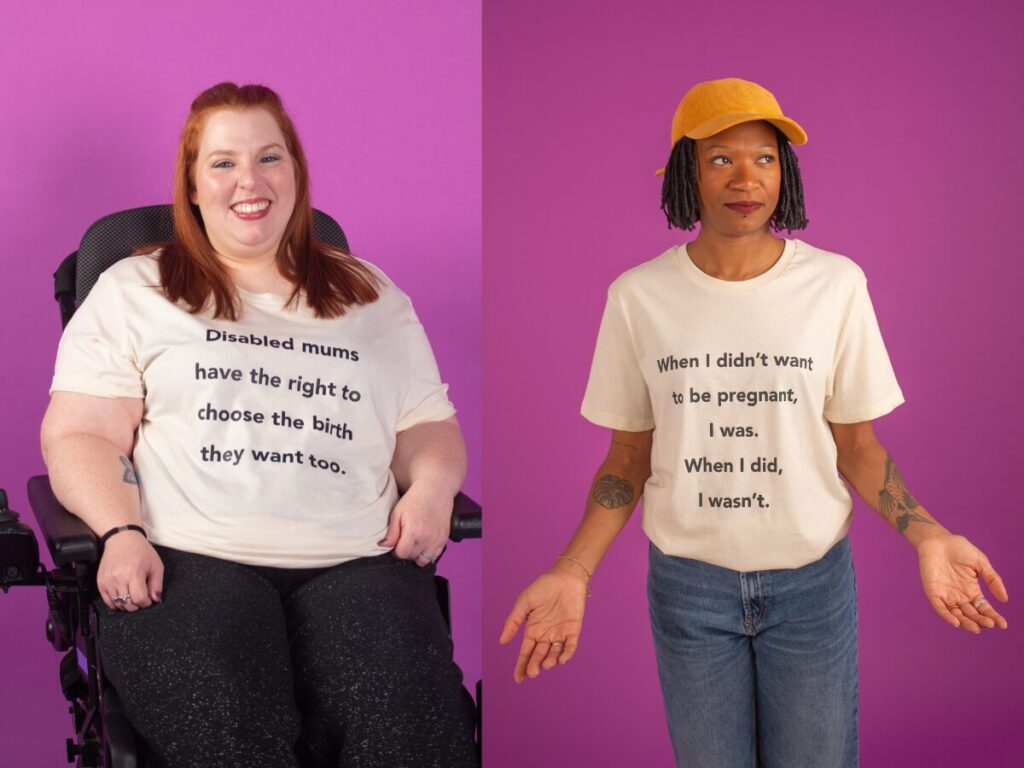
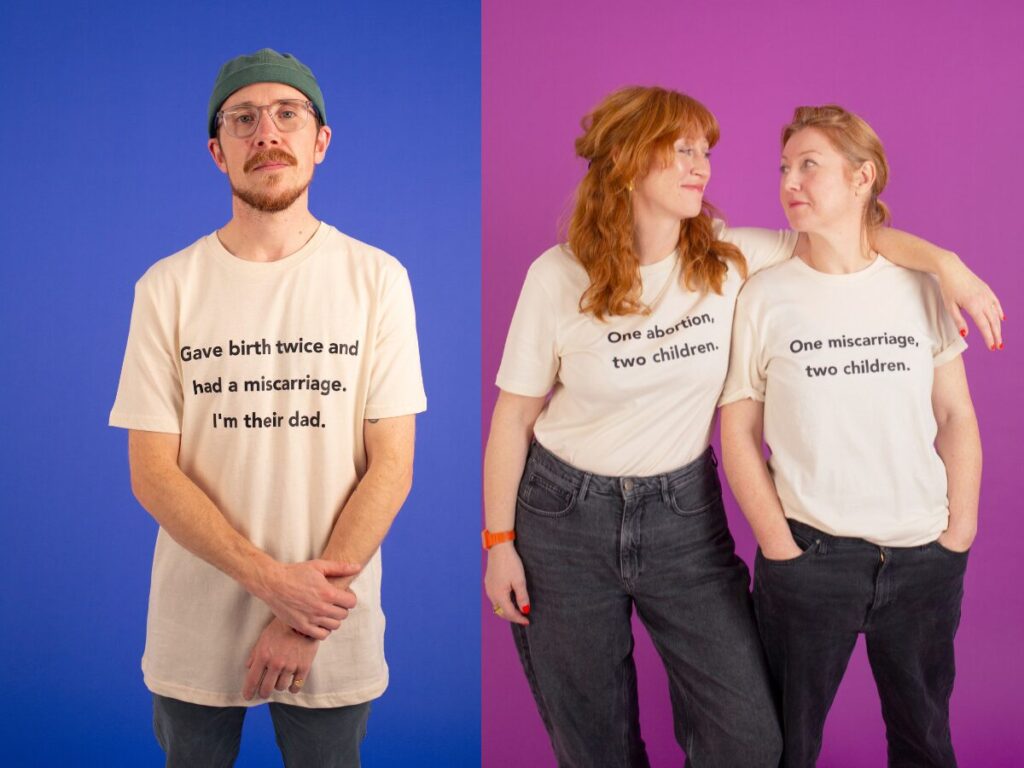
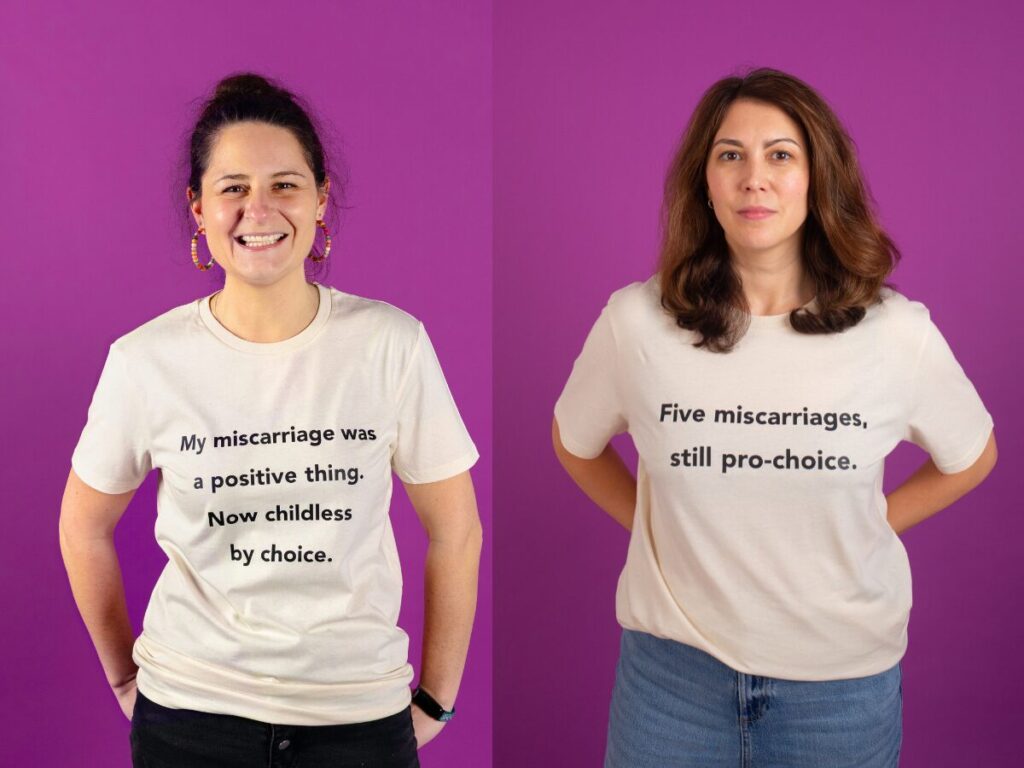
Created in collaboration with photographer Tara Todras-Whitehill and artist-curator Meg Ferguson, the exhibition brings together portraits of people wearing T-shirts bearing self-devised statements about experiences of abortion, miscarriage, stillbirth, birth and other pregnancy endings.
The aim is to make visible the diversity and nuance of experiences that are often forced into narrow categories of loss or choice, wanted or unwanted, tragedy or agency. By placing these experiences side by side, the exhibition invites viewers to find connections across difference and reckon with complexity.
The exhibition was shown at the Bomb Factory Art Foundation in London in April and May 2025 and will be exhibited at the Vagina Museum from September 2026.