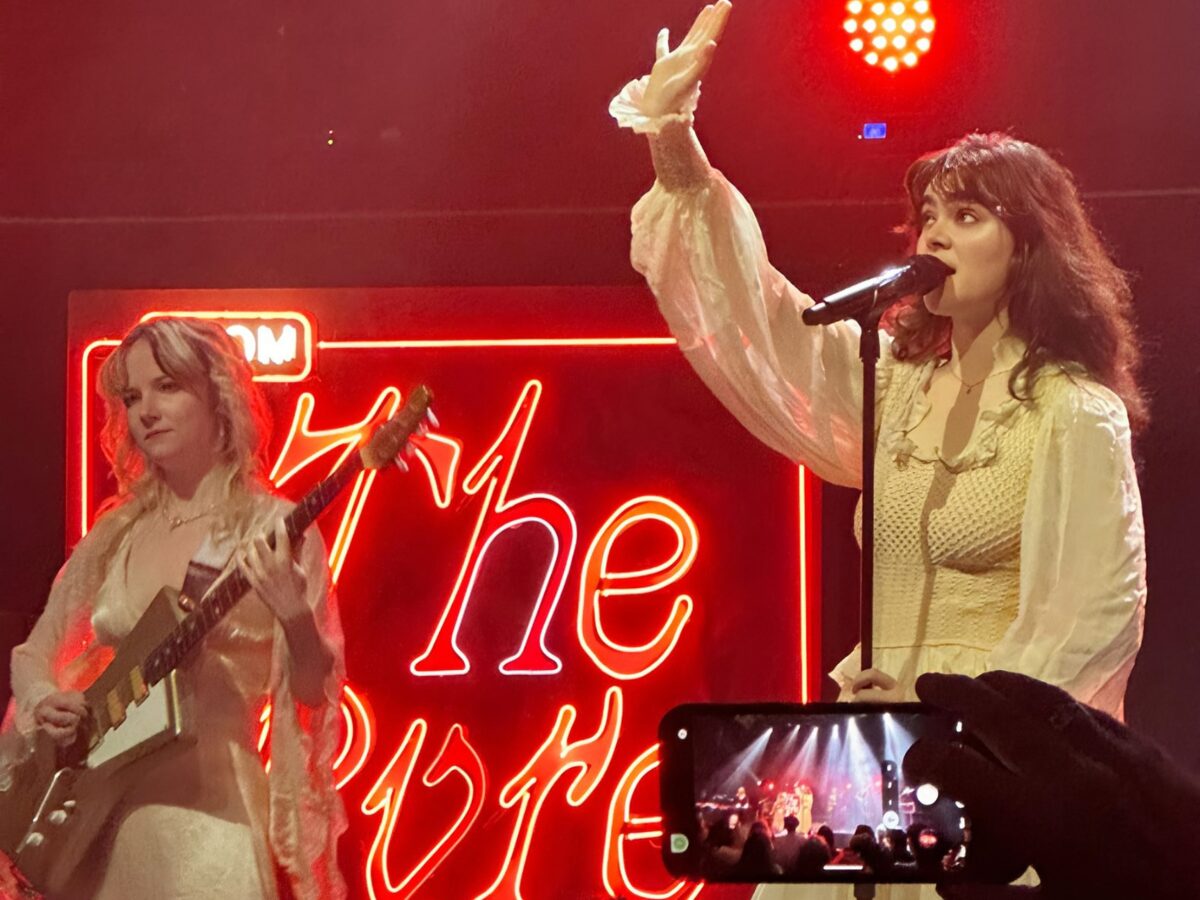
The Last Dinner Party have built a devoted queer fanbase. At a sold-out show in Wolverhampton, their fans explain why their concerts feel different to other live music spaces.
By the time I arrive at Wolverhampton Civic Hall on a bitterly cold November evening, a colourful crowd has already formed. The air bites, breath hangs visibly, and the pavement glistens under streetlights, but nobody seems to care.
I am bundled in a coat and jeans, and still shivering. Around me are hundreds of people in lace, velvet, sheer skirts and corsets, arms bare, legs uncovered, entirely committed to the aesthetic of The Last Dinner Party over any sensible concern for warmth.
Hair comes in every colour imaginable. Makeup is graphic and theatrical: sharp liner, glittering eyelids, dark lips. Dresses are adorned with ribbons and lace, and the overall effect is something like a Doctor Who timeline where the Victorians discover eyeliner and Doc Martens.
There is chatter, laughter, and the clink of stacked jewellery. There is also something more striking: queer couples holding hands openly, leaning into each other, kissing without hesitation. It is the kind of public affection that, elsewhere, might bring up my dinner. Here, though, it feels different. It feels important. It feels safe.
“I never normally feel safe kissing my girlfriend in public,” says Louise Richardson, standing a few places ahead of me in the queue. “But realistically everyone’s a lesbian here, and those who aren’t wouldn’t be here if they were homophobic.”
It is a blunt assessment, but not an inaccurate one. The Last Dinner Party’s gigs have developed a reputation, particularly online, as spaces that centre queer women and gender-nonconforming people.

That reputation has sometimes been framed negatively, as exclusionary or uncomfortable for straight men. But standing here, at a venue almost entirely filled by women and queer people, it feels less like exclusion and more like recalibration. It is a space not built around appeasing everyone, but around allowing certain people to finally relax.
Michael Campbell is one of the few men standing outside after the gig, and is familiar with this criticism. “I had heard online that men had been made to feel uncomfortable at some of their other gigs, but I’ve not experienced anything like that,” he says. “Being one of the only men here doesn’t bother me. I’m glad that these concerts can provide a safe space for women and LGBT people.”
The safety experienced at The Last Dinner Party concerts is inseparable from the band themselves. Abigail Morris (lead vocals), Georgia Davies (bass) and Lizzie Mayland (vocals and guitar) have all spoken openly about being queer and about how that shapes both their music and their audience. Their debut album, Prelude to Ecstasy, explored attraction, guilt and self-discovery through sweeping arrangements and confessional lyrics. Songs such as ‘My Lady of Mercy’ wrestle explicitly with queerness and Catholic tradition, tracing the tension between devotion and desire.
Their second album, From the Pyre, released in October, leans further into drama and rebirth, pairing theatrical exuberance with heartfelt lyricism. The song ‘Second Best’ explores the heartbreak of feeling second best to a man when in a sapphic relationship, but still being unable to sever the attachment, an experience many queer women will be familiar with.
For fans like Andisha Nazar, the band’s lyrical vulnerability and open discussion of sexuality encourages them to open up. “The band is made up of queer people, so we as a fan base don’t feel that we have to hide ourselves at their gigs,” she says. “If I was at, say, an Oasis gig, I definitely wouldn’t be as comfortable expressing my sexuality and style.”
That contrast feels telling. Rock gigs have long been mythologised as spaces of freedom and rebellion, but in reality they have often been dominated by laddishness, bravado and an unspoken expectation of heterosexuality. Football chants and cups of flying urine are things you come to expect as a regular rock concert attendee.

For many queer people, live music spaces can still feel like somewhere to tread carefully rather than exist freely. The Last Dinner Party, and other artists like them, are changing that.
“With the way politics is going at the moment, it doesn’t always feel safe being openly queer,” says Richardson. “Although it’s just a concert and not a gay club or anything, it has the same effect. You know you’ll be surrounded by queer people so you feel safe.”
The Last Dinner Party may not set out to create sanctuaries. They are, first and foremost, a band making dramatic, ambitious rock music. Yet intention is not the same as impact. By being openly queer, by writing honestly about desire, shame and self-discovery, and by refusing to flatten those experiences for broader comfort, they make music feel reachable to people who are so often pushed to the margins of cultural spaces.
In doing so, they join a growing cohort of artists, including Chappell Roan and Ethel Cain, reshaping what gigs can be: not exclusive rites of bravado, but communal spaces where different identities are not merely tolerated, but expected.