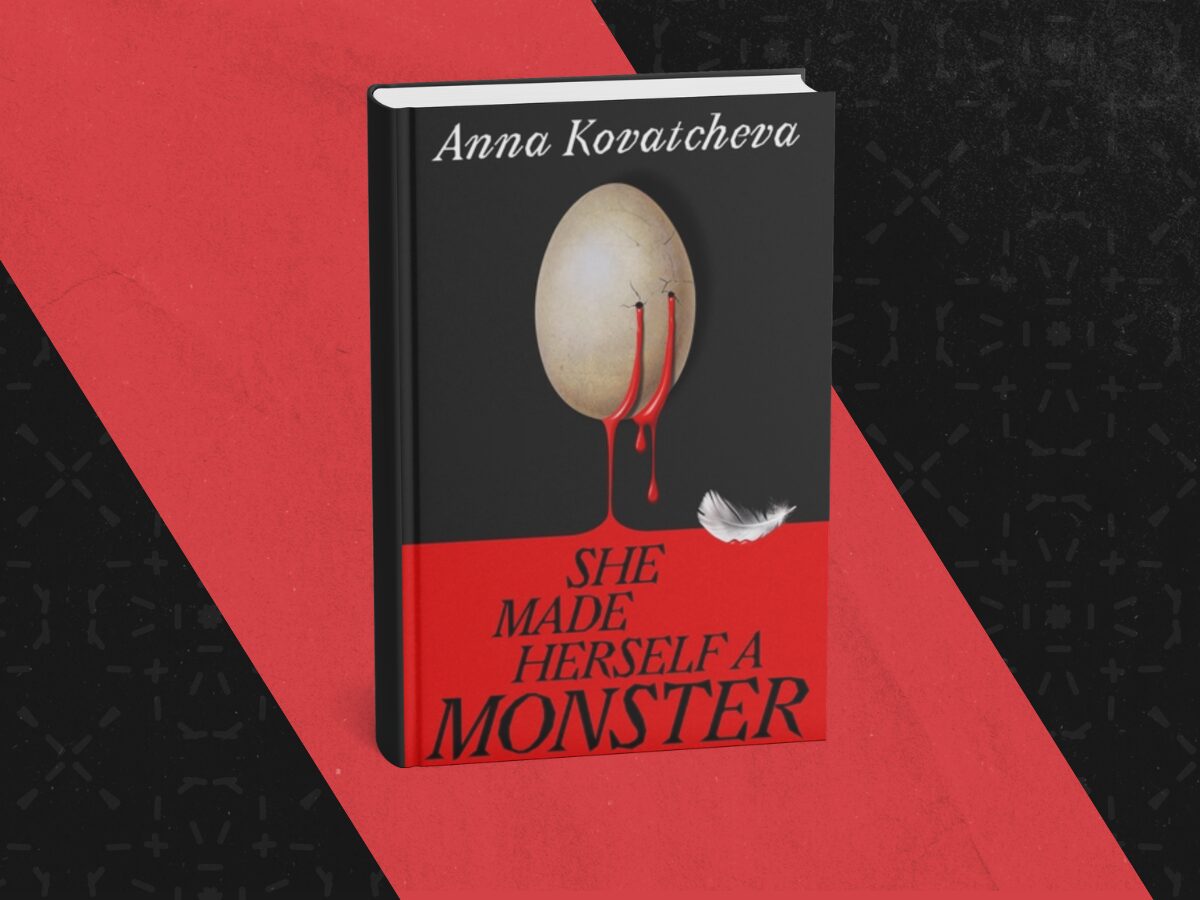
Anna Kovatcheva’s debut novel She Made Herself a Monster uses Bulgarian folklore to excavate the systems that have always mapped monstrousness onto women. Here’s what we thought.
She Made Herself a Monster is rooted in 19th-century Bulgarian folklore, steeped in the vampires, witches, and half-imagined creatures that once stalked small villages and shaped their people’s fears. Anna Kovatcheva leads her reader through the winding stories of Yana, a vampire-hunter and seer; Anka, a child believed to be cursed; and Nina and Yulia, witches navigating a world where superstition and patriarchy work hand in hand to punish them. What emerges is not a fantasy novel but a human gothic tale, a careful excavation of the very real systems that created the idea of the monstrous in the first place, and almost always mapped it onto women.
The opening scene is confronting and violent, with Yana destroying a so-called vampire to rid a small town of its vicious curse. She is singled out by her looks, with a face split in two shades, one half pale, the other dark, which her mother, also a vampire-hunter, taught her to be proud of, framing it as what makes her mystical and her story more engaging. She walks the world with one foot in the spiritual plane and one on earth, and this is why she can see, hunt, and kill the vampires that cause such disruption to everyday people’s lives without the regular folk ever seeing them.
The fluid narrative structure of She Made Herself a Monster is a well-utilised tool. Written entirely in the third person, it switches focus between different characters: primarily Anka, Yana and Kiril (Anka’s cousin), but also the Captain (Anka’s father figure and betrothed) and others. This gives us the opportunity to see the intentions and reasoning each character brings to their lives, which often conflict with those of the people around them. The fluidity of the narrative allows the reader a balanced understanding of Kovatcheva’s world and provides space for the monstrous to be human and the human to be monstrous. Even if you won’t sympathise with the decisions of a violent misogynist, you might with an abusive, loving cousin.
Throughout literary history, vampires have been used to depict perversions, parasites, societal unrest, and bigotry such as xenophobia. In folklore, though, they have been used to scare children into obedience, to explain away misgivings and pains, and to blame for the downfall of towns and people. There’s an interesting distinction between the vampire of literature, take Bram Stoker’s Dracula, who was a threat and a parasite but also reflected sexual desire and want, and the vampire of Bulgarian folklore, which is rarely seen. Its casualties are observed instead, and the image of the creature is built from that. Yana’s vampire doesn’t even primarily hunt humans; it preys on rodents and other small creatures and only moves to killing people if it has no other food source. It taunts villages with carcasses, blood, curses, and other methods of invoking fear. To a 21st-century reader, it’s clear from early on that this is not a fantasy, not a book about vampires and a vampire hunter. If you’re looking for Buffy the Vampire Slayer vibes, keep looking. What Kovatcheva is exploring is the very real superstitions of the 19th century, and how they shaped human lives, more specifically, women’s lives.
The witch of folklore, the witch that has been persecuted through the centuries, blamed for stillborn babies, droughts, famine, male sexual desire, female sexual desire, and infinitely more apparent problems in society, was not always gendered. The witch was more often than not a woman, though, and in the past three centuries has become a term almost exclusively thrown at women. If you’re reading this, I’m sure you’re aware of the acts of violence that women accused of being witches have suffered, acts not only excused but enforced by the law-making men of their times, whether in ancient Egypt or Salem at the end of the 17th century. Witch trials have led to the deaths of thousands of women. In this novel, Kovatcheva examines a woman’s mission to deter them. Yana, as a self-proclaimed vampire-hunter and seer, draws villagers’ superstitious eyes away from the women they aim to vilify and places the blame for their plights on the dead instead. By manipulating their gaze, she saves the living from the fury of those harmed by what they deem to be witchcraft and exorcises a demon from a corpse to alleviate their stress. It’s an elaborate placebo effect, designed to give people hope and lean into their superstitious predispositions: if people believe that the problem has been destroyed, they will live as if it is. And it protects women from being hanged or burned at the stake.
There are two characters in She Made Herself a Monster who are accused of being witches. Nina was popular and beloved until her husband died; in her grief, she found comfort in the beds of men in the village, and was subsequently accused of bewitching them sexually and imprisoned for witchcraft. To simplify a very complex character, she is a woman blamed for the sexual promiscuity of men and punished for their adultery. Anka never had the joy of popularity. As a result of the circumstances of her birth (I’ll let you find this out for yourself), she is believed by everyone in the village to be cursed from her first breath, and is only protected by the Captain, akin to the village’s mayor, who takes her in and raises her alongside his nephew, Kiril.
Unlike Nina, Anka does nothing to provoke her own alienation; it’s purely a product of how she was born. This makes her, from the outset, a far more sympathetic figure, a near-perfect victim, where Nina is morally ambiguous and, perhaps, less immediately sympathetic. A feminist reading this would likely push back on that summation: Nina having sex with men after her husband died was clearly her seeking comfort and support, and she can’t be admonished for it. But I’m speaking to how she is presented to the other characters in the book, and in the broader framework of the “perfect victim”, which she doesn’t achieve. I, personally, have never cared for a perfect victim anyway.
It’s intriguing to see how these two roles play out in the eyes of the men around them. Nina is a whore to everyone in the village, including the Captain, who pays her for sex and harms her greatly. Only Kiril shows her kindness, seeing beyond the labels the village has placed on her, because his education in the city has swayed him from the superstitious beliefs of home. Where Kiril shows kindness to Nina, though, his relationship with Anka is far more complex. He clearly wishes to protect her, loves her, and cares for her as family. But she provokes him easily, and he uses violence against her, going so far as to choke her to unconsciousness and leave handprint bruises around her throat for a large portion of the novel. His crimes against her are so sustained that Anka becomes certain she’ll eventually be able to provoke him into killing her. This is the backdrop to her other horror: a betrothal to the Captain, the man who raised them both, who loved her mother and now sees her in Anka’s growing face and body.

The perceptions of this marriage are deeply gendered. Anka is horrified and would rather die than marry the man she has heard beat and rape the women of the village. Her friend Margarita understands her fears; Yulia, the housekeeper, tries to protect her; Yana is immediately horrified when she learns what Anka’s future holds. The priest, meanwhile, is close with the Captain and supports the arrangement. The Captain views it as repaying a debt and is, fundamentally, highly attracted to his 16-year-old ward. And Kiril, who claims to love and respect Anka, views it as necessary and acceptable, partly because it will protect the other women of the village from the Captain. It’s a thinly veiled saviour complex with Anka as the unwilling sacrifice. He trusts that the Captain wouldn’t physically abuse her and believes that’s enough reason for her to marry him, despite the violence the Captain has shown everyone around him. Anka responds to this with devastating clarity, asking Kiril who he thinks the Captain will hurt when everyone else is gone. She understands that the man’s appetite for violence outweighs his perverted love for her.
I was deeply engaged by Kiril and Anka’s relationship throughout. They love each other genuinely, but over the course of the novel, Anka begins to see the real cracks in it. Initially she views his physical abuse as something she can control: she provokes him with words and he hurts her. Later, his betrayal nearly breaks her. We see what Kovatcheva is really saying: that a man’s loyalty and love will wane quickly when there is a woman he wants to sleep with, or a man he wants to be proud of him.
Kovatcheva’s exploration of female friendship, camaraderie, and protection is, without doubt, one of the most inspiring things about this book. Women’s friendships are so often portrayed as bitchy and backhanded, especially in older fiction, and while the 19th-century Bulgarian setting might suggest women isolated from one another and reliant on men, Kovatcheva dismantles that quietly and organically. The connection between Anka and Yulia, her family’s housekeeper, develops naturally; her childhood friendship with Margarita shifts as they grow up and Margarita chooses marriage, but its strength remains intact when they need each other. Yana and Anka’s bond is arguably more than friendship: they trust and rely on each other in ways neither has before. Yana has only ever relied on her mother, who died a year before the events of the novel; Anka has struggled to trust anyone around her. Yana shows Anka her work and inspires her. Anka is strong and powerful, while Yana is soft and sweet, despite the lives they’ve each been handed, suggesting the opposite. They complement each other, and they look after each other.
I won’t spoil this book for you; I only want to convince you to read it and discover the stories of Anka, Yana, Yulia, and Nina yourself. She Made Herself a Monster is a novel about self-discovery, about confronting the monstrous both within folklore and within society, about the women who refuse to accept the roles forced upon them, and about finding strength in the bonds between them. Kovatcheva writes with care, precision, and a deep understanding of how stories shape our fears and our freedoms. It’s a haunting, richly layered debut that asks us to reconsider who the real monsters have always been.
About the Author:
Anna Kovatcheva was born in Bulgaria and holds an MFA in fiction from New York University. Her chapbook, ‘The White Swallow’, was selected by Aimee Bender as the winner of the Goldline Press Chapbook Competition in 2015. Her short fiction has been anthologised in Best American Non-required Reading and has appeared in the Kenyon Review and the Iowa Review. She Made Herself a Monster is her debut novel. She lives in Brooklyn, New York.