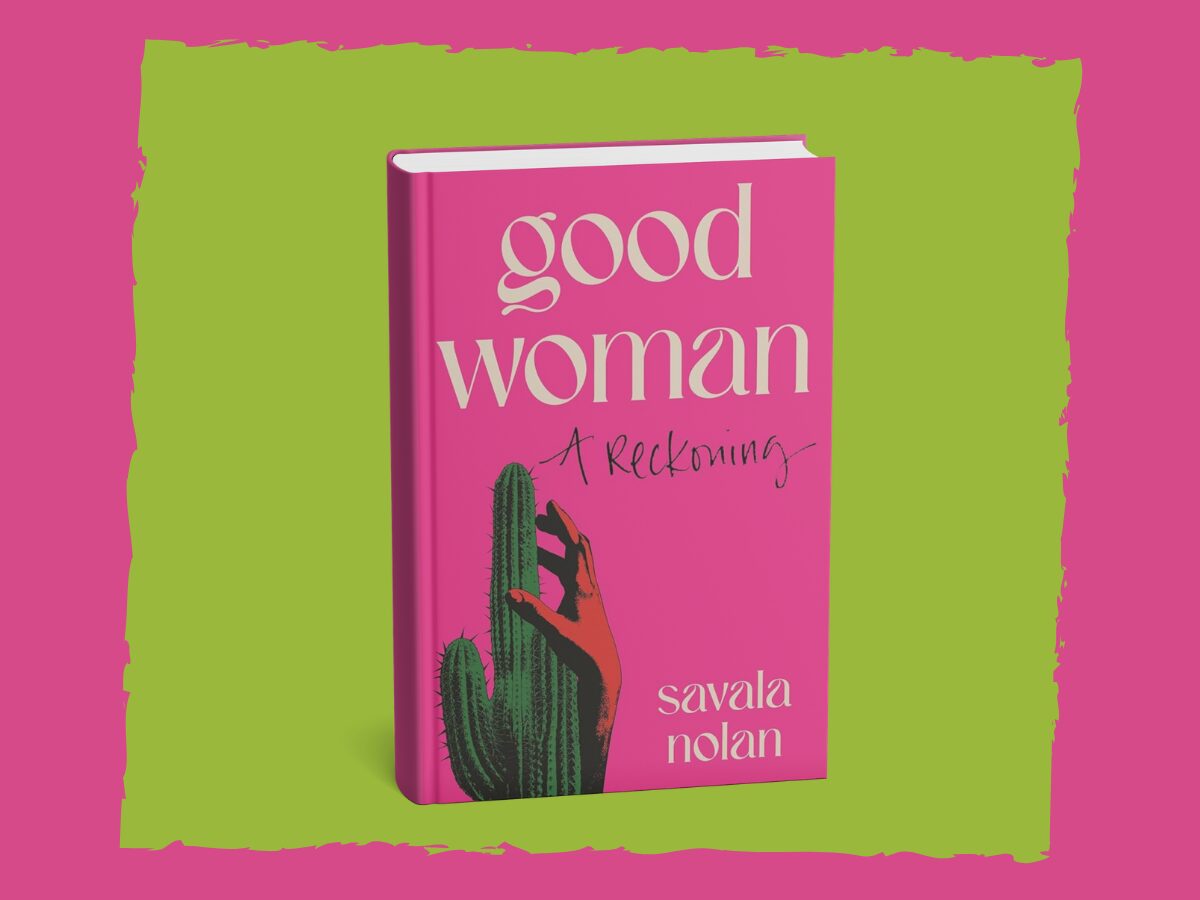
Savala Nolan’s Good Woman: A Reckoning is a collection of essays that refuses the myth of the ‘good woman’ with clarity, anger, and striking intimacy.
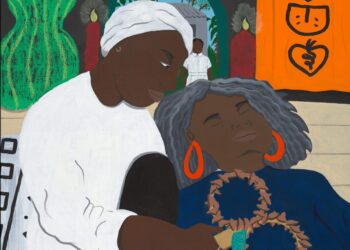
In Good Woman: A Reckoning, Savala Nolan dismantles the suffocating expectations placed on women with clarity, anger and striking intimacy. A refusal of silence, of compliance, of the myth of the ‘good woman’, and the confines that the patriarchy places over women’s right to exist. The book is a collection of 12 essays which gracefully flow between political arguments and memoir.
From the outset, Nolan rejects the cultural script that demands women be good, thin, quiet, and accommodating. Refusal becomes both a theme and a method. She asks for no permission to question the structures around her; she simply does.
One of the book’s most compelling tensions emerges in her exploration of religion. In Mother Superior, Nolan grapples with a God framed as male and father yet defined by maternal love. Savala explores how the only paternal love she has seen is conditional or frail, at least nothing close to the power and completeness of a mother’s love. The question underneath all of this is an uncomfortable one: how can women locate themselves in systems that centre male authority while borrowing the language of feminine care?

The unease extends into identity and intimacy. In Wyoming, Nolan articulates the complex, often contradictory experience of femininity as a Black woman, as well as the desire to feel protected alongside the awareness that such protection is rooted in patriarchal logic. She explores how she has found it difficult to feel feminine when the image of femininity in western society is overwhelming white and skinny. She does not resolve the contradiction of wanting to feel protected by her white partner so she knows he views her as feminine and wanting to stand up for herself as a strong, independent woman, neatly, and that is precisely the point.
Perhaps the most unsettling (though already quite understood by every woman reading this) section is Which Men. This essay interrogates sexual violence not through abstraction but proximity. The question is not if men commit violence, but which men. The statistic that 75% of assaults are committed by someone known to the victim reframes everyday interactions with a quiet horror. Beyond this disturbing fact, Nolan explains a University of North Dakota study which showed that 31.7% of the men questioned would force a woman to have sexual intercourse, i.e. rape them without using the word rape. Following on from this, Nolan also critiques how language collapses the boundaries between sex and violence, revealing how deeply normalised coercion has become; ‘our language treats violence and sex as near equivalents.’ The way sex is depicted in pornography and the kinks that many people display are violent, that is not to say that they are not completely acceptable when everyone involved is consciously consenting, but it does surround sex with a rhetoric that is not necessarily safe.
Nolan strips history of its comforting linearity. In The Recent Unpleasantness, Nolan insists that the past is not past, it is cyclical, immediate, alive. The reminder that survivors of the transatlantic slave trade lived into the 20th century collapses any illusion of distance. The violence is not historical; it is ongoing. Nolan focuses on Matilda, the last named person to cross the Middle Passage, who died in 1940 and explores how this lines up with events and lifespans that are very recent. It is an important and interesting exploration, especially in a time when people try to distance themselves from past atrocities just to barrel forward into new ones.
It’s worth noting, however, that Nolan’s analysis is deeply rooted in an American cultural and historical framework. The specific references to race, religion, and gendered experience are shaped by the legacy of US slavery and the social dynamics of the United States. While many of her insights resonate more broadly, some arguments feel less directly transferable to non-US contexts, and readers outside the US may find themselves translating, or occasionally resisting, parts of her perspective. I found myself wishing that there was a bit more exploration into different cultures and histories outside of the US, but then there are different books for that, so just be prepared when you read Good Woman that it is US-centric.
Across the collection, Nolan returns to the theme of ownership, particularly of women’s bodies. In Lest We Die of Hunger, she exposes the hypocrisy of a culture that permits male control over women’s representation while condemning women who claim that control themselves. Her argument is sharp: white men have long positioned themselves as authorities on Black women’s bodies, while denying Black women the same agency. Basically, it’s OK for men to edit Sports Illustrated and stare at almost naked women through this lens but not for women to have agency and show their bodies in states of undress on their own accord. Nolan uses the, unfortunately, already dated, example of Nicki Minaj’s Anaconda album cover and the outrage that her bare arse caused. All in all, white men think that they can tell the world about Black women better than Black women can.

Loss and reinvention run through Boom, where Nolan recounts a surgery that nearly took her voice, alongside the dissolution of her marriage. The loss of the title ‘wife’ is both personal and social, revealing how deeply women’s identities are tied to relational roles. What remains when those roles disappear is both terrifying and liberating.
Body shame and its inheritance are at the heart of Enfant Terrible. Nolan traces it through her family, showing how eating disorders and self-surveillance are passed down like heirlooms. Her response is ‘radical’: to teach her daughter to be ‘bad’, to reject the gaze entirely, and to find power not in goodness but in defiance. Nolan explores this through the fun in relating to the complex and wicked characters in media, like the Wicked Witch of the West, instead of boring, placid Dorothy.
This carries through into The Made World, where Nolan argues that a world constructed by men cannot simply be reformed, that it needs to be burned down altogether. It is one of the book’s most provocative assertions, refusing incrementalism in favour of something far more disruptive. The only way to escape this world’s inequalities are to destroy it because bigotry and privilege is so intrinsically built into every aspect of our society which cannot be unravelled with complete destruction.
The final essays, gathered under Witness, are among the most haunting. Nolan physically traces the geography of American slavery, confronting its legacy at sites like Monticello and Point Comfort. Her reflections on Sally Hemings are particularly striking, centring a woman whose story has long been overshadowed. She then travels to the land that her own ancestors, who were slaveowners, owned and where they ran their forced labour camp. Ending up with a moment at Point Comfort where the first documented Africans in Virginia arrived in August 1619. These moments ground the book’s theoretical concerns in lived, embodied history.
Yet Good Woman is not only critique; it is also instruction, albeit unconventional. In Good Advice, Nolan redefines sex beyond heteronormative constraints, challenges the stigma around women paying for intimacy, and reframes emotional labour as a form of exchange women have long been expected to provide for free. Her defence of chivalry is especially complex: not as a relic to discard, but as one of the few cultural practices that demands emotional effort from men and therefore, until true equality is found (which is unlikely any time soon), it should continue to in the tiniest way pay back women for the insane levels of emotional labour we complete for men.
What comes through most clearly is Nolan’s refusal to offer easy answers. Even her encouragement, that women remain open to love after marriage, after loss, is tempered by realism. Freedom, in her framing, is not clean or comfortable. It is something to be fought for, continuously.
Ultimately, Good Woman: A Reckoning is both deeply personal and sharply political. It moves fluidly between memoir and cultural critique, showing how systems of power embed themselves in the smallest details of everyday life. Nolan does not seek to resolve the contradictions she uncovers; instead, she insists we sit with them.
To be a ‘good woman’, the book suggests, is not a virtue. It is a constraint. And the only way forward may be to refuse it entirely.
About the author:
Savala Nolan is an essayist, attorney, and director of the Thelton E. Henderson Center for Social Justice at UC Berkeley School of Law. She is the author of Don’t Let It Get You Down: Essays on Race, Gender and the Body (Simon & Schuster, 2021). Her writing has appeared in Vogue, Time, Harper’s Magazine, the New York Times Book Review, and Forbes, among others. She helped create the Peabody Award-winning podcast The Promise. She lives in the San Francisco Bay Area. Good Woman: A Reckoning is her second essay collection.