A new global survey released ahead of International Women’s Day this Sunday has found that Gen Z men are twice as likely as Boomers to believe a wife should obey her husband. That finding has been everywhere today, and it should be. But there’s another number in the same dataset that nobody’s really talking about, and it gets to something more uncomfortable about what’s actually going on.
The survey, conducted by Ipsos and the Global Institute for Women’s Leadership at King’s College London across 23,000 people in 29 countries, found that 31% of Gen Z men agree a wife should always obey her husband, with a third saying the husband should have the final word on important decisions. Both figures are roughly double those of Baby Boomer men. That’s the number doing the rounds today, and rightly so.
What is getting less attention, however, is that the same survey found Gen Z men are simultaneously the generation most likely to say women with successful careers are more attractive to them, with 41% agreeing, more than any other generation surveyed. To a lot of people that reads as contradictory. I’d push back on that, because it makes complete sense once you understand what’s actually being asked for.

At this point, we know and understand that what the manosphere actually sells is the successful woman, reshaped: desirable, impressive, possibly earning well, proof of her partner’s taste and a boost to his status. It’s not simply a stay-at-home wife anymore. The ideology is entirely comfortable with ambition – if that ambition benefits a man and doesn’t disrupt his authority. Career success happens inside someone else’s hierarchy, her boss’s or her clients’, a structure entirely separate from the relationship at home. When she comes home, the framework resets, and the promotion stays at the door.
That distinction between career authority and domestic authority is where this survey data makes a grim kind of sense. She can earn, she just can’t use it as leverage; she can achieve, she just can’t let those achievements produce the kind of independence that would make her genuinely hard to control. The tradwife trend, which surged on TikTok through the early 2020s and has never really gone away, is the fantasy made visible: a woman who is often attractive, sometimes educated, and has chosen, loudly and publicly, to hand control back. But she is also a career woman through content creation. I find the appeal to the men watching pretty easy to understand.
It maps onto the political data too. In the 2024 UK general election, young men were twice as likely as young women to vote for Reform UK, a party whose backlash framing runs through everything it does: women’s gains, DEI, feminism gone too far. What researchers describe as the fear that men lose out as women gain equality is, for some of the men in this survey, a stated position rather than a fringe anxiety.
Read that alongside the finding that 24% of Gen Z men think women should keep their independence and self-sufficiency under wraps, again double the rate of Boomer men, and the picture sharpens considerably. Succeed, by all means. Just make sure he still feels needed.
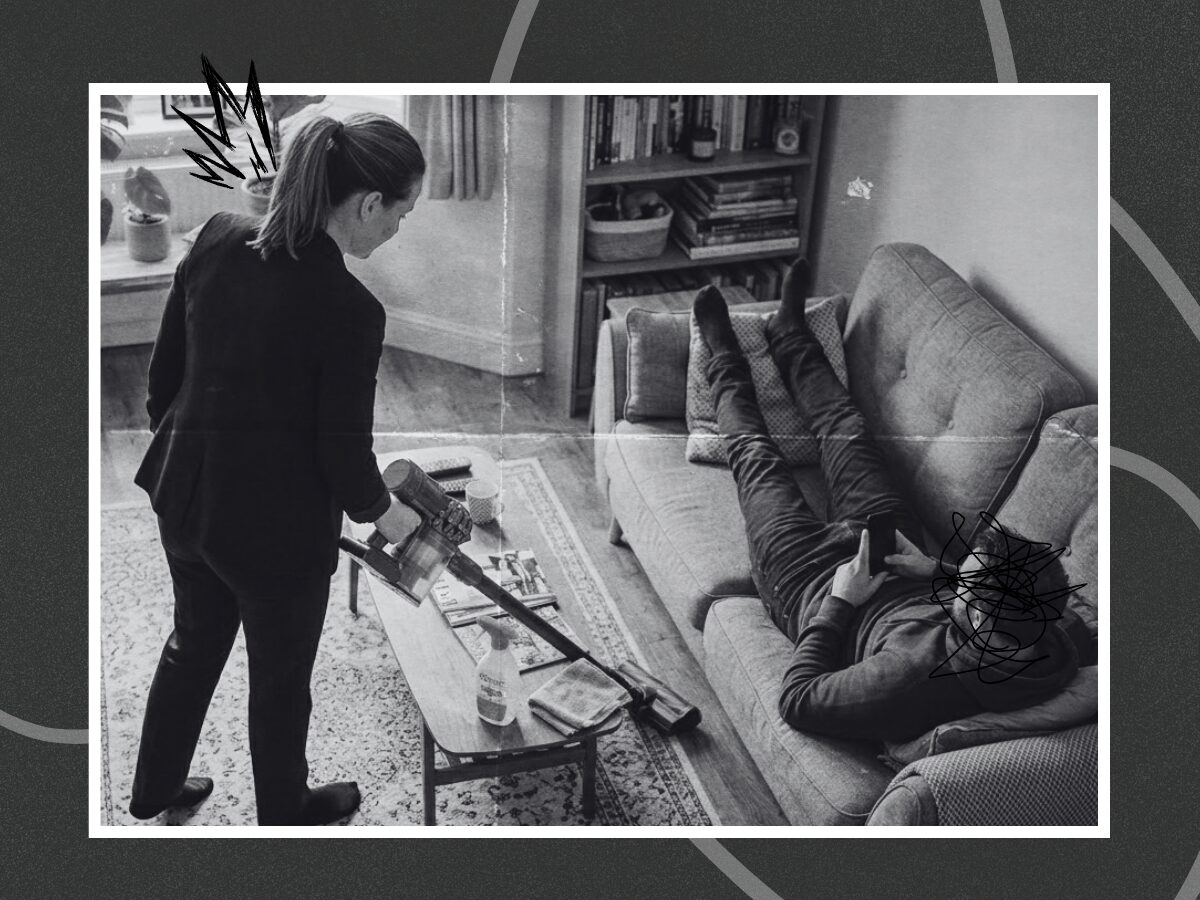
This is a generation that has been taught a very coherent set of values, and the data reflects them. These views sit comfortably alongside each other because they belong together, part of a version of gender politics that updated the aesthetics while keeping the architecture intact. Career women are desirable. Women with full independence are a different matter entirely. Part of me often wonders if this is why so many of the women I know get lulled into a false sense of relationship security. When on the first, second and third date a man makes it clear he is “all for a career woman”, they cannot be blamed for thinking he is the liberal and understanding man and partner they are looking for. Except when they move in together, they discover that his ideology stops at the front door, and inside, what awaits is a tired career woman who also must clean, cook and – apparently – obey.
So where did that update come from? We know, because we’ve watched it happen. A 2023 poll by Hope not Hate found that around 80% of British boys aged 16 and 17 had consumed content by Andrew Tate, making him more recognisable to that age group than the Prime Minister. The Netflix drama Adolescence brought that reality into the mainstream earlier last year, and Keir Starmer watched it with his own teenagers and backed screenings in secondary schools. Teachers have been raising the alarm in classrooms for years. What’s still missing is anything that looks like a structural response.

The UK-specific numbers in the survey are worth separating out. In Great Britain, 13% of men agreed a wife should always obey, well below the global average of 31%, and that context deserves to survive the wider panic. But 13% still represents a lot of men, and the direction of travel is the point: younger men in this country are more likely to hold traditional views on this than older men, which is not the story anyone expected when Gen Z came of age.
The masculinity data tells the same story from a different angle. Twenty-one percent of Gen Z men think men who do childcare are less masculine, compared to 8% of Boomer men; 30% say men should keep declarations of love out of male friendships; 43% think young men should perform physical toughness even when they don’t feel it. Young men have been actively sold a very specific idea of what a man is and what he’s owed, and these numbers show how well it landed.
Julia Gillard, Chair of the Global Institute for Women’s Leadership, noted that Gen Z men are “trapping themselves within restrictive gender norms” as much as they’re constraining women, and that framing is worth sitting with. The same ideology that tells a man his wife should defer to him also tells him to perform toughness at all times, to want nothing, to hand over the childcare only at the cost of his masculinity. Both things are happening to the same person.
At The New Feminist, we’ve covered the downstream consequences of these attitudes long enough to know exactly how concrete they get: in the gap between what equality looks like on paper and what it looks like on a Wednesday evening at home, in the emotional labour women quietly absorb to keep a partner’s sense of authority intact, in the everyday negotiations that never make it into a survey.
What this data describes, when you read all of it together, is a generation of young men who want women to have it all, as long as “all” doesn’t include authority. That’s worth being clear about, on International Women’s Day or any other day.