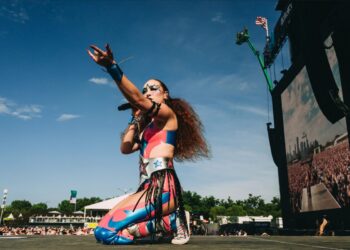
Girl Group are a dynamic and fearless band based in Liverpool who are making music that demands attention. Their new EP Little Sticky Pictures is out now and is essential listening for anyone who wants to see the experiences of women authentically reflected in song. They are a daring collective who are making infectious dance music with an ascerbic feminist edge.
Girl groups are one of the UK’s greatest exports, but far too often they feel like some of the most manufactured acts in music. The bold, sassy, hedonistic Norwegian-British collective known as, quite fittingly, Girl Group, are anything but. Their music is laced with infectious dance beats that underpin lyrics that express the joy and the daily frustrations that come with being young women in our times. The members all hail from Oslo, with the exception of Lil, who rounds out the group with refreshingly down-to-earth Yorkshire roots. Together, Girl Group are one of the most exciting and bold acts in British music right now.
We were lucky enough to spend a day with them in February and were able to talk about their latest EP, Little Sticky Pictures, which is out now. When you’re in their presence, what is most apparent is that these talented women are moving through the world as a dynamic collective built on a deep mutual respect, unifying in the overlaps of their experiences to make music that is as bombastic as it is relatable. Throughout the day, they shared their insights into making music, their thoughts on feminism and how it differs in the UK and Norway, and the ways that their adopted home of Liverpool shapes their artistry.
Your new EP, Little Sticky Pictures, drops on the 20th of March – what can fans expect from the EP? What was the inspiration behind the EP?
Thea: Sick basslines!
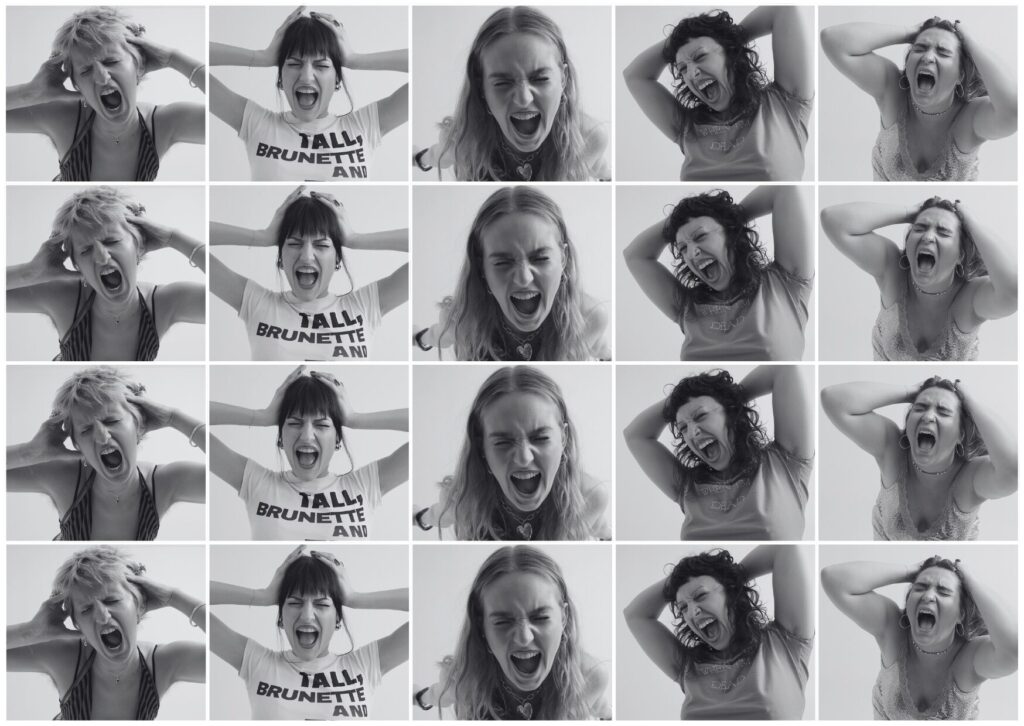
Mia: We keep saying that it feels like the older sister to our last EP, Think They’re Looking, Let’s Perform. It feels very much like we started a journey with our first EP, and now we’ve experienced more, growing older. It’s all of those same concepts of growing up as a woman and being a young woman; all the things you realise when you learn more about feminism and society. Realising ‘oh my god these things are crazy’ while you’re now an adult and you’re expected to deal with it all, while just dealing with your life. I think Little Sticky Pictures is all the different moulds you’re put into and all the ways you see a woman. The different ways you feel like you have to be.
Thea: I also feel like you can expect some nostalgia in there, and some heartfelt music.

Maria: I feel like the nostalgia point is spot on because of what we’ve tried to do with Think They’re Looking, Let’s Perform and Little Sticky Pictures visually. When we started making music together, we really bonded over how it felt like we were kids again, doing choreography in our bedrooms and feeling like we’re just doing what we did at sleepovers as kids, but for a job now. We tried to get that into the visuals with the stickers.
Mia: It is so much about reclaiming the joy in being a girl. When you see masculine and feminine, the feminine is always seen as lame and the masculine as cool. Growing up, you suddenly start to think it’s lame to do girly things. We’ve tried to reclaim that and show that it is fun to be a girl, to be a woman.
Songs like ‘Man-made girl groups’, ‘Rage song’, and ‘Flink Pike’ are very clear in their feminist messaging. What personal experiences drove the songwriting process for tracks like these?
Lil: It basically is always stuff that has annoyed us in some way, usually. All the things that we rant about to each other tend to be what we make songs about. As five individuals, they’re the things that we bond over the most and what feel the most ‘Girl Group’.
Mia: I think when we started to write about these topics, we were so hungry to talk about these issues. When we wrote before, it was more about our personal lives, romantic relationships or introspective things. Suddenly, it was like we’ve always wanted to write about, with Flike Pike, for example, having to be the best at everything. I think we were very hungry to make that into music.
Thea: Which I think is also a personal experience, but we have all experienced it – all women experience it, whether they know it or not.
Katya: Think They’re Looking, Let’s Perform very much came from having these experiences. We were writing about piss on the toilet seat, all these little things. I think Little Sticky Pictures is more about the fact that we’ve brought in all these experiences and found these common themes. We understand why they happen and how they happen, formed understanding and a lot of emotions around them. Now, coming to Little Sticky Pictures, the songs are a lot more concept based; they’re wider themes. Listen and see if you get it!

As a group, you have described the music studio as being like a ‘boys club’. What changes do you want to see in the music industry to change this feeling?
Maria: Generally, more women working with women, which is the point of why we do what we do. It’s really difficult as a woman to do anything creative and not end up in a room full of men. The only way you can change that is to really actively reach out to women specifically. When we were in university, and we tried to find a mastering engineer on a website where you can find them, we had to scroll so far before we found the one woman. It was like seventy men, and then the one woman we found. You aren’t going to work with women unless you actively choose to.
Katya: I also think there’s so many female artists, especially solo artists in the pop space who are popping off at the minute, but behind the scenes it is so male dominated. PinkPantheress recently was the first woman to win best producer at the Brits, and we were all quite shocked by that. The fact that that hasn’t happened until now says it all. There are so many incredible artists, but we just treat them so badly. So much of what we say about them isn’t about their art; we don’t value it to even similar standards to how we view male musicians and their work.
Mia: Society right now is terrifying, and so many rights are being taken away from so many. I think one of the most important things that we hope happens is people having solidarity with each other. You see it with trans rights, immigrant rights, with women, and it’s so terrifying. I think it’s in these times that people realise we are so much stronger together. One of the most beautiful things we’ve experienced is the space we’ve created by being outside of the boys’ club. A space for everyone. Seeing what that produces creatively, it creates something else. We’ve been saying, we were just supporting Black Honey, and it makes me really hopeful to see that many women and people on the outside working together.
Four of you are from Norway. How does feminism differ there and here in the UK? What are some culture shocks you experienced as women when you came here?
Thea: The term ‘Flink Pike’, which is the name of the first song on Think They’re Looking, Let’s Perform, is a term for the pressure you feel as a young woman starting from as young as five or even younger. We have a term for it there.
Maria: I think that having a term for that is so helpful; you can’t talk about a thing you can’t name. We’re all from Oslo and quite progressive environments. When I came here, I was a little surprised by how little people were talking about feminism and politics. I get the sense that people here feel a little more apathetic, more disconnected from the government. I think they feel a little more hopeless.
Lil: Yes! It’s completely different here to how it is in Norway. The youth in Norway are super engaged in politics. I think in most areas here they aren’t. If you come from certain places, you may have more of a foot in it, but politics was never a conversation at all growing up. I had to get to feminism on my own at eighteen; I’d never even heard of it. It’s been really interesting coming together and sharing those experiences – learning from each other and what these different environments have brought out of us.
Much of your music is hedonistic in nature, with an encapsulation of Liverpool’s party scene – what aspect of the scene inspires you to make music inspired by it?
Lil: The events that we like in Liverpool are quite queer events and a lot of female or non-binary crews. Going to those events and seeing that made us feel more able to make dance and electronic music. You go to these events and feel so welcomed, it’s a really inclusive atmosphere. That’s obviously so much of what we’re doing with our music, so there’s a correlation there.
Mia: Comparing it to Norway, if I go out there, I’m super aware of not going outside of the box. Not being too dressed up or dressed down. In Liverpool, you can come to one of these events in full glam or in your joggers with a hair roller in, and everyone would be like ‘that’s sick’. It’s so free, and that’s such a privilege for us to be in, and it’s made us feel more free in ourselves and our self expression.
Thea: No limits!
As artists, you have such a distinct visual and musical style. How have you cultivated your identity as a group?
Maria: To be honest, I feel like it’s still coming together. It’s something that’s just very gradually happening. Obviously, when we just started out, we had branding meetings, but still, it’s never felt like it’s been very decided or intentional. We’ve come together and made things, then come together and made things that feel very different. It’s still happening, and it’s a product of us hanging out together.
Thea: We are five very different individuals, musically. We were all solo artists who came together, and we had very different genres. It’s a pick and mix of so many different things.

Katya: I think that us having such different influences musically has really pulled the music and the project in so many directions, it’s landed in this middle place. Us coming together as a band, we start out as friends, and so many of the things we all agree on that we like are the same things that make us friends. All the jokes, the femininity, the fun, the sass, the politics – all these things that are almost separate from the music tie it all together.
Mia: It helps that we’re very different, it keeps us in check!
With the new EP coming, Girl Group is truly on the rise. What are your main goals as a group for the coming years?
All: World domination!
Mia: We’ve always said that one of our goals is to spoon feed feminism to people who might not be feminist – someone right wing, a man, maybe middle-aged, privileged, and make them love our music, then say ‘wait, there’s more to this’.
Thea: Which they do!
Katya: We have a surprising amount of grown men who love our music, who we love. It’s so nice and it’s so cool that we get to experience that.
Mia: What we’ve always said is we want to be what we needed when we were younger. We had so many great female role models, but so many of them were unreachable and perfect because that’s what they had to be in the industry. We want to be something for young girls and say you can be yourself and have so much fun, and that can be beautiful.

Katya: We’re obviously a woman and non-binary project, and our goal has been to create this space, this platform for people who fall into those categories who want to work with music and be creatives. Somehow, some way, some comment section, find each other and make music outside of us.
Maria: We want more people to be able to do what we do. It’s a lot of fun. Being in rooms that are always so light and positive and safe is unfortunately rare in the industry, and we want to somehow make that more accessible to people.
Girl Group’s latest EP, Little Sticky Pictures, is available now on streaming platforms and in vinyl format, which can be found here.
Photography by Dani Baker
Words by Adam Saraswati Rawlings
Creative Direction by Ellie Macieira-Fielding
Assistant Creative Direction by Anya Duncan
Makeup by Juna Uehara
Styling by Olive Leitch
Scroll Check shot by Ellie Macieira-Fielding
Shot at Creative Ctrl Camden