

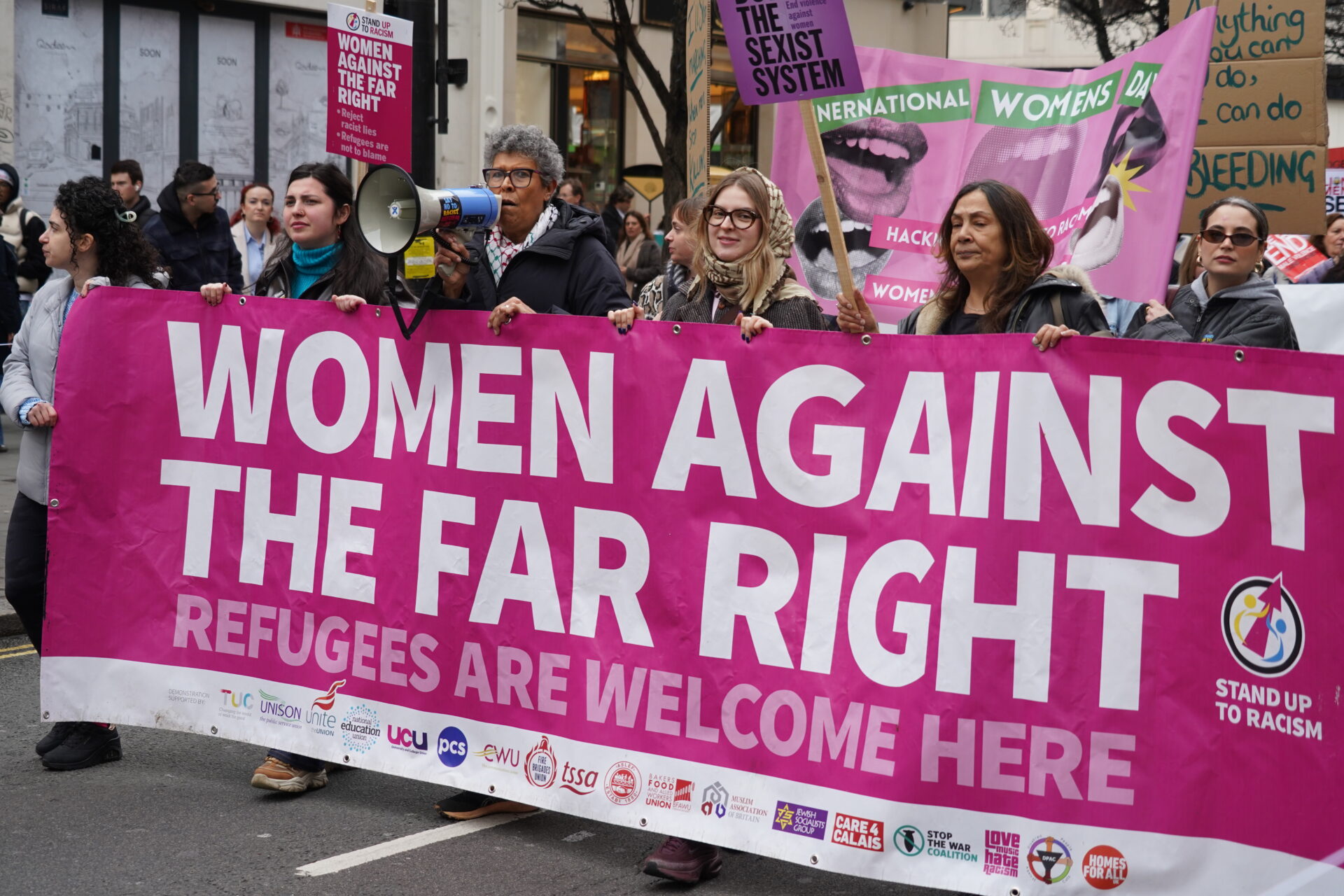
On Saturday 28 March, thousands of people will take to London’s streets for what organisers are calling the biggest anti-far-right demonstration in a generation. Here’s why, if you can be there, you should be.
There’s a line you hear a lot from the far right; which is that they’re doing it for the safety of their women and girls. That their rage, their marches, their St George’s flags on lamp posts and their WhatsApp group hatred is really just concern for our safety.
It is one of the most cynical lies in British politics right now, and it deserves to be called out.
Women Against the Far Right was founded on exactly this premise. The group, which marches this Saturday as part of the Together Alliance’s national demonstration in central London, grew in direct response to far-right actors weaponising violence against women and girls to justify racism, attacks on refugees, and open hostility to Muslim communities. As WAFR founder Samira Ali puts it: “Their racism, division and scapegoating makes us more unsafe, not less.”
Ali is right, and the data backs her up. When the 2024 riots tore through towns and cities across England and Northern Ireland, the men driving them claimed to be outraged by violence against women. But FOI data obtained by the Guardian told a rather different story: 41% of the 899 people arrested during the unrest had previously been reported to the police for domestic abuse. In Bristol, that figure was closer to two-thirds. In one police force area, it hit 68%. The men claiming to stand for women’s safety had, in significant numbers, already been reported for hurting women at home.
As Isabella Lowenthal-Isaacs of Women’s Aid told the Guardian at the time, the riots and domestic abuse were not separate problems. They were “symptomatic of deeper, connected issues, driven by the same forces of control, coercion, and misogyny.”
This is what the far right actually looks like underneath the protective rhetoric. Over 100 women’s rights organisations, coordinated by the End Violence Against Women Coalition, wrote to the Prime Minister in August 2025 to make this exact point. The signatories included Rape Crisis England and Wales, Refuge, Imkaan, and the Suzy Lamplugh Trust. Their letter was unambiguous: far-right groups are hijacking legitimate conversations about violence against women to push a racist, anti-migrant agenda. Their “concern” for women, the letter made clear, does not extend to refugee and migrant women living in fear of racist attack.

More than 90% of rape and sexual assault is committed by someone known to the victim. One in two rapes is carried out by a partner or ex-partner. One woman is killed by a partner or ex-partner every four days in this country. These are not statistics the far right talks about, because they don’t fit the narrative they want to push. We must make it abundantly clear that misogyny is not an import. And it is not the fault of asylum seekers or Muslims or migrants. It is a structural problem that has always lived closest to home.
Reform’s own record makes the point rather well. The party that claims to represent ordinary people, and increasingly ordinary women, has pledged to scrap the Equality Act 2010 and all equality, diversity and inclusion measures. These are the legal protections that underpin women’s rights in this country. Reform MPs also voted against the Employment Rights Bill, which included stronger protections against workplace sexual harassment. This is what protecting women looks like in practice, according to the far right: removing the laws that protect them.
Nigel Farage has publicly praised Andrew Tate as “an important voice for young men.” Research cited by the LSE’s Centre for Women, Peace and Security shows that far-right populism and patriarchal social control share not just an ideology but a function to not liberate women.
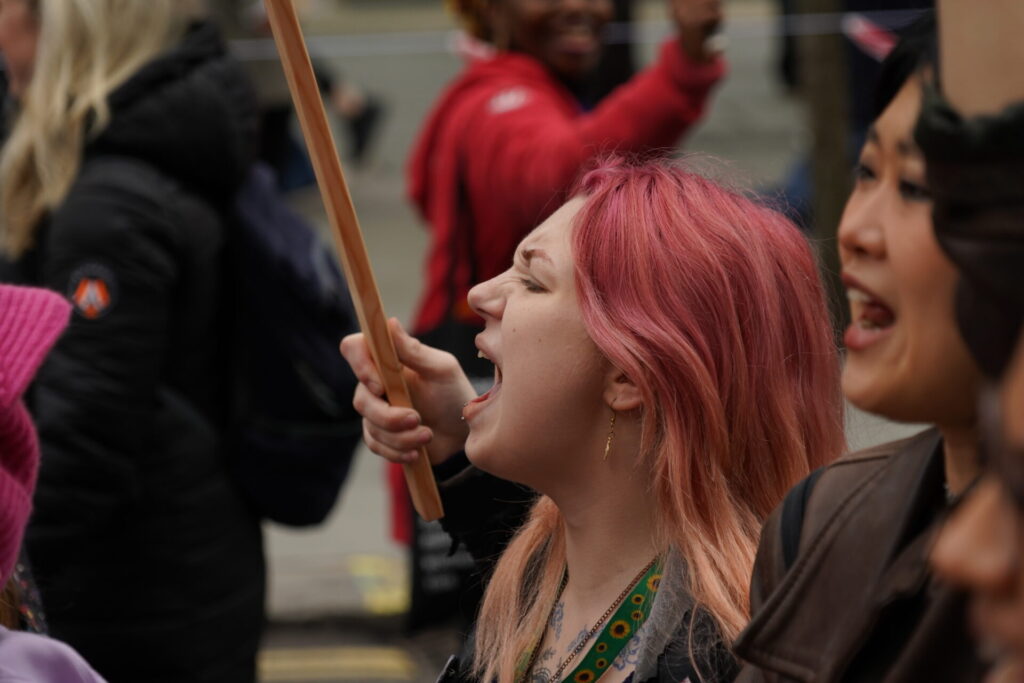
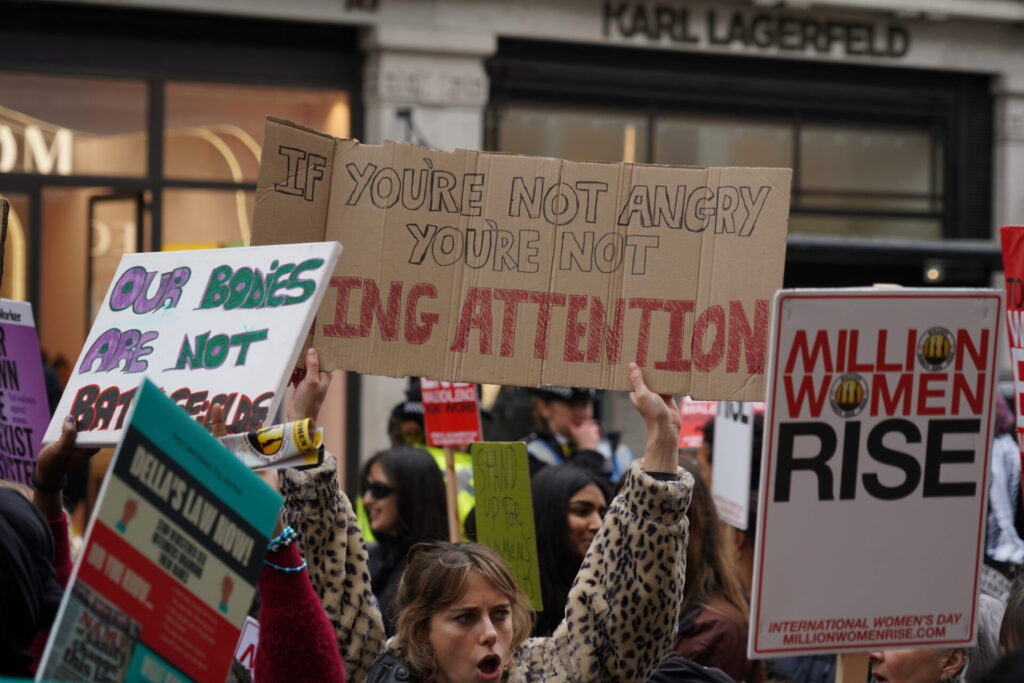
This weekend, the Together Alliance brings together trade unions, faith communities, environmental groups, anti-racism organisations, and people who have never been on a march in their lives. Organisers are expecting tens of thousands, with coaches coming in from cities across the country. Deborah Frances-White, comedian and host of The Guilty Feminist, will be there. Diane Abbott will be there. And the women’s bloc, stewarded by WAFR’s Sophia Beach, will be there, loudly, with a message that has always been true: the far right does not speak for us, has never spoken for us, and is in fact one of the clearest threats to our safety and freedom.
“The far right are trying to organise everywhere,” Sophia says. “They claim to be protectors of women and children, but they are our biggest threat. Misogyny and the far right have always gone hand in hand.”

There is a version of feminist politics that treats the march as someone else’s cause. That cordons off gender from race, from class, from the question of who gets to be safe in public space. That version of feminism has never worked, and it never will. You cannot fight misogyny while tolerating the racism that misogyny runs alongside. You cannot claim to care about violence against women and stay silent when refugee women are being terrorised in their own communities. These things are connected. They have always been connected.
This Saturday is a chance to push back in the most straightforward way available: by showing up in large numbers.
The march assembles from 12pm on Park Lane, departing at 1pm through Piccadilly, Regent Street, Pall Mall, and on to Whitehall. An accessible shorter route assembles at 1pm outside Waterstones at Trafalgar Square. You can find travel information, accessible routes, and bloc details at togetheralliance.org.uk/march.
London is an anti-racist city. On Saturday, we’re keeping it that way.









You are quite simply the epitome of left wing trash. You are a disease to western society. Good luck for the future because you are going to need it.