
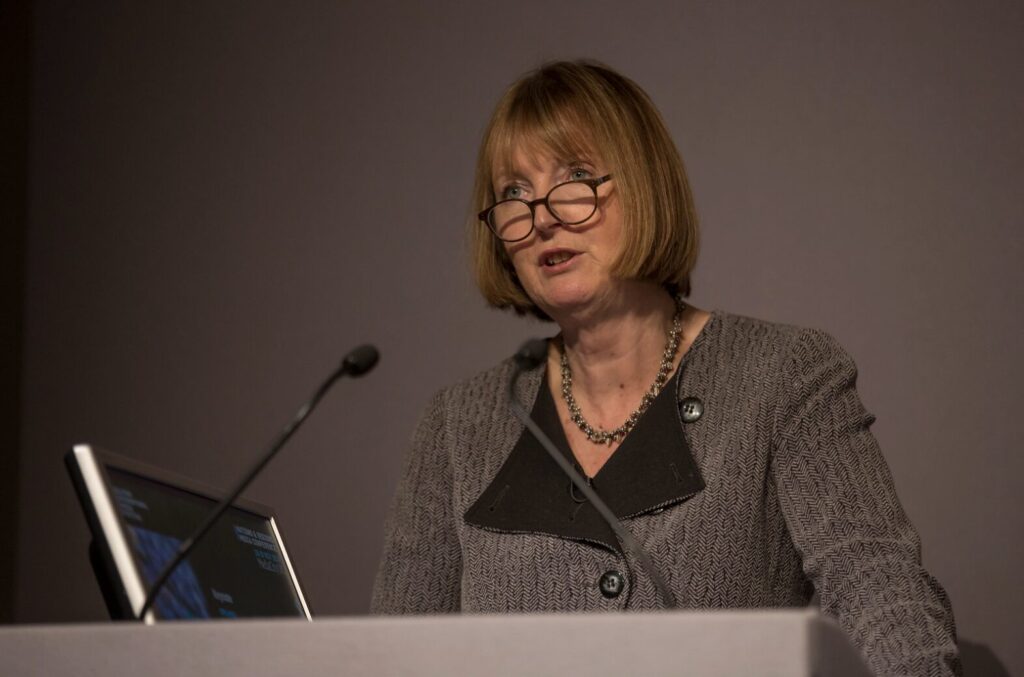
Labour’s recent appointment of a new advisor on Women and Girls is “politically thin“, writes Toni Haastrup, Chair in Global Politics at the University of Manchester.
Harriet Harman’s new position as the Prime Minister’s adviser on women and girls is easy to see for what it is: a political signal. Following a bruising set of local election results, Keir Starmer needed to project steadiness, seriousness and moral purpose.
Bringing back one of the party’s most recognisable feminist figures helps do that. But the appointment also raises a bigger question: is Labour recommitting to a substantive politics of gender equality, or simply rediscovering the language of it?
Downing Street says Harman will help “galvanise” government action for women and girls, with a remit focused on violence against women and girls, economic opportunity and representation. Those aims are hard to oppose; the difficulty is that they remain politically thin until they are attached to institutional authority, clear policy mechanisms and material commitments. Without that, the role risks reading less as an agenda and more as a gesture.
That matters because symbolism is not the same as substance. Harman’s presence may reassure those who want to believe women’s equality still has a place in this government’s political imagination. At a moment when Starmer is fighting for his premiership, the symbolic function of the appointment becomes even clearer.
Amid pressure over economic policy, the rise of the far right and declining political trust, “women and girls” risks becoming a way for the government to appear caring without showing how it would actually redistribute power.
There is good reason to be cautious. It is not yet clear how this new advisory role relates to Harman’s existing position as the UK’s special envoy for women and girls. A generous reading would be that the government is finally trying to connect domestic and international gender policy more coherently. That would be welcome. The UK’s current National Action Plan (NAP) on Women, Peace and Security (WPS) agenda now explicitly claims that domestic and foreign policy cannot be treated as separate spheres.
If Harman is now expected to operate across both arenas, this appointment becomes a test of whether the government’s claim to integrate domestic and international gender policy has any practical institutional meaning.

But if that is really the ambition, the government has not explained how this integration will be delivered, nor how it will account for the different experiences and good practices of devolved administrations in Scotland, Wales and Northern Ireland. Without that, coherence remains more aspirational than real.
The international dimension is especially important because this is one of the few areas in which the UK has long claimed leadership. Through commitments to the WPS agenda and successive NAPs, British governments have claimed to be champions on gender issues in peace and security, globally.
Yet that leadership is increasingly difficult to sustain in material terms. Recent parliamentary scrutiny has been blunt on this point. The House of Commons International Development Committee’s 2026 report on WPS argued that UK commitments have not been matched by funding, staffing or accountability, and warned that reduced development and gender expertise inside the Foreign Commonwealth and Development Office (FCDO) is actively hindering delivery. That assessment sits alongside the longer shadow cast by the further reduction of aid from 0.5% to 0.3% of GNI. In practice, that meant the loss of flexible funding for many grassroots and women-led organisations, especially those working on peacebuilding and sexual and gender-based violence in conflict-affected settings.
In other words, this is not just a rhetorical contradiction: the state continues to invoke feminist commitments to peace abroad while dismantling the infrastructure needed to sustain it. The danger is not that governments speak about women and girls; it is that they do so in ways that empty feminist politics of its structural demands.

That is also what makes Harman an interesting figure here. She comes from a feminist tradition that see gender inequality as closely tied to work, pay and economic security. From that perspective issues like welfare and representation matter because government decisions can either reduce inequality or make it worse. Contemporary Labour gender politics, as reflected in this government, often feels even narrower and more managerial by comparison: attentive to optics and selective forms of representation.
In that framework, it becomes possible to speak constantly of “women and girls” while erasing the lives and livelihoods of trans women. Any optimism that this more ostensibly progressive language will produce more expansive gender politics has not been held up in practice.
By carving out “women and girls” as a distinct advisory portfolio, with no clarity where it fits with economic strategy, social security, migration, foreign policy and public spending the government continues to treat gender as a stand-alone issue rather than as a relation of power that runs through all government responsibility.
This approach makes it easier to promise action on misogyny while sidestepping the ways insecurity is produced through low pay, welfare retrenchment, hostile border policy, overstretched public services and the wider cost-of-living crisis. In that configuration, gender can be managed symbolically rather than addressed structurally.
That is why Harman’s appointment should not be read straightforwardly as evidence of a renewed governmental seriousness about gender equality, even less as proof that it will deliver gender justice for all women and girls. It prompts a more uncomfortable question: what use is gender equality language when it has been stripped of its most transformative implications? If Keir Starmer’s Labour wants this appointment to signify more, it will need to show not only that it can speak about women and girls, but that it is prepared to fund, institutionalise and democratise the conditions of their security. Only a truly transformative feminist leadership attuned to how gendered power operates across domestic and international politics can offer a meaningful break from the current path.
Featured image credit: University of Salford | Licensed by creativecommons 2.0