
Mo Carrier is the CEO and founder of MyBliss, a sexual wellness company designed by women for women. They have just two products on their site, condoms and lubricant.
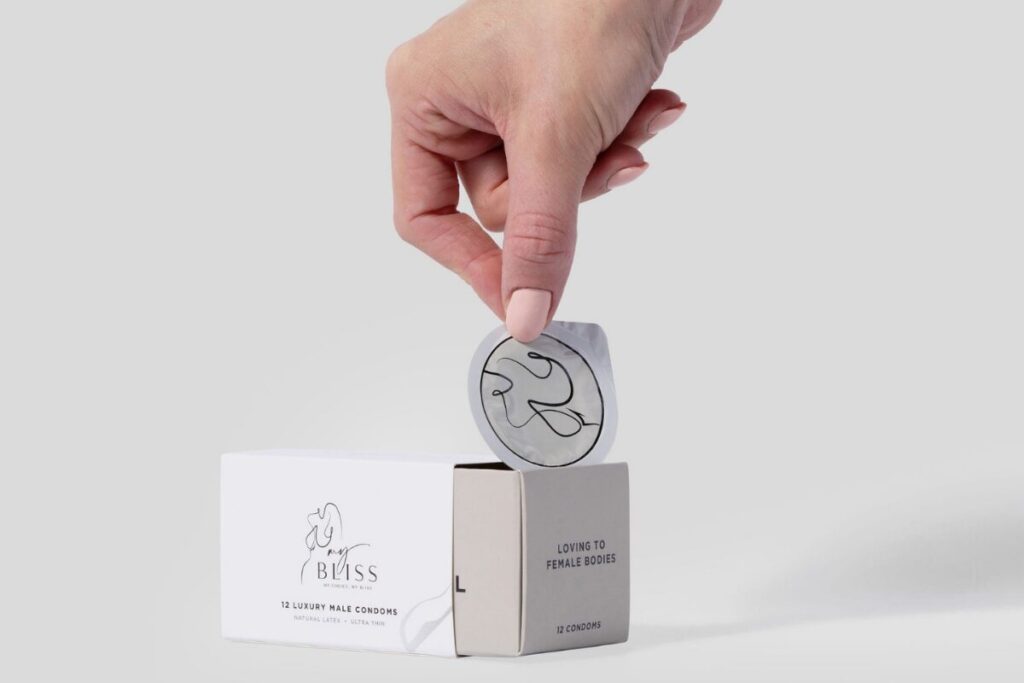
The condoms are packaged in cute looking coffee pod style packaging with a simple line-drawn outline of a female figure, the idea being that the condoms are made deliberately with women and their vaginal health in mind.
Mo started the company in 2021 with her partner Joel and the idea for the condoms came when the couple decided to go off hormonal contraception after Mo struggled for years with negative side effects. When they returned to using condoms they found themselves disliking what was available, Mo explained:
“We were instantly put off when we noticed the very male-centric packaging and the lack of information on the ingredients.”


This made Mo want to find out more about the industry and if there was something that really worked for her.
“We soon discovered that the condom industry regularly used ingredients that were irritating and infection-inducing to women. In fact, there is no requirement to test condoms on the vaginal microbiome in any certification across the globe. It was clear male condoms are seen as a male product despite the fact it’s used internally for women.”
Mo wanted condoms that were catered for women’s bodies, that were designed for the people the condom’s properties would have the most effect on, and with that My Bliss was born.
Since launching the company, My Bliss condoms have been featured in the Cosmopolitan, Men’s Health, and Glamour magazine.
Through her company, Mo continues to argue for women’s health and consideration in the sexual wellness sphere.
Mo told me that she believes that “Condom certification should include mandatory testing on the vaginal microbiome to ensure products do not cause disruption, irritation, or encourage the growth of harmful bacteria such as Candida.”


Candida refers to what is commonly known as a Yeast Infection, which studies believe 138 million women suffer from. Yeast infections are treatable and can occur from time to time, but figures also show that 6% of women suffer from recurrent episodes of it.
She told me that for My Bliss products the company invested in a clinical study in order to assess what impact their condoms could have on the vaginal microbiome. She also expressed that she hoped that this could set a new benchmark for the industry that may encourage other brands to do the same kind of studies.
So how are My Bliss condoms catered to women’s bodies?
Mo explained that they are made with natural rubber latex and lubricated with organic silicone oil, which is hypoallergenic. What makes them more vaginal health friendly, she explained, is about what they don’t contain more than anything.
“We do not use glycerin, parabens, spermicide, fragrances or other ingredients commonly associated with irritation or microbiome disruption. Silicone lubricant does not feed yeast, alter vaginal pH or introduce unnecessary additives.”


“That knowledge would have saved me a lot of discomfort and confusion”
My Bliss also features information and articles on women’s sexual health on its website, Mo explained that they share this information because she thinks that women’s sexual health education still has ‘significant gaps’, she said:
“So much of what we’re taught focuses on avoiding pregnancy, rather than understanding pleasure, the vaginal microbiome, or how sex can impact our wider health. Many women aren’t told that condoms don’t just prevent pregnancy, they also create a physical barrier that reduces exposure to semen and new bacteria during sex, both of which can temporarily disrupt the vaginal microbiome.”
Research is starting to show that spermicides have an effect on the vaginal microbiome.
“This can be particularly relevant in the early stages of a new relationship, when our bodies are adjusting to a partner’s microbiota. There is also increasing scientific discussion around conditions such as bacterial vaginosis and how they may relate to sexual activity.”

For Mo this is personally important, when I asked her what she could tell her younger self she said: “Honestly? To use condoms more.”
She went on to explain that she had struggled with recurrent thrush for years and how she never understood just how much sex, semen, and the vagina’s microbiome could have a role in these issues. “That knowledge would have saved me a lot of discomfort and confusion.” she said.
She implored that the sharing of this information is not just to be provocative but that it is imperative to women to better understand more about how their bodies work, so they can make more informed decisions, ‘It’s about equipping women with knowledge’ Mo said.
‘There is growing recognition that women’s health is not niche. It is foundational’.
I asked Mo where she thought women’s health still needed improving in so many areas, but that through her business she has met many women working in improving women’s health.
“Women’s health has historically been underfunded and under researched. For decades, women were excluded from many medical trials, and research has disproportionately focused on male physiology.
“ We are still playing catch up in areas such as the vaginal microbiome, endometriosis, perimenopause, maternal mental health and sexual wellbeing. There is also a broader cultural gap. We often treat women’s symptoms as normal rather than worthy of investigation. Pain, hormonal fluctuations and recurrent infections are frequently minimised.
“What gives me hope is that this is changing. There is growing recognition that women’s health is not niche. It is foundational.”
Through her work she managed to win a femtech grant and through this has become involved in a wider ecosystem of women working in the industry, she told me that she has seen that a lot of innovation is happening.
Revelations from a lubricant survey
After developing their condoms, MyBliss went on to make a lubricant. As part of that research they did a survey with their customers about their lived experiences to understand what kind of lubricant women felt they wanted to see on their shelves.
“The results were striking.” Mo said.
“Forty four percent of respondents said they experienced sensitivity or irritation after sex, and twenty eight percent reported vaginal dryness or discomfort.

“Seventy percent said they wanted a product they could use when they felt irritated or dry. It reinforced something we already suspected. Lubricant is often positioned as optional or purely about enhancement, but for many women it is about comfort, protection and recovery. Friction during sex can contribute to soreness and micro irritation.”
Before MyBliss
Of course growing up Mo didn’t know she would go on to be the founder of a condom company, in fact at university she was studying art history and she wanted to become a curator.
Then she went on to work in corporate jobs.“I think a lot about how if I’d known growing up that I’d be an entrepreneur running a business with my partner I’d be amazed. I never wanted to be an entrepreneur when I was younger, it seemed really risky and unreliable. However, when I was in corporate jobs I was made redundant twice in two years and I’ve been working on my business for five years now and feel far more stable.”
“Motherhood has actually made me a better founder.”
Mo also became a mother for the first time in September. I wanted to know how her life has been since then, juggling the ever-busy job as an entrepreneur and her new identity as a mother.
“I’ve absolutely loved becoming a mother. It has been the most grounding and perspective shifting experience of my life. It has also forced me to become far more intentional with my time.” Mo Said.
“Motherhood has actually made me a better founder. It has sharpened my focus and reminded me why I’m building in women’s health in the first place.”
She also told me that it made her better at asking for help, being lucky enough to have involved grandparents and outsourcing her marketing has helped her ability to balance everything with her newborn.
Future of the company
Mo wants the company to continue to improve the standard around intimacy and encourage the rest of the industry through their products to do the same. To Mo this means continuing to deepen their own clinical research and have their product be something that supports the industry to change as well, not just disrupt it.