
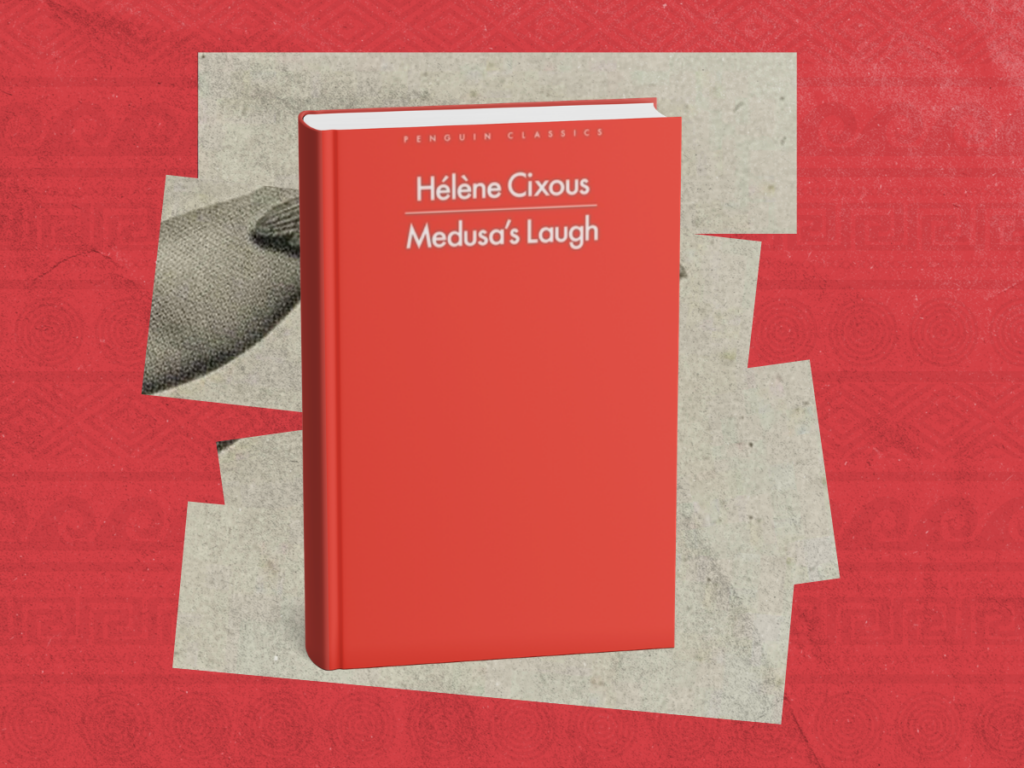
Penguin’s new translation of Hélène Cixous’s Medusa’s Laugh brings her furious 1975 call for women to write back to bookshops.
“Women must bring themselves into the text – and into the world, into history – on their own initiative.”
Hélène Cixous’s bombastic juggernaut of an essay from 1975, The Laugh of the Medusa, has a brilliant new translation and a slightly new name. Medusa’s Laugh, translated by Eric Prenowitz, arrives in paperback as a Penguin Modern Classic on 12 November. It’s the first new English translation in half a century.
If you haven’t encountered Cixous before, she is a French writer, playwright and academic, born in Oran, Algeria, in 1937. By the time she wrote this essay, she was already a published novelist and had helped establish the experimental university at Vincennes following the protests of May 1968. In 1974, she founded a women’s studies centre there, helping make women’s lives and experiences a subject of academic study in their own right.
The Laugh of the Medusa became one of her best-known works and a landmark of feminist literature. Its argument is urgent, sometimes unruly, and directed straight at its readers. Women must write themselves into a world that has spent centuries telling their stories for them.
Having a new translation dropping in 2026 feels particularly fitting. In a world of fake news and voices being drowned out by the ever-monotonous hum of social media, pop culture and Men At The Pub, we could do with a call to action.
Feminists, it’s time to write.


A different kind of feminist argument
The essay first appeared in the French journal L’Arc, in an issue dedicated to Simone de Beauvoir and the women’s movement. It was born in second-wave feminism, when arguments about women’s work, sexuality, reproductive freedom and place in society were reshaping public life.
But feminists didn’t all agree on what liberation should look like. Beauvoir had famously argued that women’s position was made by society, rather than determined by biology. Cixous approached the question through literature and language, asking what women might write if they stopped having to see themselves through men’s eyes.
For her, the problem went deeper than women struggling to get published. The conventions of literature itself had developed in a world where men held most of the power. Men had largely decided what counted as serious writing, which experiences deserved attention and how women appeared on the page.
Cixous wanted women to challenge those conventions and find out what else writing could do.
The essay reached English-speaking readers in 1976, through a translation by Keith and Paula Cohen published in the American journal Signs. It became widely taught and anthologised, introducing generations of readers to Cixous’s work.
Prenowitz’s new translation offers a chance to encounter it afresh. One small change is there on the cover. He removes “the” from the familiar English title, giving us Medusa’s Laugh. “The Medusa” can sound like a type of monster. “Medusa” is someone’s name. For an essay concerned with how language shapes women’s identities, it’s a fitting place to begin.
Taking back the story
Hélène Cixous says that women should be reclaiming their own stories and the ability to represent themselves. Put like that, it might seem obvious. But she is also interested in what stops us, even when we technically have the freedom to speak.
She describes the woman who stands up at a public meeting with her heart pounding, struggles to get her words out and then finds that nobody is really listening. She writes about the shame of writing in secret, and the fear that what you have to say is somehow embarrassing or unworthy of anyone’s attention.
It’s hard as a writer not to feel all tingly and empowered reading her, partly because those feelings are so recognisable. We are constantly told that the pen is mightier than the sword, but we often forget. It’s difficult to feel powerful when you’re second-guessing every sentence.
Fifty years of progress have opened doors, but they haven’t removed the voice that tells women their writing is too emotional, too angry, too personal or too feminine. Nor have they guaranteed that a woman who speaks will be heard.
Cixous understands that the barriers can become habits. You learn to hold something back, soften your opinion or decide that someone else could probably say it better. Her essay pushes against that instinct, insisting that women have something to gain by writing before they feel ready or have anyone’s permission.

Looking Medusa in the face
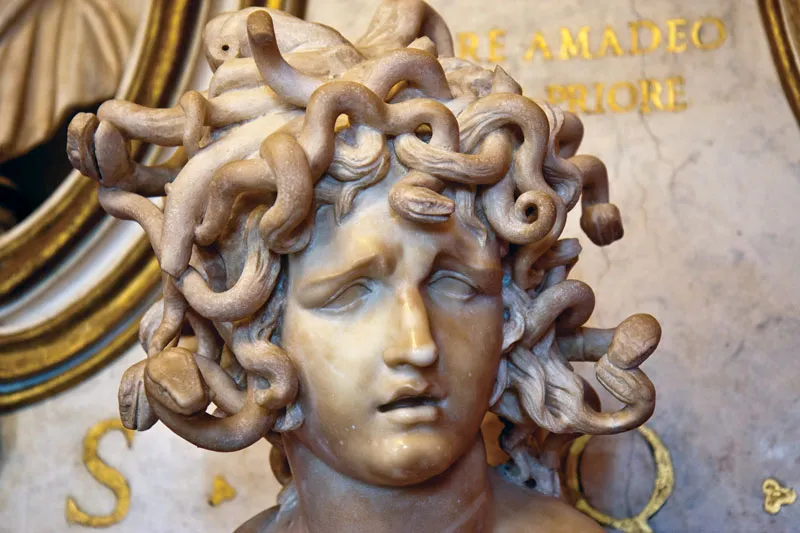
Which brings us to Medusa herself, one of the most tragic female figures in Greek mythology.
In Ovid’s telling, Medusa is raped by Neptune in Minerva’s temple. Minerva punishes Medusa by turning her hair into snakes. Later, Perseus beheads her and carries her head as a weapon. Her suffering becomes part of a story about a man’s heroism.
Cixous looks at someone society calls frightening and monstrous, and finds her laughing. Instead of taking pity on Medusa, she challenges the story that made her something to fear in the first place.
Medusa has had a long afterlife as an image used against powerful women. As Mary Beard has discussed, female politicians have repeatedly been depicted as the Gorgon, including Hillary Clinton during the 2016 US election.
But women have also taken the story back. Natalie Haynes’s Stone Blind, which tells the myth from Medusa’s side, belongs to a much wider wave of feminist retellings. These books return to stories we think we know and ask whose experiences were pushed to the edges. That is closely connected to Cixous’s argument. When women tell the story, the monster might become a person. The faithful wife might have ambitions of her own. The woman whose suffering helped a hero grow might finally get more to do than suffer.
Could you imagine how different Barbie might have been without Greta Gerwig’s perspective as its director and co-writer? Who gets to tell a story shapes what it can say.
Really, Medusa laughed so Barbie could run.


Why it still matters
The struggle over who gets to represent women hasn’t gone away. It runs through the books we read, the films we watch and the images of women that circulate online.
Gisèle Pelicot’s decision to tell her own story in A Hymn to Life offers a particularly powerful example. After years in which men had abused her and recorded what they did, she chose to make her experiences public and write her own account. Her insistence that shame must change sides echoes Cixous’s concern with the shame women are made to carry.
At the same time, technology has created more ways for women’s bodies to be represented without their consent. The use of AI to generate sexualised images of real women gives a disturbing new relevance to Cixous’s argument about women being denied control over their own bodies and identities.
Writing cannot resolve all of that on its own. But having the ability to describe your own experience, challenge someone else’s account and be recognised as a person with something to say matters.
This is a short but powerful essay, and it can be vague, experimental and flowery. It lacks some of the conventions you might expect from an academic argument. Cixous repeats herself, plays with language and moves between ideas with an energy that can be exhilarating and occasionally difficult to follow.
But that is part of what makes it worth reading. She is asking what women’s writing could become if it stopped having to meet expectations built around men’s lives. It makes sense that her own writing should try to push those boundaries.
You don’t have to agree with everything she says about women or femininity to feel encouraged by it. There is something moving about a writer addressing you with such confidence that you have words worth putting on the page.
The world has stripped away so much, but we are left with our voices and a pen, and it’s time to take up arms.
So what’s the point?
The point is to write like a girl, and to laugh your head off about it.
Medusa’s Laugh by Hélène Cixous, translated by Eric Prenowitz, is available in paperback from Penguin Modern Classics for £9.99 from 12 November 2026.