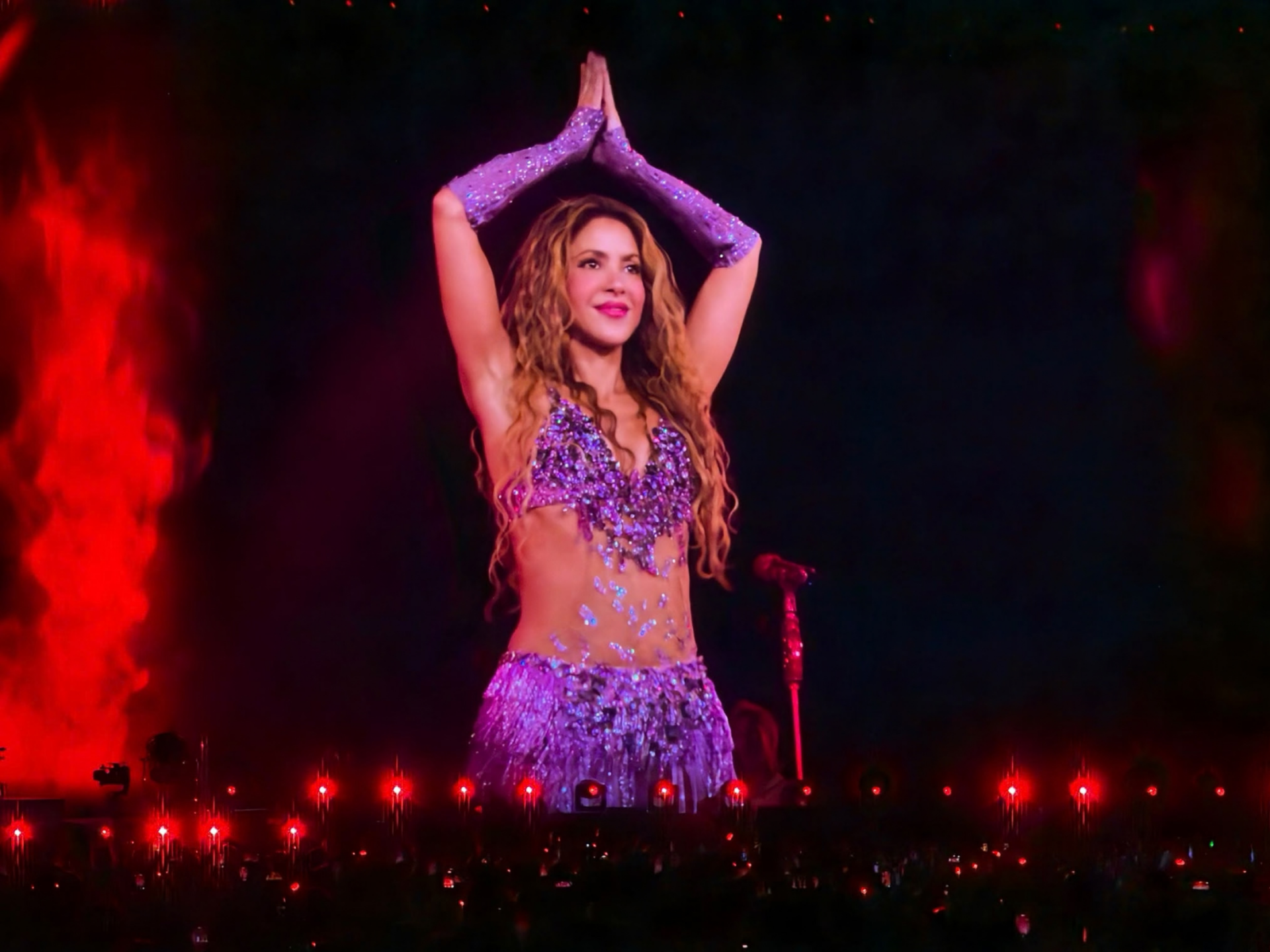
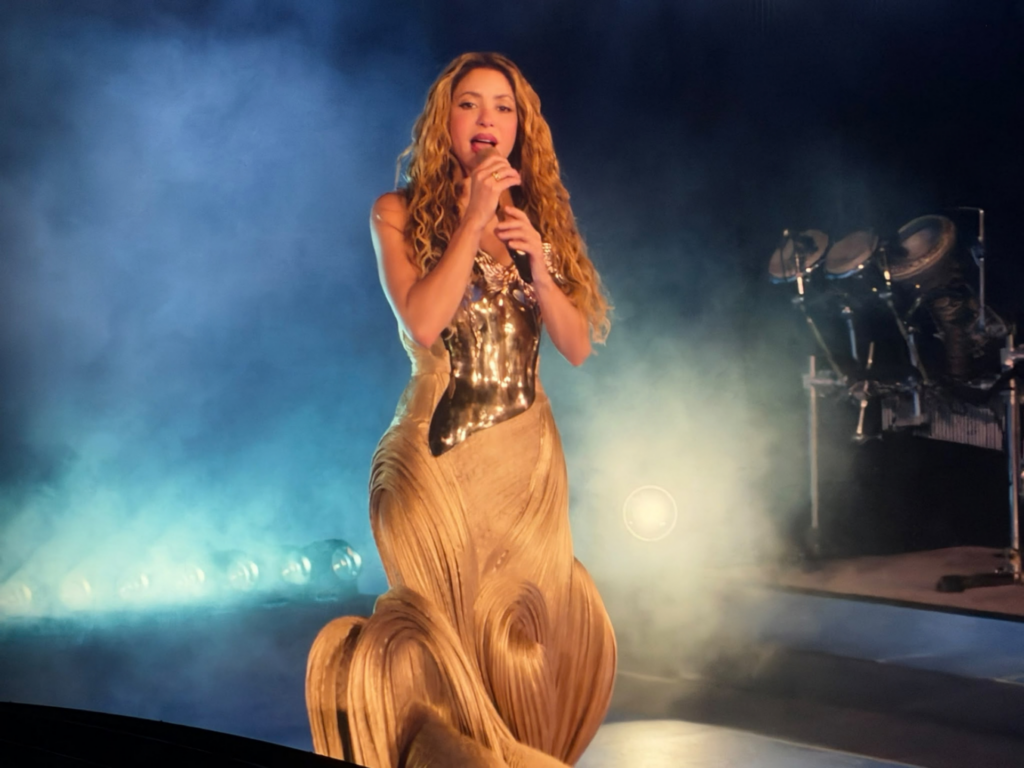
Shakira is currently hosting a residency in Madrid for her Las Mujeres Ya No Lloran Tour at a custom built festival ground and stadium called Estadio Shakira. I attended the concert, experiencing what can only be described as a once in a lifetime celebration of Latin culture.
It is not uncommon in the changing landscape of concert tours for musicians to sell out the mega stadiums of the world; it is an entirely different matter to have the power to build them. That is exactly what Shakira has done. When her heavily anticipated European leg of the Las Mujeres Ya No Lloran Tour was announced, it was revealed that she was hosting a twelve night residency in Madrid. The venue in question, Estadio Shakira, has been host to a cultural festival branded Es Latina to celebrate the culture that Shakira has been a global ambassador for across 30 years of her career.
The tour is her first in over six years, beginning in Latin America with legs in the US and Canada and subsequent shows across the Latin world. Included in this run are a legendary 13 sold out dates at Mexico City’s GNP Seguros, more dates in one stadium than any other artist in history. Her run in Mexico, which saw her travel across the country, concluded with a free show in Zócalo square in Mexico City, attended by 400,000 people. She also took the concert to Copacabana Beach in Rio De Janeiro for a free show attended by over two million people. Throughout the run of the tour, she has continued to tweak the setlist to local contexts.

The vibes in Madrid
In the days leading up to my date, the city of Madrid seemed to radiate excitement. Amidst the city wide festivities, however was a smattering of politics. As I made my way to Estadio Shakira, I observed a large protest working its way through the city. Amongst the protestors were many calling to improve the conditions for people working in the Spanish public education system. This comes on the back of protests the week before to improve tenancy rights in Madrid, following the eviction of an 87 year old woman from her apartment after a rapid rent increase of 275%. The protestors were happy to speak with me, one of whom, a teacher called Lara, shared her thoughts on the protests. Of the protests, she said:
Several protests have come together due to overlapping issues, such as the housing issues protested last week and the problems in the Spanish education system. The result of the protests in an ideal world would be that the President would stop being President and someone else would be there and that the teachers of the Community of Madrid would be in charge, at least the same as the rest of the autonomous communities. That people and students who have special educational needs would be better attended and that the teachers would dedicate ourselves to teaching, which is our thing, not to administrative issues.

She continued to explain when asked about the wider context of the protests: “People are angry across Spain because basic issues are not being solved. The problem is that if they are not resolved as soon as possible, what comes after is the far-right. They will probably come out just as they are coming out in the rest of Europe, because everything will get worse and our quality of life and social rights will get worse. In other words, we have to mobilise, and we have to get those above to make the right decisions.” She then excitedly discussed the Shakira residency with me and wished me a great time at the show.
After a few days in Madrid that feels evocative of the spirit of the city. As the beating heart of Spain, it was refreshing to see a city so publicly in support of Palestine and the LGBTQ+ community – it was difficult to wander more than a few paces before seeing a flag or placard for either cause. While this is not untypical of any metropolitan city, Madrileños everywhere spoke to me with confidence about the left-leaning values of their home city.
A note on logistics and safety
If you’re intending to visit Estadio Shakira, I’d heavily encourage you to save yourself the stress of hunting down a taxi home and take the metro from Villaverde Alto to Sol in the centre of Madrid. This was what I did after waiting for a taxi for over 40 minutes. I had concerns as a solo attendee about the safety of taking the metro alone at night, given it is a 20-30 minute walk from the venue, but this route was far easier and felt far safer than waiting for a taxi that simply wasn’t coming. There were some security guards at various points on the walk to the station, and footfall is heavy after the show, so you are very unlikely to be travelling there alone. The main drawback of having a custom built venue is that getting there and back if staying in central Madrid was a little taxing. I heavily encourage you to get to the venue a few hours early (doors open typically between 1pm and 3pm subject to date) to explore the entire set up and to give plenty of time before the show.

Estadio Shakira also had plenty of accessible entrances and dedicated guides for those with various accessibility needs. There were also free water refills by the toilets at the far left and far right of the festival grounds. For those who are sensitive to the heat in Spain, handheld non-electric fans are permitted, and there are spaces to escape the direct sun.
Exploring Macondo Park
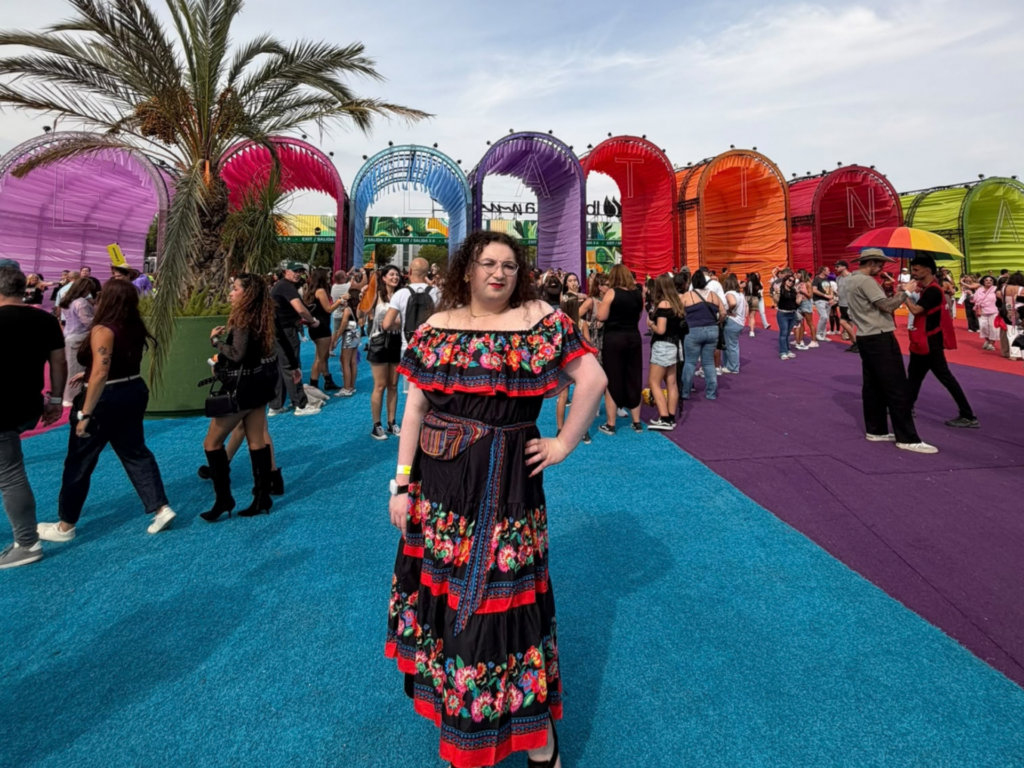
Following my interactions with the protestors, I continued south towards Estadio Shakira. After an admittedly massive headache navigating the complex public transport network of Madrid and sifting my way through a maze of road work diversions, I was in an Uber and on my way to the show. When you arrive at Estadio Shakira, you’re immediately greeted by a huge series of multicoloured archways welcoming you with the festival name, Es Latina. The excitement was palpable as I passed under one and into the main festival grounds, named Macondo Park in honour of the central fictional town of Colombian author Gabriel García Márquez’s novel, One Hundred Years of Solitude. Shakira and Márquez maintained a close friendship for over a decade before his death, united as examples of Colombia’s rich cultural tapestry internationally.
The festival grounds contain eight distinct zones, many explicitly to highlight specific aspects of Latin culture, including gastronomy (el Mercado), literature (biblioteca), and Shakira’s cultural impact (Museo de Shakira). Across the entire custom built venue, there were sporadic appearances of carnival performers, adding to the sense of magical realism that originates with Márquez and emanates across Shakira’s career. I personally found the three zones I highlighted earlier to be the most exciting. Biblioteca hosts literature panels with female authors from the Spanish-speaking world, while the rest of the zone features work from over 20 Latina writers and other women in the field. While I was there, I sat in on a panel with Elísabet Benavent discussing her recent novel, Una Niña Buena.

I feel this is emblematic of the spirit of what Shakira has tried to accomplish with Es Latina. In her own words, she wanted to expand beyond her own concert and create a cultural experience that builds a bridge between Latin America and Iberia, and on to the wider world. For a British person especially, we have such little immediate exposure to the cultures of the Ibero-Latin world. While I personally have a deeper understanding of Latin culture through my choice to learn Spanish and explore beyond Shakira’s music, there will be many fans who attended the residency who will have learned so much more about the pride and traditions that have shaped Shakira’s artistry. Notably the gastronomy area gave myself and other attendees the opportunity to try cuisines not common in our home countries, I noticed stalls representing countries like Mexico, Colombia, Peru, and Brazil amongst many others.
Entonces, what does Es Latina mean?
Before the concert, I spoke to a number of fans about what brought them to the residency. There were fans from all over the world; many were themselves Latin immigrants in Europe who have waited with bated breath for Shakira to finally bring the Las Mujeres Ya No Lloran Tour to their adopted home. One of them was Marisol, a Peruvian woman living in Germany. She was wearing the purple wig and office attire synonymous with Shakira’s video for Las De La Intuición; the outfit has become a popular choice for fans attending her concerts. Marisol discussed the impact Shakira has had on her life, stating:
Shakira feels like a lifeline to me sometimes. Living in Germany, there are very few other Latin people and the social climate there is getting quite scary. Being able to be here in Europe at a place where this powerful Latina is showing everyone the beauty of our community and the value we bring means so much.
A short while later I spoke to a Spanish family attending the concert; in their number were three generations of women united by their love of Shakira. As I spoke to them, the mother of the group told me how “Shakira is something that unites us. My daughter loves her now as I did as a child, and my mother loves her too. Between my daughter and my mother there are nearly 60 years, but Shakira is a constant.” The sentiment rings true; at the concert it was common to see people of every age, of every ethnicity and of every social group. To be frank, that’s one of my favourite things about being a Shakira fan. Through my love of her music, I’ve been able to make friends across the globe, from California to Morocco to India to Brazil.
As I spoke to another fan, Dolores, who was travelling from Colombia, she reaffirmed what was so important about Es Latina. She said:
This whole thing is on another level. Shakira has proven to the world that Colombia is a country full of talented people with dreams and aspirations. We may not all be able to conquer the globe like her, but she inspires us to work harder, and to cherish our beautiful culture.
That sums it up really; Shakira is a symbol of the integrity of Latin America, and specifically of Colombia. It is not lost on me that this incredible celebration of Latinidad was happening in the very heart of Spain, the country that colonised almost all of Latin America. Shakira herself has had a complicated relationship with Spain (more on this later), but to set her sights on its capital with an assertion of her heritage in such a dynamic and profoundly impactful fashion is simply awe inspiring. Perhaps most emblematic of this is her performance of Girl Like Me, the second song in the concert’s setlist. During the performance, she takes a moment to shout out Latinas country by country, notably including a nod to Spanish women during the Madrid dates.

I can’t help but feel like there is an undercurrent of personal healing for Shakira in this residency. She has been able to reaffirm the fierce connection she has with her fans here in Europe, witnessing firsthand our dedication to take flights, for many of us navigating a country whose language we don’t speak, all to be a part of this ineffable moment in her career. She said as much on stage, expressing gratitude and love for her European fans, thanking us for making the trip to Madrid to see her perform.
Okay, so what’s the significance of this happening in Spain?
As I stated earlier, Spain is probably the most divisive country in regard to Shakira’s personal life. She lived there for ten years, moving to Barcelona to be with her then partner, Gerard Piqué. After a very public breakdown of that relationship due to his infidelity came the new challenge of a now dismissed tax evasion case with La Hacienda, Spain’s tax body. It is a country that has been monumental in her career, serving as her gateway into European stardom and has continued to be a devoted fan base for her. In general, the people of Spain have been loyal to her amidst the turbulent years she spent there.
Her choice to pick Madrid for her residency is indeed pointed, deciding to not take it to Barcelona as a possible final jab at her ex-partner who used to play for the city’s football team. It is also pointed because Madrid was the centre of Spain’s colonial project in her homeland. After a public smear campaign led by their tax authorities, it is abundantly clear that the spirit of exploitation of Latin American wealth is alive and well within aspects of the state infrastructure. While Shakira herself has shown only grace and generosity to Spain and the Spanish public, it is hard to not sense the postcolonialist undertones of a Colombian woman symbolically occupying the Spanish capital and doing so with a bombastic celebration of Latin culture.
This is further expanded by the fact that during Es Latina, Shakira has invited several Latin and Iberian artists to perform across the festival’s different zones. While I was there, I saw sets from You Wanted A Hit!, a DJ duo made up of two Colombian women, and Yerai Cortés, a Spanish flamenco artist. For Shakira, Es Latina is about building a bridge between her homeland and the colonial power that shaped it. Other notable acts who have either performed or are set to in later dates include Maro and Nathy Peluso.
A global show, a global artist
While the concert and the wider festival around it are clearly a stellar representation of Latin America, Shakira’s artistry stretches far and wide beyond her home region. There are moments such as the performances of Ojos Así and Suerte (Whenever Wherever) that pay homage to her Lebanese roots. For both songs, Shakira performs a traditional belly dance, scored with the beat of doumbek drums while she belts out Arabic minor scales. Particularly in a seemingly never ending climate of hostility towards all things Middle Eastern across the Western world, this form of soft diplomacy carries some real weight.
At other moments, such as the segment dedicated to Dai Dai and Waka Waka, we are focusing on the umbilical cord that stretches across the Atlantic linking Africa and South America through a shared history, one that contains the pain of the transatlantic slave trade and the flourishing cultural exchange that Africans brought to countries like Colombia and Brazil. This aspect of the concert is opened with a voice over of African languages. The intention in Shakira’s choice to embrace African sounds has always been to highlight the fact that in Colombia the imprint of Africa on the culture is inescapable. This is perhaps best represented as she performs the champeta, an Afro-Colombian dance that she first debuted at the Super Bowl Halftime in 2020. Elsewhere in the show, there are moments that give us Afrobeats and Reggae, further strengthening the display of Africa and its diaspora as a musical and cultural force.
The concert is also a bit of a whirlwind of Latin music. One second you’re in the midst of an infectious salsa rhythm that gives way to merengue, or vallenato, reggaeton, or cumbia. With 12 albums and 35 years of music under her belt, Shakira has been able to showcase the sheer diversity and complexity of Latin music, packaging it through a pop filter to deliver it to people in places far removed from the origins of these sounds. Across her career, Shakira has been able to explore sounds from across her region and the wider world with care and sensitivity. Within Shakira’s long discography, you can hear every continent, each corner of the globe, given its own space to shine through her idiosyncratic lens.
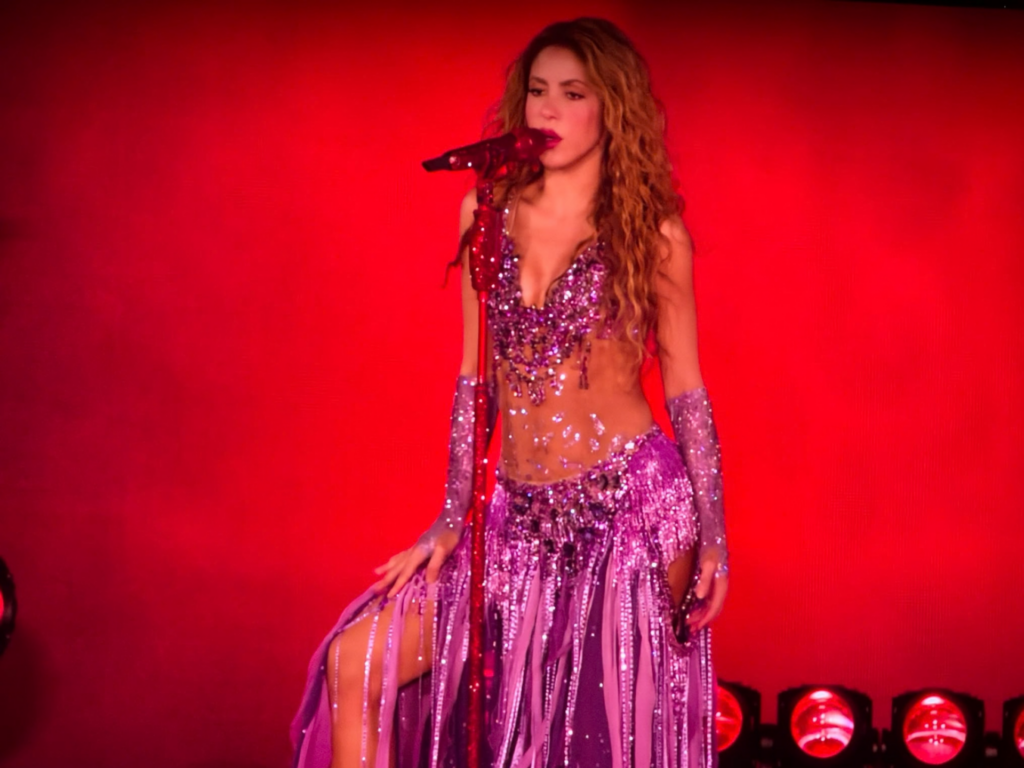
Las Mujeres Ya No Lloran and the feminism of Shakira
The concert tour takes its name from Shakira’s most recent album, which in turn is derived from a line in her global hit – Shakira: BZRP Music Sessions, Vol 53. It means women no longer cry, and it was a statement about refusing to give more tears to a man who betrayed her trust and the sanctity of their relationship. Since the song was released in January of 2023, this lyric has served as a central thesis of Shakira’s outlook on womanhood. She has been more candid about her experiences as a woman, particularly a Latina, in the music industry and how she has felt pressure to conduct herself post-divorce in specific ways. It must be said, however, that this message is well and truly reinforced by the time she closes the concert with the rebellious anthem.

From the opening act, we see Shakira celebrate her identity as a Latina with Girl Like Me and encourage women to use their intuition with Las De La Intuición. Later in the show, she, with a cheeky change in lyrics for those in the know, delivers strength and self assurance as she sings Don’t Bother. There are several moments in the show like this, other songs that come to mind are TQG, Soltera, and Chantaje. While the feminism is not inherently overt as to name the patriarchy, the thematics of this show, down to its very name, are drenched in a specific Shakira brand of feminism.
The most telling moment to espouse this idea for me was her performance of the 1996 single, Pies Descalzos, Sueños Blancos. The song comments on many things, taking a jab at the idea of Eve committing the original sin before reflecting on the expectation for Colombian women to be married before 30. Shakira wrote the song when she was 18, but the sentiment carries true decades later. It is cognisant of the violence inherent in gender roles and the way Abrahamic patriarchy has wielded the myth of Eve’s fall from grace as a justification for marginalising the rights and freedoms of women for centuries.
The show concludes with the aforementioned Session 53, preceded by Loba. The closing act opens with Shakira’s 10 She Wolf commandments. Amongst these are to never compromise on being yourself and to view other women as allies, never competition. Loba, better known in the UK by its English version, She Wolf, is a song that sees Shakira embrace the inner untamed aspect of womanhood. It marked a point in her career when she felt more free to explore her own sense of desire and control, harnessing the “she wolf” inside to reclaim a sense of autonomy.
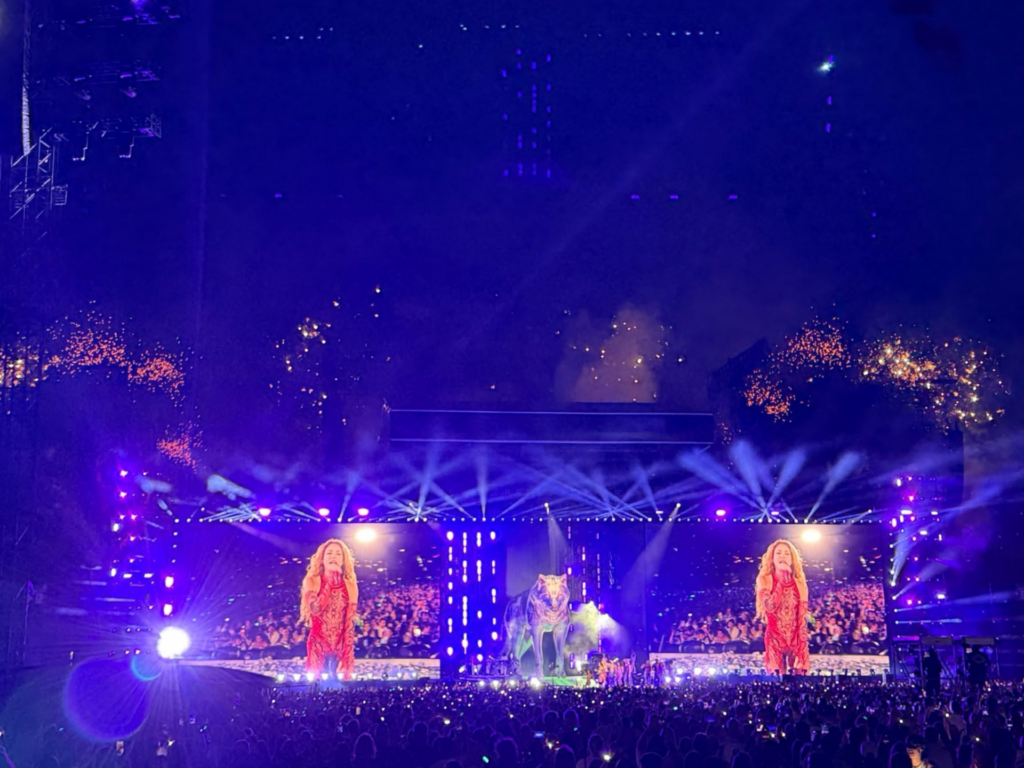
This takes us to Session 53, which is a triumph of Shakira’s unshakable ability to be honest as a songwriter. The song is a powerful and direct cutting down of her ex, taking shots at him, his mother, his mistress, and La Hacienda to boot. When the song was initially released, it spurred a movement across Latin America and the wider world, encouraging women to embrace their rage and their pain, not shying away from the messy feelings that come with betrayal but instead harnessing them into motivation to take up space on your own terms.
The feminist current of this final act is one of radical feminine agency. Almost evocative of nolite te bastardes carborundum (don’t let the bastards grind you down), as quoted in Margaret Atwood’s The Handmaid’s Tale, the refusal to bear her pain with silence, Shakira has transformed a song borne of pain into one of the most meaningful and exciting concert closers in history. By the time the show closes with an entire stadium howling like she wolves under a perfect full moon and declaring that indeed, women no longer cry, it is hard to not feel deeply empowered.
Shakira, La Loba
I’ve been a Shakira fan for 20 years or so. From being a child, she has always been the artist I’ve gravitated towards the most. It is with gratitude that she has shaped me to be a person who is globally minded and interested in learning about cultures different to my own. With this tour, she feels more herself than ever before. After an extended period of time where a relationship compromised her career and her ability to pursue her professional goals, she has been able to construct an experience that feels appropriate to an artist of her caché.

While she has always been an exceptional performer, having seen this first hand at the El Dorado World Tour in 2018 – the Las Mujeres Ya No Lloran Tour feels like a different animal, perhaps it is a she wolf. The concert is an expression of joy and independence; it is an assertion of Latina identity at a time when the world needs to see the dignity and the beauty of Latin culture more than ever before. Across the world, the social positioning of immigrants is being challenged by the awakened monster that is fascism. We see that clearly and alarmingly across the United States, all over Europe, and in our own backyard in the UK. Shakira has spoken openly before about how it feels to be a Latina immigrant in the US since moving there two years ago; she is aware of the climate. She is also aware that the more powerful message she can share is one of happiness and strength. That is what she does with this concert.
With the Las Mujeres Ya No Lloran Tour, she gives you three hours (or rather a whole day as far as this residency is concerned) to put aside the anxieties of being different. Under her command, you are able to give in to the euphoria of watching a generational talent take a symbolic victory lap across the stage in a country that has given her so much and taken in equal measure. More than ever, we need people like Shakira to remind us that the world is a far greater place when we embrace it in its entirety – from the deserts of La Tayrona to the peaks of the Andes to the heart of Spain. Truly, of course, women no longer cry when we have her infectious example of joy and celebration to guide us.