


Content warning: This article contains detailed discussion of rape, drug-facilitated sexual abuse, child sexual abuse, and image-based sexual abuse.
CNN’s investigation into the Telegram channel Zzz uncovered a working curriculum for drugging and raping women. Here is what the online rape academy story actually is, what the viral version got wrong, and why getting it right matters.
CNN recently published an exclusive exposé on a Telegram channel titled Zzz, which they accessed through a pornographic hosting site called motherless.com. The channel, which has now been taken down, consisted of almost a thousand male members sharing tips on how to drug and rape the women in their lives, as well as sharing videos and images.
Shortly after CNN broke the story, an X post discussing the article, stating 62 million men had attended an online rape academy, gained over two million likes, and rightly so. That figure is bone-chilling. The figure is also not true, and I’ll get to the specifics of that further down, because the way this is being talked about online matters more than the correction itself.
I want to be very clear that I am in no way intending to minimise this story. Actually, I would like to do the opposite, because what is there, and what is true, is bone-chilling, if not more so. Though our online community is rightfully enraged and rightfully screaming about this issue, we have to have these conversations with accuracy, because every inaccurate claim weakens the credibility of the women who are doing the work to take this seriously. I would like to discuss this story through the lens of our own research, and explain why it’s so important that we focus on the reality of this issue rather than using incorrect facts as clickbait and activist rage content.
First, I want to walk you through what CNN actually found, because the real story has been partially obscured by the viral version, and the real story is worse in ways the viral version cannot capture.
CNN’s reporters spent months inside the ecosystem of ‘sleep content’. One journalist, Saskya Vandoorne, posed as a male user on Motherless to gain access to Zzz, and what she and her colleagues documented there was akin to a working curriculum. Members swapped specific drug names and dosages, warned each other about overdose risks, advised on how to increase the dose if the first attempt failed, and compared notes on how to avoid detection.
The channel also functioned as a marketplace. One member, operating from the Spanish territory of Ceuta on the North African coast, ran a mail-order business selling ‘tasteless and odourless’ sleeping liquid, shipping internationally for 150 euros a bottle with the pitch that buyers’ wives would not feel anything and would not remember anything. Other members advertised paid livestreams of the rape of their unconscious partners at around twenty dollars a viewer, paid in cryptocurrency to obscure the transactions.
So, what is motherless.com, and why should it be treated differently?
Motherless.com is the site that linked out to the Telegram channel Zzz. It describes itself as a ‘moral free file host where anything legal is hosted forever’. Motherless is hosted in the United States and operates under Section 230 of the Communications Decency Act, a 1996 law that largely shields platforms from civil liability for content their users upload. What this means in practice is that Motherless can host tens of thousands of videos that sit in a legal grey area, and face almost no consequence for doing so, as long as it removes material when flagged by law enforcement.
On the surface, Motherless looks and acts like any other pornographic website. So one of my first questions was, why visit Motherless over another more mainstream porn site like PornHub? This, unfortunately for me, required a personal investigation into the site.
It didn’t take long for me to discover the answer to my question. The first thing I noticed was the tags. Motherless hosts more than a hundred categories that are no different to any other porn site. However, the content on the site exposes itself in its tag system. Alongside the ordinary fare were tags like ‘against her will’, ‘wife raped’, ‘wife forced’, and ‘unaware’. The most trending video on the site involved a woman crying.
What struck me next was the forum architecture. Motherless has a section called ‘shouts’ that functions as a public message board. The first thing I saw when I opened it was a user advertising child sexual abuse material, claiming to have buyers available for children aged six to eighteen.

The groups section held channels organised around specific forms of racialised and gendered abuse. A group called ‘someone’s daughter’, with 10,100 members, eroticised the fact that the young women posted were somebody’s child. A group called ‘somnophiliacs’, dedicated entirely to sharing images of ‘sleeping or passed out girls’, had 10,300 members. A group called ‘anti-feminism’, with 8,300 members, described itself as being about ‘the art of female degradation’. Inside it, users had posted threads on why violence against women was necessary, and at what age a woman should experience her first rape. The answers did not suggest a lower limit.
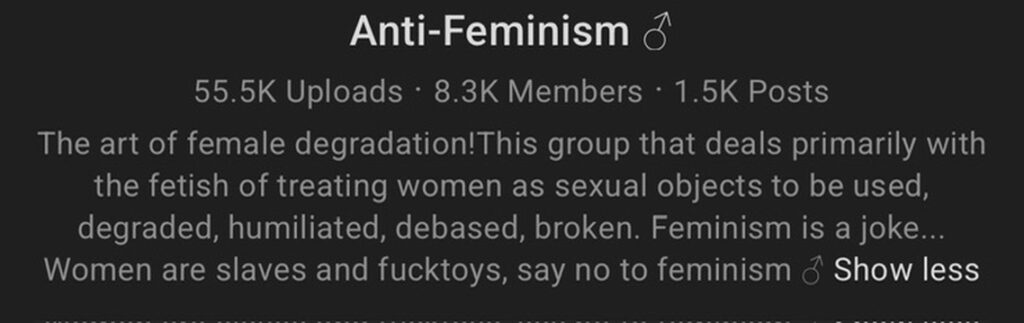
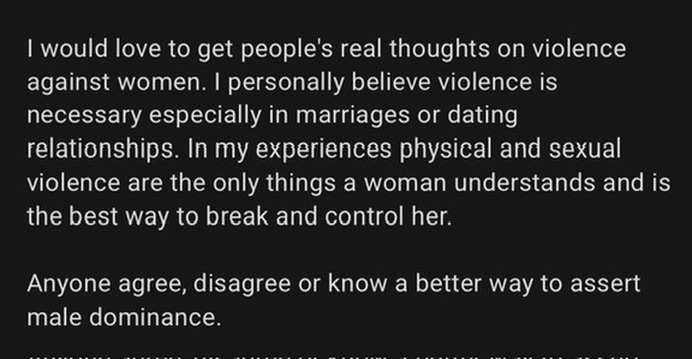
The more graphic ‘eyecheck’ content, in which men film themselves lifting the closed eyelids of unconscious women to prove to viewers that the woman really is asleep, is something CNN located inside the Zzz Telegram channel specifically. The distinction matters because Motherless and Telegram are doing different jobs in this ecosystem.
This is the answer to my original question. The reason men are on Motherless rather than on one of the mainstream tube sites is not because the content there is categorically different in kind. The mainstream sites have plenty of content that should not exist on them either, as campaigners have documented for years. The reason men are on Motherless is because of the architecture. Motherless provides the discovery layer: the tags, the groups, the forums, the ‘shouts’ board, and the ability to find other men who want what you want and to signal to them that you are one of them. Once you have found each other, you move. You post a Telegram link in the comments, or drop a group invite in the ‘shouts’. The real operational conversation, the drug dosages, the evasion tactics, the commercial transactions in sleeping liquid and livestreams, happens one click away in an encrypted channel. So, in other words, sites like Motherless act as a shop window. Telegram is like the back room.
This two-layer design is exactly what makes the ecosystem so resilient. When Coco, the site used by Dominique Pelicot to facilitate the rape of his ex-wife Gisèle Pelicot, was taken down, the users did not disappear; they migrated to Telegram channels like Zzz. Now that Zzz has been taken down, they will have migrated again. Motherless itself, meanwhile, continues to operate untouched on its content, because the legal architecture is protecting it.
Let’s talk about Telegram, its many crimes, and how it gets away with them.
If Motherless is the shop window, Telegram is where the transactions happen, and Telegram has built its entire identity around the claim that it does not and will not look inside its own back rooms.
Telegram is headquartered in Dubai and markets itself on privacy, minimal moderation, and encrypted group chats. Its founder and CEO, Pavel Durov, was charged in France in August 2024 for failing to prevent a range of illicit activity on the platform, including the distribution of child sexual abuse material and the facilitation of organised crime. Zzz is just one of many groups like it. A 2024 investigation by AI Forensics, titled ‘Harassment as Infrastructure’, documented sixteen Telegram groups and channels across Spain and Italy with roughly 24,000 combined users, trading non-consensual images of wives, ex-partners, acquaintances and public figures, many of them taken with hidden cameras or while the women slept.
When CNN’s reporters entered Zzz, it was taken down during the course of the investigation. Telegram, asked to comment, said content that ‘encourages sexual violence is explicitly forbidden’ and is ‘removed whenever discovered’. The ‘discovered and removed’ framing puts the burden of discovery on journalists, researchers and survivors. It allows Telegram to arrive after the fact, take down the group, and leave the users to migrate to a new one by the weekend. The platform cannot sell end-to-end privacy as its core product while also credibly claiming to know what is happening inside the group chats that privacy protects, and so it does not try.
How have we got here? Patriarchy, psychology and a visceral disgust.
I am not going to try to explain, psychologically, the inner life of a man who films and rapes his sleeping wife to sell the footage to strangers for twenty dollars. I do not think it is our job, as women, to keep performing that particular intellectual labour.
What I am willing to do is name the system that makes this possible, because refusing to name it is how we got here in the first place. I want to hand over, briefly, to someone whose work I greatly admire, the critical theorist Louisa Toxvaerd Munch. In one of her recent videos, she spoke about the banality of misogyny. Her argument, drawing on Hannah Arendt, is that misogyny has become so normalised inside the fabric of patriarchal capitalism that it is barely legible as harm any more. As she puts it, ‘evil becomes so normalised in society… because you become so enmeshed within a system that you can never see outside of it. It becomes very difficult to name, very difficult to challenge and very difficult to call out because you were inside of it.’
It is the joke at the pub about the ball and chain. It is the toys we give children, predator for the boy, prey for the girl. It is the unpaid domestic labour, the underpaid care work, and the construction of male identity around being the breadwinner, the protector, the subject for whom the woman is the object. Toxvaerd Munch’s prescription is the one I keep coming back to, because it is both the smallest possible action and the most serious: ‘The only way we make this kind of behaviour unacceptable is if we call this out, is if we expose the system for what it is.’ Refuse the banality. Call out the joke at the pub. Make misogyny unthinkable the way casual racism has, in most rooms, become unthinkable. It sounds almost too small against a twenty thousand strong video library of unconscious women, and yet everything I can find in the research says this is where it starts. The men in Zzz were once boys being handed predator toys. The pub joke is the base of the pyramid.
Where the experts think we’re going wrong
Professor Clare McGlynn KC (Hon), based at Durham Law School, has spent over a decade working to modernise UK criminal law on sexual violence. She coined, with her colleague Erika Rackley, the term ‘image-based sexual abuse’, was central to the 2015 campaign that made possession of rape pornography illegal in England and Wales, and has worked on the Online Safety Act, the criminalisation of cyberflashing, and the ongoing fight to criminalise sexually explicit deepfakes.
Speaking to CNN for the Zzz investigation, McGlynn said, ‘UK law is generally well equipped to cover the range of criminal offences committed by men who drug and rape their partners’. The problem, she said, is that the global online ecosystem ‘persists because of a reluctance from governments to go after what she sees as the heart of the problem: the online platforms themselves’. The legal tools to prosecute individual perpetrators exist, and the political will to hold the infrastructure accountable does not.
Ofcom’s response to Motherless is the clearest illustration of this. Motherless’s parent company is Kick Online Entertainment S.A., registered in Costa Rica. Ofcom investigated the company in 2024 for failing to complete a ‘suitable and sufficient illegal content risk assessment’, closed the investigation once the paperwork was submitted, opened a second investigation into age verification, and in February 2026, fined it. When CNN asked Ofcom about the content on the site, the regulator said its job was ‘not to tell platforms which specific content to take down’ and that ‘responsibility is on platforms to decide whether content is illegal’. In practice, the UK regulator with the power to fine platforms up to 10% of their global turnover has used that power to penalise Motherless’s parent company for not checking the age of the people watching 20,000 videos of unconscious women, while leaving the videos themselves alone. That is the specific shape of the gap McGlynn is pointing at, and it is a gap the EVAW and #NotYourPorn Image-Based Abuse Law campaign has concrete proposals to close.
Why the correct numbers are important
I said at the start that the 62 million figure is not accurate, and I want to come back to it now.
The 62 million number is Semrush’s estimate of visits, not users, to Motherless.com as a whole in February. The Zzz Telegram channel at the centre of CNN’s investigation had nearly a thousand members. Does this matter? Let me take the correction on its own terms. If the 62 million figure is visits rather than individuals, the next question is how many fewer individuals we are actually talking about. If a single person visited Motherless once an hour, every hour, for every day of February, that is 672 visits. Divide 62 million by 672 and you get roughly 92,000 people. That is the absolute upper limit of how small the correction can make this. Ninety-two thousand men returning around the clock to a site that functions as the discovery layer for channels like Zzz, and that is the most generous possible reading. In reality, almost nobody visits a site that often, so the real figure most likely sits well above that. With this framing, you can certainly see why the exact number doesn’t feel as important and instead is being leveraged by men to minimise the story.
However, the two numbers do describe entirely different things. That does not mean Motherless’s 62 million visits is not an issue; it is very much a big issue. You only need to read our earlier findings on the site to feel sick to your stomach about the mass of men consuming this content.
I want to be very clear about what I am and am not saying here. This correction does not make the problem smaller. If anything, it makes it scarier. If those 62 million are visits rather than individuals, it describes a smaller, more concentrated group of men returning to this content thousands of times over. It describes addiction, radicalisation, and an echo chamber of violence that these men are living inside every day. This correction, in my eyes, does not mean the point is being missed and (at least on my part) is not a campaign to minimise the horror of this form of rape; it just means the problem is deeper than the online conversation is allowing for. I think it is important to address this.

What the misinformed statistic also does is hand men who do not want to engage with the real story something to point at. The viral X post was shared in good faith by people who were, correctly, horrified. I understand the impulse. When you are furious, and the number seems to justify the fury, you share with little extra thought because ultimately, the size of the number doesn’t negate the severity of the action. Except, now men who do not want to engage with the real story have a fact-check to point to. One inflated number gives cover for ignoring all the verified ones. The 20,000 videos, the thousand men in Zzz, the livestream economy, the sedatives shipped from Ceuta, the Ofcom fine that was about age verification rather than content, the Pelicot verdict, the Polish arrest of Piotr, Zoe Watts in Devon whose husband of sixteen years crushed their son’s sleeping pills into her tea. All of it becomes, in the reply guy’s telling, ‘the thing the feminists got wrong’. The correction becomes the story, and the story becomes nothing.
This matters for how we talk about VAWG in ways I think our community underestimates. When we inflate, we make the problem feel too big to act on and too diffuse to name. 62 million men is a despair number. A thousand men in a specific Telegram group, using specific drugs, linked out from a specific US-hosted site, trading content on an app whose CEO has been charged in France, is a number you can do something about. You can demand Ofcom use its powers. You can demand the Image-Based Abuse Law that McGlynn, EVAW and #NotYourPorn have been drafting since 2024. You can demand the Bertin Review recommendations be implemented. Precision is a precondition for action.
The phrase ‘online rape academy’ itself, incidentally, was not CNN’s invention. It came from Sandrine Josso, a French centrist MP who was drugged with MDMA by a sitting senator, Joël Guerriau, in November 2023. Josso has since co-authored a French parliamentary report on drug-facilitated sexual abuse with Caroline Darian, Gisèle Pelicot’s daughter, who believes she too was drugged and assaulted by her father. It was Josso who described the Telegram-and-porn-site ecosystem as ‘schools of violence’, as ‘an online rape academy, where every subject is taught’. The phrase belongs to a woman who was drugged by a lawmaker and who has spent the last two years organising with other women who have been. That is the provenance of the language, and that is who we are amplifying when we use it accurately.
Where are all the male allies?
I have just written several thousand words on a story about men, mostly for women to read, and as I do so I am aware that the men who could be doing this work, who could be writing to other men about this, who could be breaking the culture of silence inside the rooms I cannot enter, are largely absent. Scroll through the comments on the CNN piece, the secondary coverage and social media. The men who turn up are often there to explain that the number was wrong, or that ‘not all men’, or to ask whether we have considered that false allegations exist.
These men have wives, partners, brothers, colleagues, fathers, friends. Somebody knows. Somebody has seen the browser history, or the late-night laptop angled away, or the bottle that arrived in the post from Ceuta. Somebody could say something. A thousand-member Telegram group for drug-facilitated rape can only run if the men around those men stay quiet. The silence does active work in the system.
What are we actually shouting for?
Their silence is its own form of complicity, and it is all the more reason for us to be loud. Loud and wrong, though, is worse than quiet, because loud and wrong is what the backlash feeds on. Every inflated figure, every careless framing thrown into a post gets screenshotted and used to discredit us. We give them the weapon, and they use it on us.
The main takeaway of this piece is that we are living through a digital sexual abuse crisis and it feels, reading the comment sections and the group chats and the research, like women are fighting it largely on our own. Shout, yes. But what are we shouting for?

There are, as I see it, three places the work sits right now. The first is the patriarchal normalisation of sexual abuse and its pipeline into the lives of young boys. If misogyny is banal by the time a boy is fourteen, he is halfway to Zzz before he has consciously chosen anything. The work is in schools, in the home, in the culture, in every adult refusing to laugh at the joke. The second is the legal architecture of user-led adult sites like Motherless. Section 230 is an American law, but the Online Safety Act is ours, and Ofcom has powers it has not yet been willing to use. The Image-Based Abuse Law campaign from EVAW, #NotYourPorn and McGlynn has concrete proposals, including an online abuse commission with the power to hold platforms accountable. The Bertin Review has recommendations. These are specific asks that can be made of specific politicians. The third is Telegram, which sits behind every one of these stories, and which has built a business on not looking. We need to be paying close attention to that.
The women in the videos, the women like Zoe Watts and Amanda Stanhope who have stepped forward after Gisèle Pelicot made it possible to, the women we do not yet know about it because they are still asleep in their own houses, deserve better than our fury wasted on the wrong figures. They deserve our fury aimed correctly, weaponised with accuracy. They deserve a movement that gets the story right, because getting it right is how we win.











This is horrifying.
I keep thinking how the hell do we mobilise women to do something since men clearly won’t.
My god, this is horrifying. Some men really REALLY hate women.
My god, this is horrifying. Some men really REALLY hate women.
The actual reality of this network is horrific enough without the need for inflation. Misrepresenting the data gives those who want to minimize the issue an easy way to attack the credibility of the entire story. Let’s focus our energy on the real, documented evidence that investigators have worked so hard to uncover. viist us master of informatics