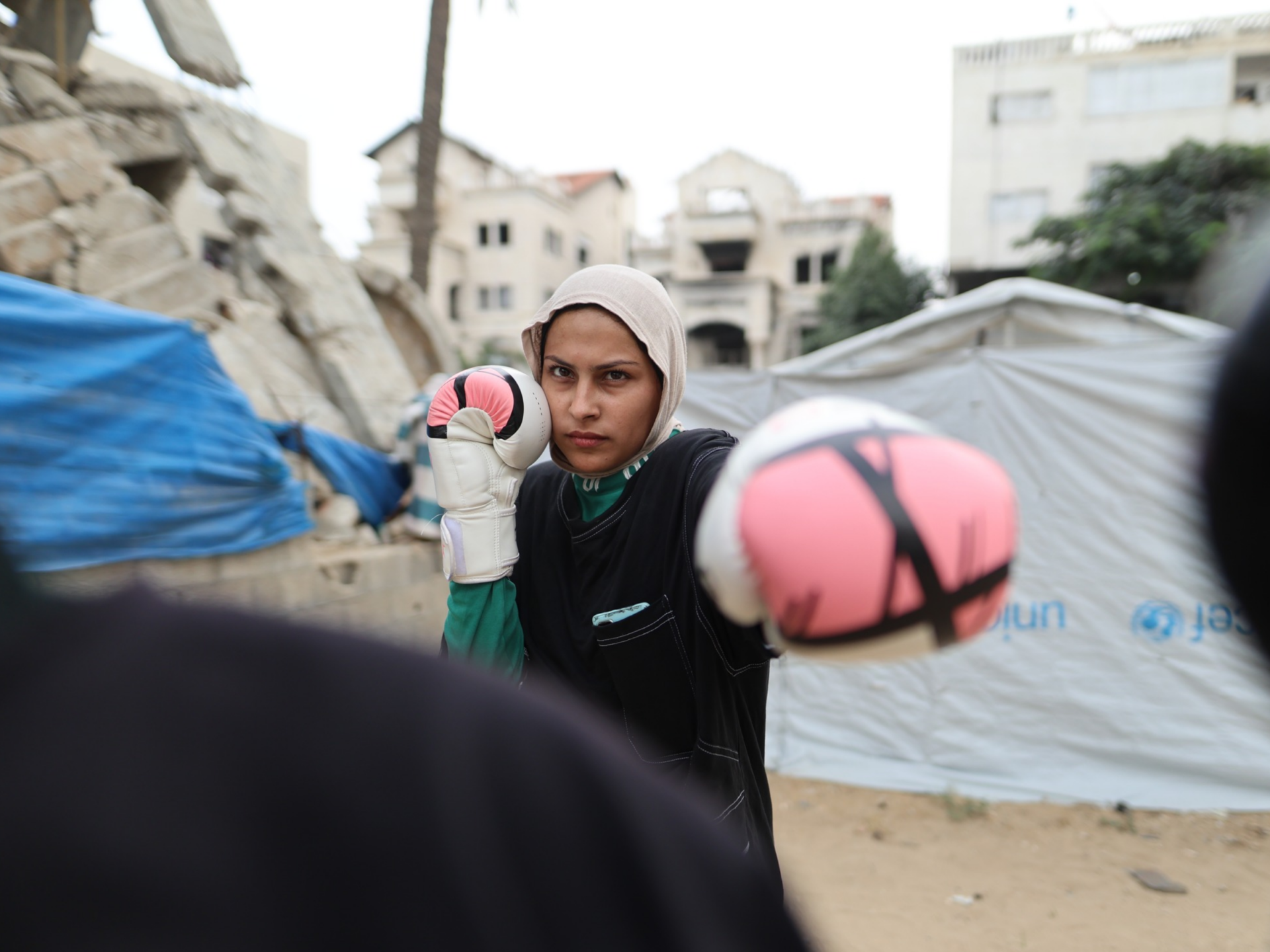
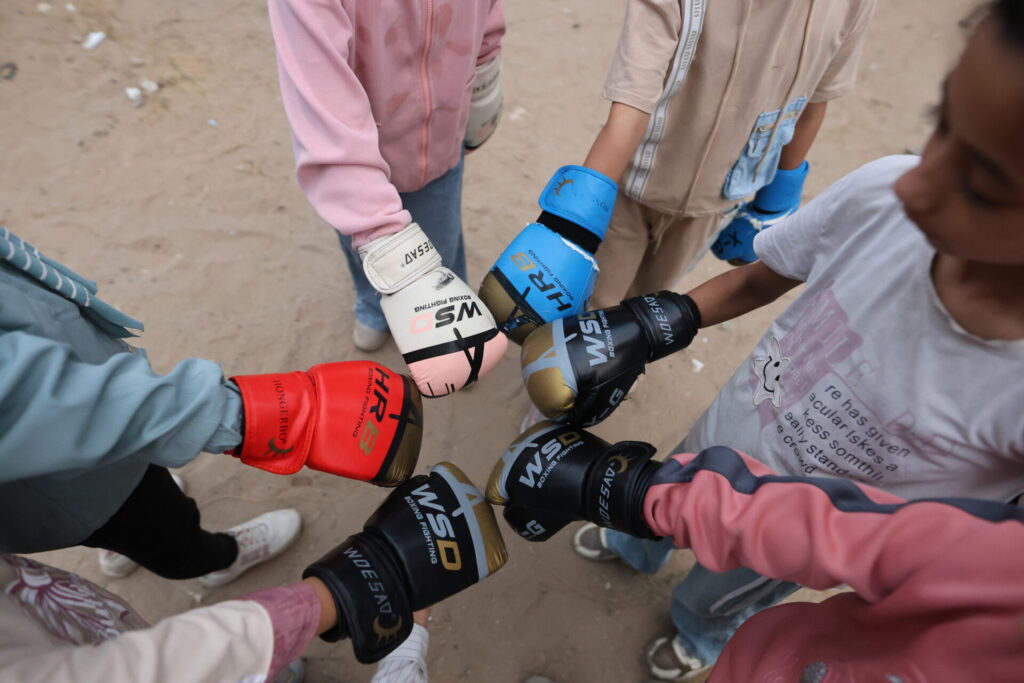
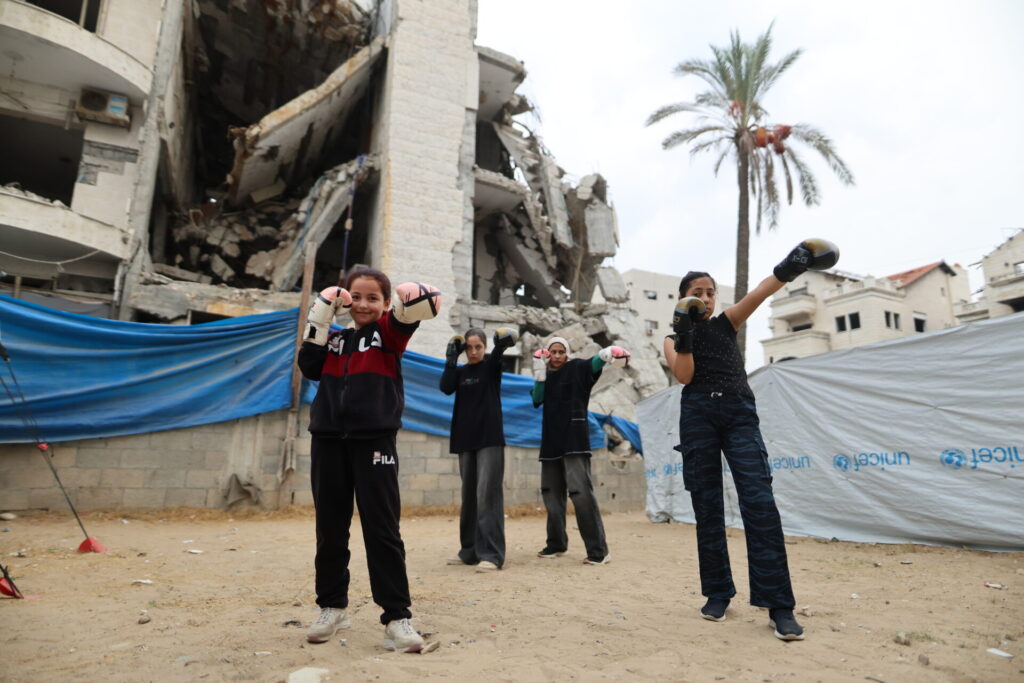
Amongst the rubble, a group of women in Gaza continue to practice boxing as a form of resistance and resilience.
Rima Abu Rahma was 21 years old when she decided to learn how to box. She would have no idea how this personal challenge would transform into a movement that encouraged women across Gaza to become stronger.
Since this moment in 2021, the resilience and strength of Gaza Boxing Women has captured the attention of people around the globe. After the devastation of October 7th and Hamas’ attacks on Israel, conflict rapidly escalated in the region. Israel’s ethnic cleansing campaign in Gaza has tragically resulted in the death of more than 74,000 people, with casualty numbers continuing to grow each day. Yet last year, over 70 women across tents in the north and south of the region continued to regularly overcome unimaginable hardships to box together.
Today, as the genocide continues, the members of Gaza Boxing Women are still fighting.
Getting started
The beginnings of Rima’s relationship with the sport were unlikely, and wholly unglamorous. Driven by a desire to develop her self-defence skills, boxing stood out to her as something appealing, but completely unknown. She says, “I’d never thought of boxing as a sport for women, and the image of a woman with gloves never crossed my head, and then when I found out that we can do that, it felt exciting.”
She describes the initial struggles of finding a club that would offer boxing for women. When there were none willing to take her on, she instead found a private coach and the basic equipment to start punching.

However, at this point, both Rima and her coach did not foresee the growth that their small boxing community would undergo. Rima says that at this point, “I just wanted to box. I wasn’t looking for anything else- it wasn’t a business idea or plan.” Eventually, they found a basement that they could practice in, and Gaza Women Boxing was born. At first, Rima’s parents “were a bit worried about me boxing with this man we didn’t know in a basement”, so she was made to bring her sister and a friend for safety.
After she started posting photos of their training sessions on Instagram, local women and girls started to contact her, asking to join. “Slowly the number became bigger and bigger to the point where we had to stop and to say, ‘Okay, this is becoming serious, we need a name, we need to create a club. We’re becoming something, and the number is much more than one boxing session can handle. We need to organise ourselves better’. The whole of the project started from that point.”
Growing the club
From that moment onwards, the club grew quickly, welcoming girls as young as seven and as old as thirty-eight. All age groups were encouraged to mix socially, and were accepted no matter their reasoning for joining. Rima reflects that “I think if you ask any of the women and the girls of the club, each one of them would have her own story and reasons for why she’s doing that [boxing], especially now. Some of the girls come to have fun, some comfort, physical, or to get fed. I wish you could write this story for each one of them.
“Some, especially the younger ages, see it more seriously as a sport in which they want to become professionals. And I am working with the other women who help me to manage the club to make all of these options possible. Like whatever is the reason, we are still going to be a family, we are still going to have fun, but you are still going to get the best professional training that we can provide in the Gaza Strip.”
Before she found enjoyment from the act of boxing, Rima herself held a personal motivation for becoming more active. She describes being followed in the street by an unknown man, and realising “this was the moment that it clicked for me: I need to be stronger.”
But, as is a similar experience for many young women in Gaza, she had not had many opportunities growing up to participate in sport. “My family, and I believe a lot of other families in Gaza, they did not see sport for kids as a necessity. They cared more about us getting certificates, education, learning languages – the kind of skills that is needed for survival in this world and to get you out at some point to get a better education and to be able to bring money home. But, sport, it was something that is seen as a distraction. So, at 21 when I looked around, I felt like, ‘okay, I’m really weak. I don’t know how to do any kind of sport’.”
Going against social norms in Gaza
Rima recognises that she is “lucky to come from a modern family that gave me my liberties as a woman”, as they supported her through the exploration of this new passion. However, she saw that for many of the women around her, freedom was more conditional:
“When I started, I noticed that for a lot of women who wanted to join us at first, it was a problem for the family. At some point I had to talk to some parents, I asked my dad to talk to fathers of other women and girls to convince them at some point. I talked to the husband of one of the girls and I convinced him that boxing is a good sport for his wife.”
Her situation was “not the normal thing for the other women of the club, and it took a lot of convincing, a lot of science behind the sport, a lot of explaining that psychological effect of boxing on the women and how it’s good for them if they’re able to punch to defend themselves, for them not to be meek. And slowly, we started doing that.”
However, alongside this success quickly came the beginnings of a backlash on social media. Rima describes how “some social media outlets in Gaza took photos of us and posted it in a controversial way in attempts to create debate. And this is where a lot of people, whether they were from Gaza or from outside of Gaza, they started attacking us, saying that we don’t present the image of a good Gazan woman, that we are not worthy of marriage material, or that they should cut our heads, burn us, and burn the club.” She stresses that this not all of Gazan society, rather a proportion “with mentalities that are more closed-minded and extremist.”
Instead of accepting defeat, the group instead slowly worked to normalise the image on gloves in the Gaza Strip. For Rima, she “likes to believe that all the violence and extremism in the Gazan society was a result of the oppression that we were facing as a society and the continuous wars, the siege, the occupation, the violence that we were born into and grew up seeing and living in everyday life. If all of this changes, this [extremist thought] wouldn’t exist anymore.”
The women’s approach to changing society’s perception of them has always been rooted in attempting to work with people rather than against them. “When we opened our last club, we invited our community leaders, people from different backgrounds, women leaders of feminist associations.
“For example, in more traditional places in Gaza, the governance is taken from what we call a Mukhtar. And so, we invited the Mukhtar, and we explained to them the sport, we showed them the club, we showed them the women boxing, and we showed them our side of the story. And when those people accepted us, the others who looked up to them accepted us too.”
The club after the genocide began
Before October 7th, Gaza Women Boxing was flourishing. Rima describes the hope that they all felt at the time, as “our goals changed from making it accessible and possible, to thinking ‘okay, now we want strong Gazan women boxers to participate in the international tournaments, to go to training camps- we want our women to be fearless fighters. This was the conversation on the table, and it was like a dream.”
“This all turned to ashes when the genocide started.” After the October 7th attacks, the club turned from its dreams towards survival: making sure that all the girls were alive, and that everyone had shelter and food.
Stuck outside of Gaza, unable to return home, Rima recalls how difficult it was to communicate with the rest of the club: “I used to get a message every two weeks, or whenever they got access to connection. It was hard at the beginning. It was a lot of unknown, and we didn’t think much about the club. We thought about it as our family.”
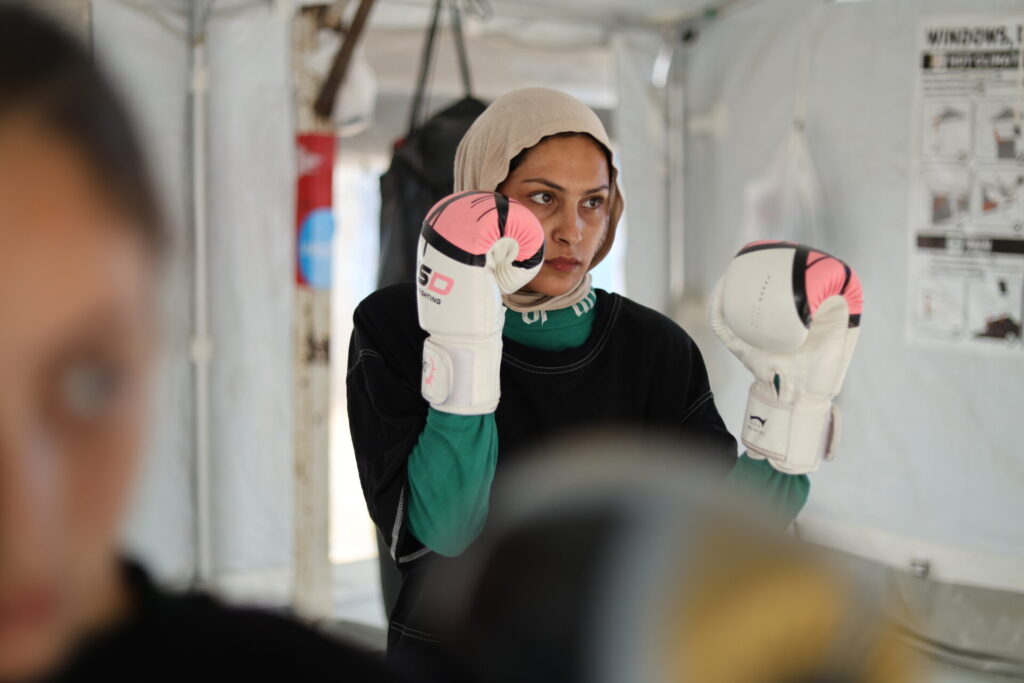
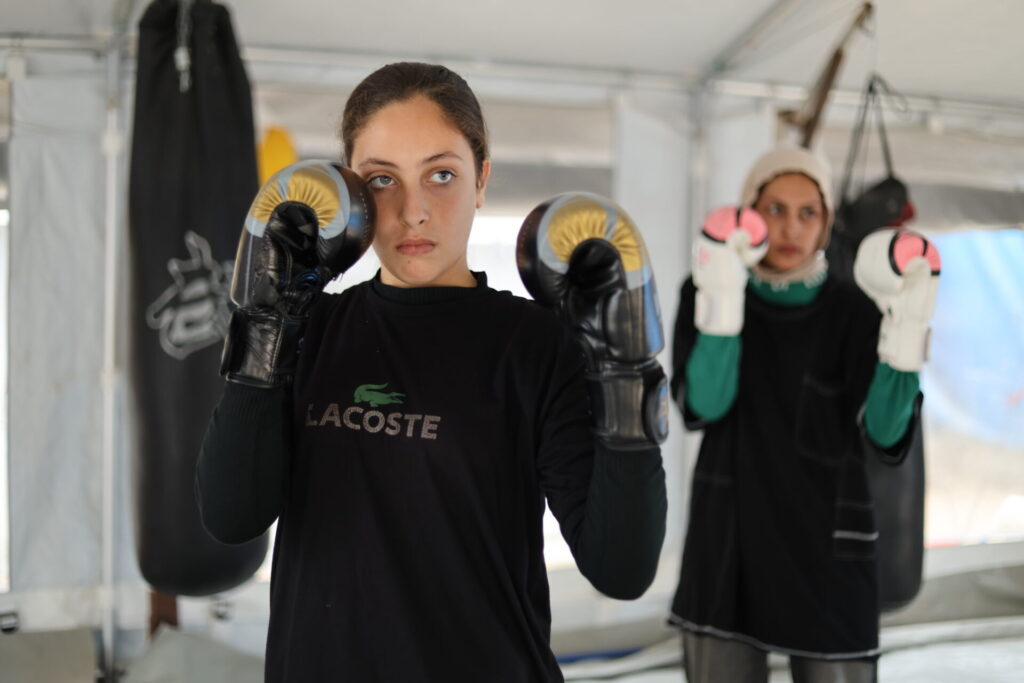
In 2024, the girls decided that they wanted to start boxing again. However, Rima describes the hesitation that she felt about that decision. “The problem was that it was famine. It was genocide. They were living in tents; there was no access to toilets, food, or clean water. The idea of people being in groups was dangerous.” Despite her concerns, the girls started boxing again, this time from between tents. Pillows were used as punch pads, and chairs became the markers of a makeshift ring. “They didn’t have proper sports clothes; they didn’t have anything that an athlete or a sports person has or needs. They didn’t have the bare minimum of a normal life, let alone a normal athletic life.”

The club’s priorities thus turned from a place of sporting ambition to a place “where girls and women could have an hour of feeling normal, of moving and seeing the other girls- going back to the normal human life that they had before all the inhumane circumstances that were imposed on them.”
This was particularly important due to the gendered burden that falls on women during moments of political crisis. These pressures did not spare the club’s members, as they had to exchange boxing practice to fetch water and food to cook for their families. In these circumstances, “sport went back to being a luxury, not a necessity.”
To combat this, the club attempted to ease the burden of the mothers amongst their community through setting up an additional tent where their children were safely watched over whilst the women boxed. Equally, for the younger members of the club, when formal education was suspended indefinitely, the club became their primary source of organised socialisation, granting the girls “a space where they own their bodies” in safety.
“We saw that it’s not only food, shelter, and water that the human needs to feel alive.”
Boxing as a form of resilience
Furthermore, as the women suffered multiple losses from within the club, Rima recognised that “the existence of boxing in this context was essential for the girls’ resilience. We saw that it’s not only food, shelter, and water that the human needs to feel alive.”
Alongside becoming a place of social and mental wellbeing, the club at times also doubled as a place of physical sustenance: feeding the girls when famine hit Gaza. Rima speaks of “during the famine, the coaches noticed that one of the girls was not punching correctly and asked her, ‘You punch much better than that; what’s wrong?’ She replied that she hadn’t had a proper meal in three days.

“We had already lost a lot of people during the genocide to bombing and to killing, and we didn’t want to lose more to hunger. In 2026, people dying from hunger is prolific. So, we tried to speak out and collect donations.” Buying rice and pasta was hard to come by, and cost far more than normal. However, the women worked hard to coordinate and find enough resources to provide every club member and family members with at least one meal a day, or food parcels.
Just last month, the UN announced that funding shortages had forced the World Food Programme to reduce food assistance in Gaza by roughly one third. Rations are set to be cut in half, endangering much of the population. Already, only one in five children consume a sufficiently diverse diet, and over 200,000 people need immediate food assistance in order to prevent them from starvation.
This scarcity of resources, whilst worsening by the day, is not unfamiliar to the women. Even during the beginnings of the club, Rima recollects how “resources were always controlled by the occupation, and there was always sacrifice. This was the situation already before October 7th, and after, it just became worse. From bad to worse.
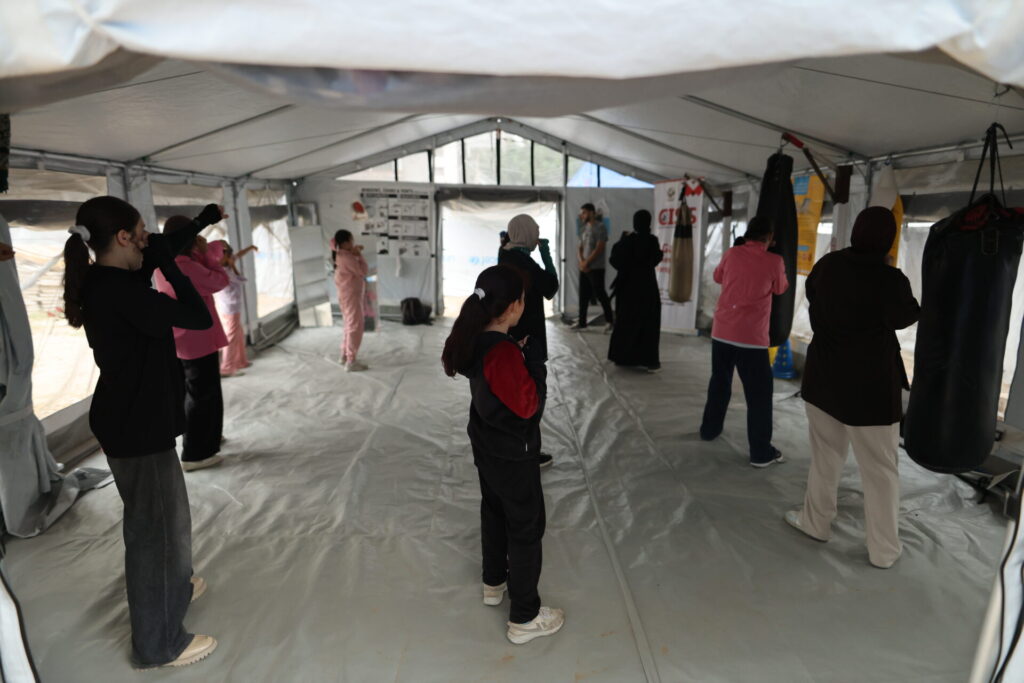
“A lot of people ask me, ‘How can we deliver equipment, boxing gloves, etcetera to the Gaza Strip?’ And I’m like, ‘I would have been there if there was access to Gaza, like, I would have been home’. It is impossible. What we can do is buy what is already there, for extremely high prices- like four or five times the price than in the past.”
The club’s next adversary is the harsh conditions of the approaching winter months, which threaten to make boxing in their tent untenable. But once more, women have worked pragmatically, finding a plot of empty land that was owned by one of the members’ fathers before the genocide started. Rima remarks that whilst it is far from rivalling a normal boxing gym, or even what they had before, she still hopes that it will be a better place for the girls- with a stable floor for practising and constructing tents.
How things stand with the boxing club now
Rima herself is still rebuilding her world in exile from Gaza. “My situation was another side of what happened to Palestinians after October 7th. I got stuck outside of Gaza on my way back home. It wasn’t planned, so I found myself without resources, homeless, and in addition, I had this moral obligation to get back to the girls at the club.” She speaks of having to lead a double life: whereby she had to rebuild her life in the West, applying for residency and paying bills each month, whilst still trying to support the club.
Despite being geographically ostracised, she remains dedicated to the club and its future. She has, alongside fellow refugee club members, spearheaded the management of the club. Between them, they have managed the growth of the club’s social media, fundraised, and worked through budgets and management plans.
Alongside the dedication of their team, Rima recognises the support that they have received from the international boxing community. “It wasn’t just me trying to look and reach out to people; people were looking for us. People were reaching out to us, offering their help; they were manifesting, but they were also offering to act, which was extremely needed.” In particular, the Italian solidarity group Boxe Contro l’Assedio (Boxing Against the Siege) have provided unwavering support to the women. Together, they won the Sphere the World Award at the 2025 WEmbrace Awards, granting them international recognition of their sustained efforts.
For now, simple aspirations of sporting success are halted as priorities instead turn towards the survival of the club and its members. For Rima, her focus is “keeping the club alive and maintaining the accessibility for women and girls to be able to come. Whatever could be between them and being in the gym, we will find a solution- and believe me, every day another problem pops out of nowhere. One day, there is no more transportation; the next, there is sickness everywhere; the third, it’s injuries. And of course, no proper medical care, no clothes, and no equipment.”

She dreams of “accessibility to people with more skills, to more competitions, to people who can develop the skills, the techniques and the professional side of the club.”
Her parting wish is simple: “For the future, I want to rebuild the club; I want this place to exist as a proper boxing club. I want the girls to simply have whatever any other boxer in the world can have.”