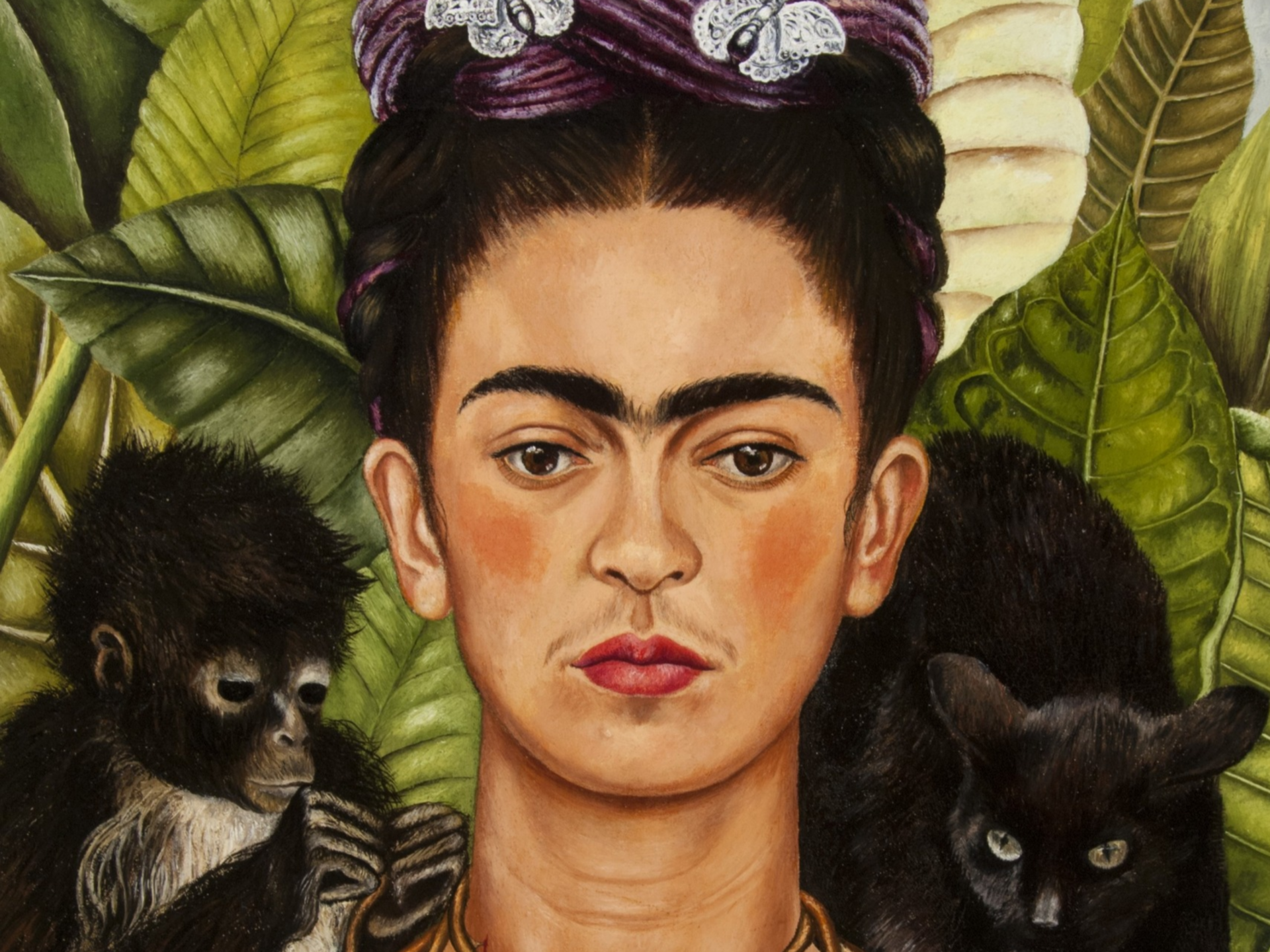
The Tate Modern Gallery in London is housing a limited run exhibition of the art and belongings of Frida Kahlo. The exhibition, named Frida: The Making of an Icon, seeks to explore the artist’s life, works, and lasting legacy.
Anyone who knows me knows that Frida Kahlo is a huge personal inspiration of mine. I have a tattoo in honour of her on my arm; one of my cats is named after her – she is one of my reasons for being a feminist. It was with much excitement and anticipation that I learned that some of her art was to be displayed in a limited run exhibition at the Tate Modern in London. The exhibition, Frida: The Making of an Icon, is set to be on display until the third of January and seeks to locate Kahlo as a lasting force for artistic expression while offering much needed texture to her often misunderstood artistic footprint.
The exhibition is structured with chronology in mind, beginning with pieces that reflect the start of Kahlo’s artistic life. In this first segment, there are pieces that address how Frida processed a nearly fatal tram crash that left her with lifelong ailments and disabilities. It was in her hospital bed that she began to paint plaster casts on her torso and explore what art can offer as a way of navigating deeply felt bodily trauma. It was particularly moving to see one of the casts that she painted on proud display. As someone who has admired her work and her life story for many years, this moment was one that grounds the experience as you continue to navigate a life and legacy often defined by pain.
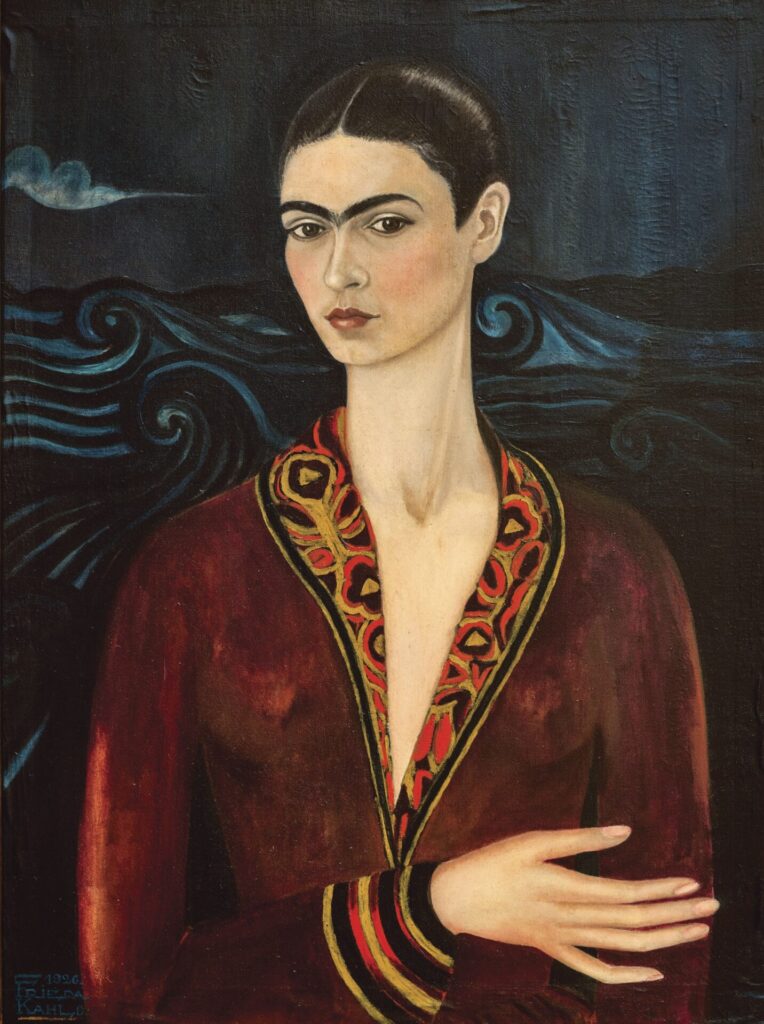
Self-Portrait (With Velvet Dress)
1926. Private Collection
Frida Kahlo in communion with women
One thing that was particularly effective is the way that the exhibition locates Frida in a consistent conversation with other women in the art world. Throughout the exhibition, her works are displayed alongside those of other women, many of whom were her contemporaries. While Frida has become the face of the period she was creating within, she was one of many rising talented Mexican women who reshaped the artistic landscape. Of particular note were the inclusions of works by figures like María Izquierdo and Alice Rahon. In this decision to display a selection of Kahlo’s contemporaries, the exhibition has an interest in defining Frida as one of many rather than one above any – a subtle but essential distinction that casts a much needed light on other artists who deserve our attention and consideration.
This is a through line in the later segments of the exhibition as the focus shifts from Frida’s own life and onto her legacy after her passing. There was considerable attention given to highlighting several artists, mostly women and LGBTQIA+ artists, who have identified with Kahlo’s brand of creative expression and used it as a lens to explore their own identities and beliefs. In a global conversation about women, resistance and art, Kahlo is at the centre. She is a touchstone of what it means to recognise the female form as a site of revolution and the ground zero of oppression. I was particularly moved by the way the exhibition took care to position Frida as a significant figure in the rise of El Movimiento – a social movement for equity and civil rights for people of Mexican and, more widely, Latin heritage in the US in the 1970s. While Frida herself had been dead for 20 years by the time the movement was in its full swing, her position as a symbol of Latina identity and her rejection of Eurocentrism meant that she became a central figure of this point in history.
They widen this understanding to capture how Frida has existed as a foundational figure for women across the world as they explore the power art has to be a tool for expression and liberation. Positioning her alongside an intersectional collection of artists whose work is displayed in the exhibition, such as Laura Aguilar, Nalini Malani, Santa Barraza, and Ana Mendieta. There is attention drawn to how Frida is a consistent reference for a number of artists, with particular attention given to artists of intersectional backgrounds, including other Latinas, the LGBTQ+ community, and other figures from postcolonial backgrounds. The collection facilitates a conversation about how Frida is inherently a guiding light for generations of creatives who connect to her deep embodiment of the idea that the personal is political. It is largely this understanding that first drew me into the mythos of Frida as a teenager.
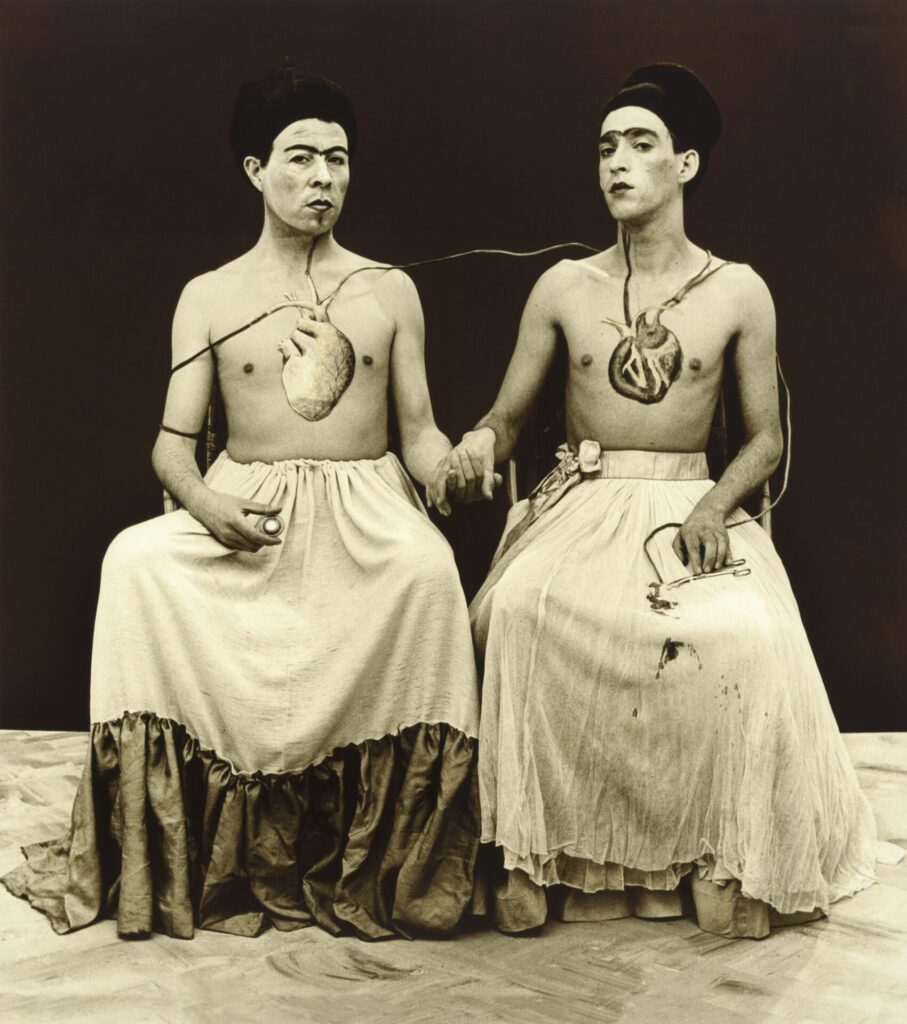
Las dos Fridas, 1989. © Yeguas del apocalipsis. Tate Collection.
Image courtesy Malba Foundation, Museum of Latin American Art of Buenos Aires.
Frida, and the language of rebellion
Behind the immediate impact that the often over-focused on unibrow leaves on people, it is the irrefutable sense of self that emanates from her work that captivated me. Frida was an artist who recognised that the body, particularly for women, is a site of political and personal communication. She utilised her body to communicate her truth. Sometimes that was a truth defined by her consistent ability to challenge gender roles, at other points it was defined by her embrace of indigenous Mexican traditions in stark contrast to the dominating Eurocentric aesthetics and ideals that still weight heavy across Latin America. This is particularly significant given the fact that indigenous women across the Americas still experience marginalisation and serious threat of violence.
Her legacy is one that encapsulates the tension between mid-twentieth-century industrialism in the United States and her desire to not only retain but to celebrate her identity as a Mexican woman. The exhibition takes care to emphasise the importance of Latina identity in Kahlo’s work. Her work is curated with a specific intentionality to embrace the importance of indigeneity to Frida, namely in the care taken to explain the origins and symbolism behind her choice of dress. The exhibition features five of Kahlo’s former outfits and pieces of her jewellery; this allows you to build a tangible connection to the artist. Through the display of some of her personal effects, the exhibition draws attention to Frida the woman, rather than Frida Kahlo the artistic export.
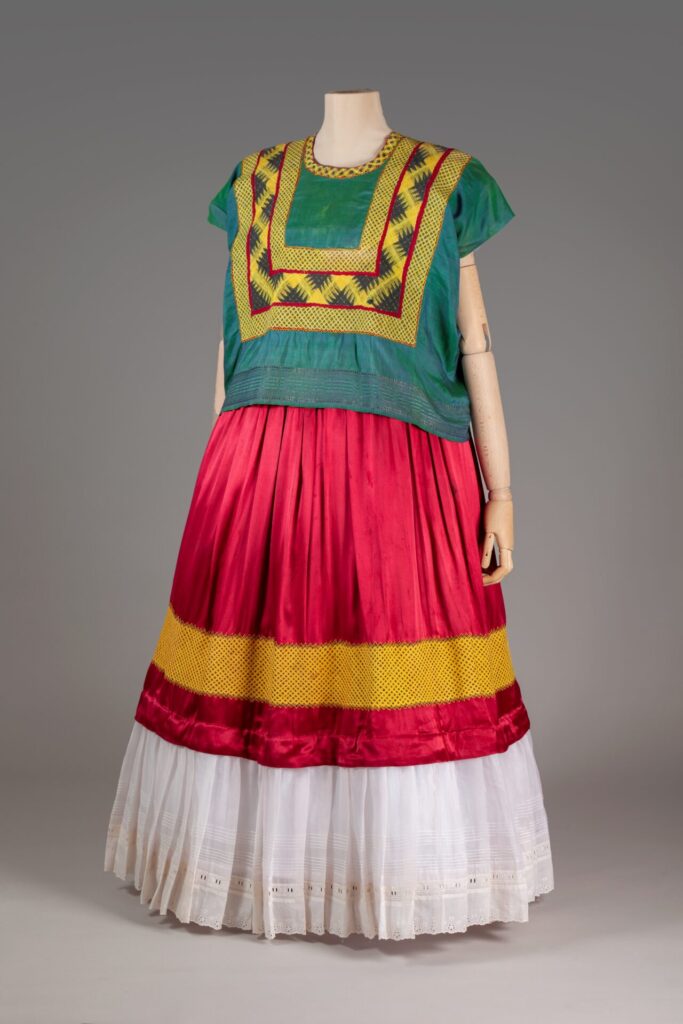
Through the intentionality of highlighting the connection between how Frida crafted her own image and the indigenous cultures of Mexico, the connection is made between the art and items you are looking at and the postcolonialist sentiments so eminent in Kahlo’s artistry. That is perhaps the aspect of her work and legacy that has most inspired me. The defiance of embracing pre-Columbian culture at a time when industrialism and Eurocentric values dominated much of the global south’s aspirations. Frida, who was of mixed indigenous and European heritage, recognised the wealth of self expression that could be located in her own indigenous identity. That is something that underpins her legacy now. For many who view her artwork, they don’t see a statement about colonialism or economics or cultural preservation, but those messages are inherent to her footprint as an artist.
Fridamania, the power of image, and capitalism
The closing segment of the exhibition centres around the idea of “Fridamania”, or essentially a study into how Kahlo’s image has been adopted and reproduced in an extremely consumerist way. It is not hard to see Frida’s likeness slapped on a staggering number of products, and the exhibition takes care to display many of these items. I do feel that there was a missed opportunity to interrogate how Frida herself may have felt about this. She was a staunch communist and was not known to have ever expressed an interest in becoming a reproduced symbol in the way that she has been. I appreciate that there is likely a caution around this as there is apprehension to ruffle feathers of visitors who likely have their own collection of Frida swag, and the Tate have their own ample collection of (albeit quite tasteful) Frida goodies waiting outside the exhibit for you to pursue.
As someone aware of Frida’s politics, I have always grappled with how to navigate the “Fridamania” phenomenon. Funnily enough just a floor below at the Tate Modern you can see Andy Warhol’s Marilyn Dyptic that inspires a similar conversation. Both in Warhol’s work and in the myriad products you can find for sale with Frida’s likeness, we see how public figures, and specifically women, are transformed from individuals in their own context and with their own values, into cultural shorthand for whatever values we project onto them. For the majority of people who may have a Frida Kahlo throw cushion in their living room, her actual context is largely irrelevant. They don’t see the image of her and think about the defiance of a woman who lived a difficult but emotionally vibrant life and used her creative gifts to express those things that words often cannot do justice to. She’s simply the colourful Mexican lady with the fun unibrow. I’m inclined to say that this is harmless to an extent, but much like with the loose cannon that has formed around Marilyn Monroe, in no doubt furthered by her featuring in Warhol’s work, the radical nature of Frida’s art is paved over by capitalist, and arguably neocolonialist, appropriation of her deeply personal art.
I do feel that Frida: The Making of an Icon would have been remiss not to touch on this continued story around Kahlo’s image and how it has been used. I couldn’t lie by saying that I haven’t bought into Kahlo as a visual brand as much as I have into her mythos as a complex and brilliant artist. As good curation does, I left the exhibition mulling over this tension in my own experience with Frida. Admittedly, with her likeness inked into my skin and Frida Kahlo earrings in my ears, I could recognise the fact that I too have bought into Fridamania. Hers is an image that is perhaps too captivating to resist. It is an image that we can project our own meaning onto, replicating it and reforming it as the time between her life and her legacy continues to grow.
Frida: The Making of an Icon
The Tate Modern have curated an exhibition that takes deep care to display Frida as the complex, iconic, and culturally enduring figure that she was and has only further become in the years since she died. Across the ten rooms of the exhibition, you are guided through her life and legacy with unflinching detail. Beginning with the earliest years of her career, you see one of the full body casts she wore to hold her broken torso in place after a devastating accident that rerouted her life. You later come to see how she developed a personal image that was intentionally and assertively Mexican. Eventually, you see how she left her fingerprints on the work of women in the art world who would follow her legacy. Perhaps most important of all is this aspect, showcasing the fact that Frida Kahlo is most significant as a touchstone for later artists, using her example as a roadmap to show that they too, women from Latina and other underrepresented communities, can be it because they have seen it.
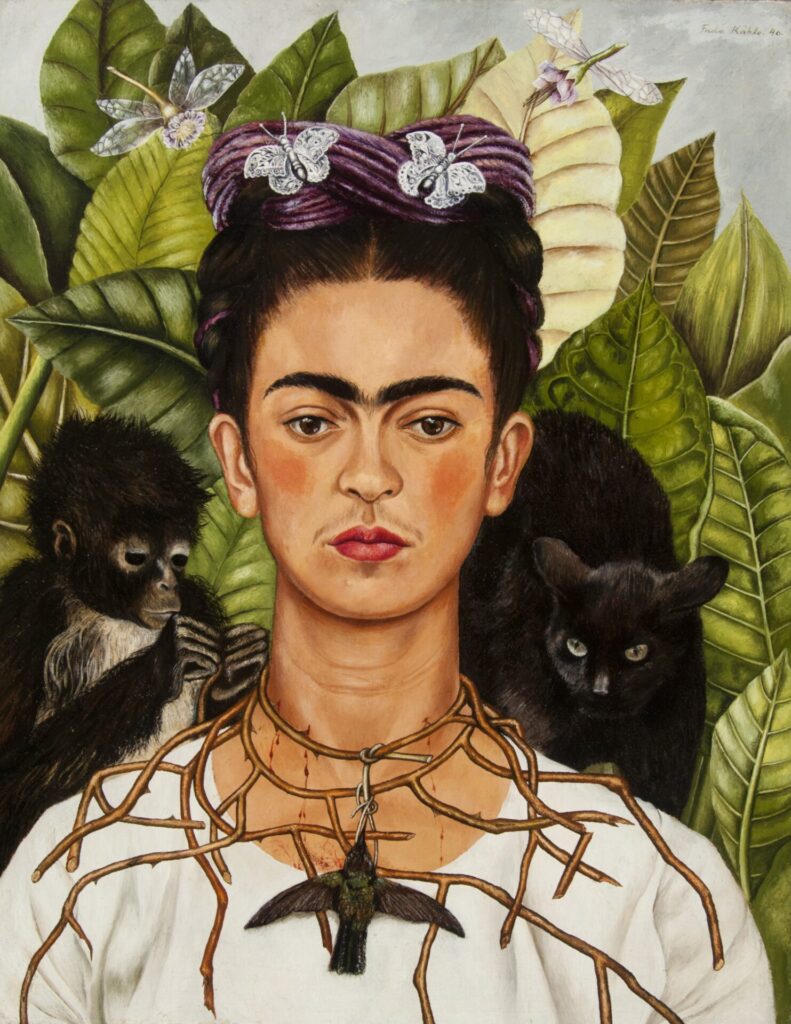
Untitled [Self-portrait with thorn necklace and hummingbird] 1940.
Nickolas Muray Collection of Mexican Art.
At one point in the exhibition, when you see Self Portrait with Thorn Necklace and Hummingbird (1940), I found myself crying. Perhaps it was just because I was inspired by a recent song by Paris Paloma that covers that very experience, but I was so moved by finally being confronted with this iconic piece of art. For someone like me who has not only loved Frida but who has taken much inspiration from her art and her life to shape my own identity as a political and creative being, to finally come face to face with this incredible work of art felt like a spiritual homecoming. A heady concoction of defiance, recognition, and gratitude washed over me as I took in each brushstroke. It is an experience I shall not ever forget.
Frida: The Making of an Icon runs until the third of January 2027 and is an excellent experience for those both deeply acquainted with Frida Kahlo and those who are entirely unfamiliar. Find tickets here.