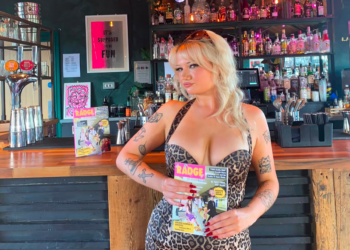
For Halloween this year, Julia Fox made the choice to dress in a costume of Jackie Kennedy’s blood-stained pink Chanel suit, worn during and in the immediate aftermath of John F. Kennedy’s assassination. The look has been criticised by many online, viewing it in poor taste. I found myself viewing it a little differently, which ultimately led me to question: when does a woman’s trauma become public domain?
As the days grow colder and the nights stretch out longer, we don our best spooky attire for Halloween. In recent years, the holiday has become a contest amongst celebrities to outdo one another as they construct elaborate costumes. Some, like Jade and most notably Heidi Klum, have made it an integral part of their brand. This year was no different as Instagram was flooded with a smorgasbord of ghosts, ghouls, and gore. Scrolling through, one costume stood out to me. It was Julia Fox’s ode to tragic Americana in a near carbon copy rendition of Jackie Kennedy’s baby pink Chanel suit, adorned in the spilt blood of her husband, John F. Kennedy. It is an image so ubiquitous that it is recognisable even at the briefest of glances.
Many had raised eyebrows at this choice on Fox’s part, arguing that to reference such a tragic event was in poor taste. My own thoughts were rather different, though. I recalled other references to the same post-assassination image, namely Lana Del Rey’s use of it as a key motif in the video for her song National Anthem. So instantly recognisable is the image of the former First Lady maintaining a stoic composure in the immediate aftermath of the assassination. Accounts of the hours following the fatal shooting note that while Jackie was encouraged to change out of her blood-stained clothes, she insisted on keeping the suit on to visibly show the severity and finality of what had occurred. All of this culminates in a question that I have: at what point does tragedy become part of the pop cultural canon? Particularly through the lens of tragedy that befalls women, where do we draw the line, and does that change with time?
Tragedy is a commodity
In the video for National Anthem, before we even hear the song itself, Del Rey recreates another story from the annals of Americana. She, in her best breathy cadence, sings Happy Birthday, Mr President in the style of Marilyn Monroe. Monroe, dressed in a sheer gown, sang the song for JFK, a mere two months before she died. Del Rey evokes these two women because they have become symbols of womanhood and femininity, as much in opposition to each other as in mirrors of one another. Marilyn and Jackie have long been cast in the public memory as romantic rivals, both stories irrevocably changed by mortality and tragedy. The media have maintained tight roles for the two women, Monroe, the tragic bombshell fated to die young, and Kennedy, the dutiful wife standing solemn and poised even in the front row seat of her husband’s murder. These stories captivate us and engage us. We are so drawn into the glamorous and macabre nature of these narratives, and they shape our ideas of womanhood through a decidedly tragic lens.

Perhaps nobody is more essentialised in this light than Marilyn herself. Despite being a real, fallible person, Monroe in the decades since her death has become increasingly more and more a symbol of both beauty and horror. She is not alone in this, however; other figures such as Amy Winehouse, Janis Joplin, or even Britney Spears become dwarfed as people in the shadow of their hardships. Women in the public eye are so readily turned into cautionary tales, symbols of the cost of fame or icons of melodramatic misfortune. This is abundantly true when we look at the litany of biopics made about people like Winehouse and Monroe. In recent years, amidst a wave of celebrity biopics, both have had their lives put to screen. Both Blonde and Back To Black were highly criticised for zeroing in on a singular story of these women, exploiting them for trauma porn.
Trauma porn refers to the practice, so common in the media, of essentialising a person’s lived experience and condensing it down into only the most shocking details for our entertainment. This isn’t unique to celebrity; the genre of true crime often does the same with murder victims, zooming in on their final moments while skimming over the person they were before. So often, the lives of women are reduced to a parade of tragedies and broken bodies for our entertainment. Ultimately, the persistence of trauma porn in the narratives made about figures like Kennedy, Monroe, and Winehouse only serves to reduce these women and the lives they lived, oversimplifying their legacies. All this while profiting off these stories, both in capital and cultural consciousness. Unsurprisingly, trauma porn has significant racialised overtones, often reducing black women to bodies that endure trauma. This, coupled with the misconception idea that black women have higher pain tolerances and the cultural expectation for black women to be ‘strong’ has a compounding impact on how their stories are told.
Trauma and scandal as entertainment
In the case of Kennedy, she made a conscious choice to keep the pink suit on, pillbox hat still in place atop her head. In her own words, she wanted us to remember that image, and for America to be confronted with the reality that her husband, the president, was dead. It is a sobering but brutal statement about the bleak realities of that fateful November day. Kennedy was no stranger to crafting a narrative for consumption by the public. Indeed, the lot of all who live in the White House is to be tasked with constantly constructing how they want to be perceived. That burden doesn’t suddenly go away in the midst of a presidential assassination; if anything, it only intensifies. For better or for worse, she did her job exceptionally well, to the point that the image of her is so recognisable and replicable that six decades later, we’re still talking about it and reproducing it for Halloween costumes.

Personal hardship very often becomes part of a public figure’s mythos. In a landscape where the tabloid media makes it their literal business to splash the inner lives of celebrities in headlines, it is an inevitability that real life trauma exists in a liminal space where it feels more like fiction than reality. No truer was this than in the 2000s, when the minutiae of Britney Spears’ personal struggles became serialised like a soap opera. While there were voices in the media more sympathetic to her, the narrative was one of disapproval and ridicule. Even now, in the aftermath of the #FreeBritney movement, her behaviours are still continuously dissected on social media and in dwindlingly relevant tabloid outlets. The lives of well-known women remain fodder for our entertainment, regardless of the privacy that may be owed to the women in question.
Another story from the lofty world of American politics is that of Monica Lewinsky. Lewinsky has described herself as patient zero of internet bullying following the news that she had been involved in a blatantly unequal relationship with then-President Bill Clinton. Despite the indisputable fact that Lewinsky, a White House intern in her early 20s, had significantly less power than the president, it was Lewinsky who gained an unwelcomed mythos. Across the emerging internet and more traditional media she was lampooned and her story exploited far from her own control. The narrative around Lewinsky followed her for over two decades, still being brought up during Hilary Clinton’s 2016 election campaign.
Lewinsky was a young adult when she entered an affair with Clinton. Barely out of university, she was robbed of her agency to tell her story on her own terms. In the years since, she has had to dedicate immense amounts of time and effort to claw back her narrative, and for some who are either unaware or uninterested in what she has to say, she will always be a cautionary tale about tangling with powerful men. One thing is, though, she has still had the chance to claw this narrative back, transmuting her lived experience into a platform to confront slut shaming and stealing women’s voices amidst public scandal. Figures like Monroe and Winehouse don’t have that same ability, and their stories became public property.
Controlling the narrative
As previously established, Kennedy chose to be seen the way she was following JFK’s assassination. A less fatalistic example is in the music of artists like Taylor Swift, who are inherently autobiographical. Swift has built her career on a catalogue of songs that serve as her diary entries dating back to her teenage years, through heartbreak, public scandals, and the inner workings of her personal life. She isn’t alone in this, countless women in music have used their music to explore and expose their personal tragedies. You could almost even suggest that it is expected of songwriters to reveal their pain to us in an act of capitalising on trauma. It cannot be ignored that this personal connection to constructing her own narrative was a leading factor in Swift’s campaign to own her masters recordings, something she achieved earlier this year.

Who are we to tell them not to? It is their life after all. Even Julia Fox herself is perhaps now best known for her brutally honest autobiography, Down The Drain. In this book, she unflinchingly details addiction, sexual assault, stalking, sex work and a turbulent upbringing. Naturally, this makes for a captivating read and one that ultimately leaves the reader left feeling they know Fox and have immense respect for her. Through her words, she projects her version of womanhood as one that has been messy and complicated, laced with trauma that we, the reader, are then consuming for our own entertainment.
Further to this, by exposing themselves in the ways that they do, famous women can create an image of womanhood that connects to the harsh realities of living under violent patriarchy. Even if you haven’t had a public breakup like Swift, you’ve likely had feelings akin to the ones she shares in her songs. Even if you haven’t faced substance abuse and sex work like Fox, you feel drawn in by the self-exposure of her words. Even if you haven’t (and I’d be very shocked if you had) experienced the political assassination of a spouse, you know what the image of that Chanel suit represents.
Whose stories are they?
Fame is a curious thing. When you exist in the public eye, a version of yourself exists outside of yourself. Particularly when you reach a level of ubiquity like Marilyn Monroe, the human is dwarfed by the icon. I guarantee that at least once in your life, a girl you know has shared a quote of Monroe’s on social media. Namely, the infamous ‘if you can’t handle me at my worst, you don’t deserve me at my best’ which is actually not something Monroe said. Her image as a symbol of classic Hollywood glamour and the ultimate cautionary tale of the cost of fame has outlived her 36 years. The iconography of her image supersedes the realities of her complex and very human existence. In many ways, we have taken her life and made it our own, and that includes all of the difficulties she had that culminated in her premature death brought about by a drug overdose. Eerily similar are the lives of Whitney Houston, Amy Winehouse, Janis Joplin, and others. They exist in the postmortem as pop culture canon for us to mine for the stories we want to tell about them, and few stories sell more effectively than those of traumatised and tragic starlets.

With this in mind, is it the public who truly owns the narrative? Particularly when talking about the lives of women who are now long dead, it is the culture rather than the subject that continues to tell and retell the story. By extension, it is that very culture, one built on a foundation of patriarchy that normalises and commodifies the hardships of women, that selects what details comprise the main beats of the story and which are discarded as superfluous. As I write this, I am reminded of another blonde starlet of the old Hollywood era who died young, Jayne Mansfield.
Mansfield died in a car accident; in some accounts, the accident was so severe that she was decapitated in the collision. I am reminded of this because, before I’d ever seen one of her films or even a picture of her, I was told this was how she died. Despite having a colourful life that included a successful film career, a stint as a member of the Satanic Temple, and a run as one of Hugh Hefner’s playmates (what happened to sex sells?), it is this violent death that now leads the conversation about her life. When we, the culture at large, are the authors of women’s stories, so often it is their pain that dominates the conversation.
Reclaiming the narrative
When Julia Fox put on that pink Chanel suit, adorned in blood stains, I imagine she did so knowing it would be a polarising choice for a Halloween costume. In her own words, she described her choice as a statement, citing Kennedy’s decision to construct the narrative following the assassination as performance, protest and mourning all at once. As one of pop culture’s most authentic and unapologetically feminine voices, it almost feels poetic for Fox to pull this reference from the catalogue of cultural iconography. It cannot be denied that if Halloween is a day that invites us to play in the shadows of the human experience, what is more terrifying than the poised femininity of Jackie contrast with the visceral violence of the worst moments of her life.
In a world where women are always caught in the crossfire of men’s guns, it all becomes far more real and more poignant than the slew of vampires and werewolves that make up more typical costume fodder. The reality of the image of Jackie Kennedy is that they have long moved past their original meaning. In those images, we see the expectation of women to keep it all together even when the sky is falling. The blood on that pink suit is a totem to the pressures of women in the public eye to never be allowed to stumble, fighting the expectation to break instead of stand tall. Isn’t that the condensation of what it is to be a woman living under the brutalism of patriarchy?