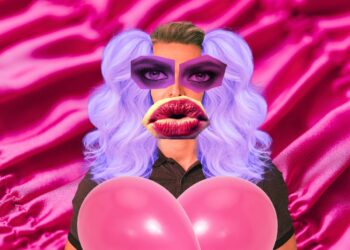
Paris Paloma is back with a new song, Good Girl. The song is a bold and unapologetic statement against the body politics that are inflicted on every woman, and by extension all gender diverse people. Through its lyrics, and the symbolism of the music video, she rejects the toxicity of diet culture, the pressures of body positivity, and how patriarchal expectations of what a ‘good girl’ is diminish women and their autonomy. It is the latest in a collection of music from Paloma that feels like the apex of pop music feminism.
We’ve all heard the anthemic bridge of Paris Paloma’s 2024 instant classic Labour more times than we can count. Scoring videos on TikTok feeds of women defying the patriarchy, it cemented Paloma as one of the defining voices of protest music in the 2020s. Last year’s Good Boy only furthered this as Paris compares red-pilled men to loyal but starving dogs at the feet of manosphere giants like Elon Musk and other billionaires. The song, which features Dame Emma Thompson, felt like an expansion on the themes of Labour while retaining a unique point of view. We loved Good Boy so much that it made our best of 2025 playlist last year. Paloma’s latest song, Good Girl, only serves to solidify further her position as the feminist pop star that so many of us need blasting through our headphones.

Good Girl is heavily centred on Paloma’s own relationship with her body and the pressures that our patriarchal culture inflicts upon women and their self-image. The song opens with spoken word poetry, discussing the concept of wanting to be free of being removed from the external conversations about body image. The liberation of divorcing oneself from body politics is something that Paloma acknowledges with realism. She recognises that the relationship we have to our bodies is complex and cannot be simply resolved through a 2010s-style body positive mindset.
It is a fantasy to ubiquitously love one’s body; the reality is that patriarchal pressures have conditioned us to have a continuously ambivalent and problematised relationship with our physical selves. We want to shut out the noise, and it feels almost like we can, but the reality is we can’t. Paris draws a comparison to water in a cup to demonstrate this relationship with the body. While the body contains us, it is not something we necessarily have to love, merely acknowledge. This concept is furthered by the fact that she expresses that she does not love her body, and the pressures of the body positivity movement can actually make it harder and more protracted to do so. The water does not love the cup – the self does not love the body.
Paloma’s lyricism has always been a strength of her artistic footprint. Good Girl sees her continue to weave biting social commentary into poetic lyrics that feel grounded by their meaning, yet ethereal in the lyrical choices made. Of this song, the lyricism is potent and raw. This also makes it heavily relatable for anyone (namely women and gender diverse individuals) who have to contend with the fact that our bodies are, and have always been, political playgrounds for men to control and legislate. Most pointedly, she expresses the perceived impossibility of ‘cleaning up’ the relationship with her body. We are always trying to define what our bodies mean to us; should we hate them, or should we love them? They mean everything, they mean nothing. It is unrealistic, and it is exhausting. Paloma’s song acknowledges this in a way few pieces of music on the topic have before. While the occasional mainstream song has tackled body politics, it’s not something we hear much about in music.

The video, directed by Georgie Cowen-Turner and starring Richard Armitage, sees Paloma as a sculpture come to life. It feels symbolic of rejecting the way patriarchy literally constructs women’s bodies. At the beginning of the video, Armitage is examining an amalgamation of mannequin parts that resemble the female body. It is evocative of the way patriarchy reduces women’s bodies into a collection of parts to be valued and fetishised, instead of aspects of a whole being. As Paris comes to life in the video, her autonomy and her removal from Armitage, the sculptor, mirror the refrain of the song itself: that if a man calls her a ‘good girl’ one more time, she will, in her own words, break his nose. It is a statement video that complements and furthers the radical rejection of body politics expressed in the song.
Sonically, the song marks a shift in direction for Paris, who has until now heavily leaned into acoustic and folksy-sounding music. Good Girl has an electronic production and, despite the lyrical depth, feels more danceable than previous work. It is a move that has paid off for Paloma, as the grounded and realist quality of her music is retained while she explores new avenues for her music. Vocally, she retains her strength and emotionality, something that has always stood out to me about her as an artist. When singing about the intimate, often painful topics that she does, it is her ability to emote through her vocals that makes her work so effective.
Good Girl is a song that we needed in the pop landscape. While other artists like Lorde have recently explored the body as a site of politics and personal trauma, Paloma has examined not the body alone but the barrage of pressures society places on it. Perhaps the most radical of all her lyrics is the very opening one, that Heaven is a fed girl. In a climate where the heroin chic uber skinniness of the 90s and early 2000s has been resurrected, we need to remember that diet culture is broadly harmful to us. She delivers this message, not to educate us, but to reassure us that the ambivalence, the frustration, the comparisons, and the utter hopelessness of living in a politicised body is something we share with every other woman. It is a song that makes one feel seen and understood, and that is something that every single person this song was written for needs.
You can listen to Good Girl on Spotify and check Paris Paloma out on tour with Florence and the Machine this February and March.