The final season of Euphoria portrays sex work through an alarmingly hollow lens with the message that the women who engage in it deserve to be humiliated and punished.
This article discusses drug use, sexual violence, and contains spoilers
Sam Levinson’s Euphoria began as a dynamic and considered exploration of drug addiction through the lens of a glossy teen drama that sought to separate itself from the Riverdales and Pretty Little Liars of the world. With its third and concluding season, it has opened a heavy-handed conversation about sex work and the women who engage in it, with a dialogue that has drawn criticism and scrutiny from its own fan base. The third season follows the main cast years after the events of the second, interrupted by the COVID-19 pandemic, the writers’ strike, and the blossoming stardom of its main cast. With all that in mind, the approach to the concluding season is… odd.
As the episodes continued to release week by week, it became glaringly obvious that the show suffered from the success of its cast, and allegedly from their interpersonal conflicts. Some of the cast, namely Hunter Schafer and Jacob Elordi, were all but absent from the show, with sometimes only a few minutes of isolated screen time per episode. It also suffered from weird pacing, fragmented and underdeveloped plot lines, and the limitations of the now typical eight episode series length. While the focus of this article is on the conversations that Euphoria sought to facilitate, it cannot be understated that this season was questionable for a number of reasons that exist outside of its positioning of sex workers.

Sam Levinson and the humiliation ritual
The discourse online has rightly noticed that the way Levinson writes his female characters often centres on finding a myriad of scenarios to put them in to punish them. The term ‘humiliation ritual’ has been used to describe the antics that characters, namely Sydney Sweeney’s Cassie, go through across the arc of season three. I cannot disagree. Levinson clearly wanted to comment on the prominence of OnlyFans, and the wider changing nature of the sex industry, but I would argue was the wrong voice to give appropriate levity to a dialogue that requires a sensitivity that Euphoria simply did not have. Perhaps that is not surprising when you consider that the heavily criticised The Idol is another of Levinson’s creations. The Idol suffered from a creative direction that sought to position women as vessels for sexual objectification and trauma, something that has certainly carried through to this season of Euphoria.
Utilising a focus on sex work does, I have to admit, feel very evocative of where our culture is currently at. At moments in the show I felt like Levinson was finally touching on the reality that we are a mere skip away from a world where the already dystopian desire to be an influencer is being replaced in the dreams of young women with being an OnlyFans creator. You need only look at the popularity of the Bop House on TikTok to see that this reality is pretty much already here. In a culture both obsessed with and reviled by the women who monetise their bodies, it is indeed a reasonable point of inspiration for a show that has established itself with its first two seasons to be unafraid to poke at society’s murky underbelly. Particularly in scenes where Maddy (played by Alexa Demie) discusses the lucrative market that OnlyFans has created, it feels cognisant of the scale of the modern sex industry. In the next beat, however, we see some of the most porn-brained television I have ever witnessed.
Outside of OnlyFans, the show also covers both the world of strippers and sugar babies, though I would argue both are fairly surface-level and the points made about both aspects of sex work are underbaked at best. What is most notable is that despite her proximity to these storylines, Rue, the show’s protagonist portrayed by Zendaya, who has been described by Levinson as at least somewhat a mirror of his own life, is protected from the sexualised degradation that a majority of the other characters in the show go through.
The crime of being a sex worker
This is probably most startlingly obvious when you compare Zendaya and Chloe Cherry’s portrayals in the same scene of the opening episode. Both of their characters are working as drug mules swallowing fentanyl balloons and smuggling them across the Mexican border. While this is shown in both characters’ portrayals to be uncomfortable and traumatic – appropriate given this behaviour can quickly turn from dangerous to fatal – the way this is shown is alarmingly different. Cherry is seen covered in saliva, gagging, and at one point a dog is licking faeces off her leg. This scene, depicting a seriously dangerous action that is often done under duress by victims of human trafficking, is played for shock value and, it would seem, to mirror violent pornography.

Cherry was actually discovered by Levinson when she herself was working as a pornographic actress in a Euphoria parody. It feels plain disrespectful to display her on screen in this way when that context is known. While Cherry has stated that she had no issue with the scene and even received applause from the crew for her performance as it was filmed, I cannot help but notice that Zendaya was able to avoid this same portrayal of the same action. While it is indeed central to show the dehumanisation of being forced to swallow fentanyl balloons, it feels like Levinson is using an actress who has appeared in pornography to deliver a sensationalised, porn-brained and intentionally degrading scene to hook viewers in. Frankly, it went too far and feels inherently misogynistic, maybe even puritanically minded.
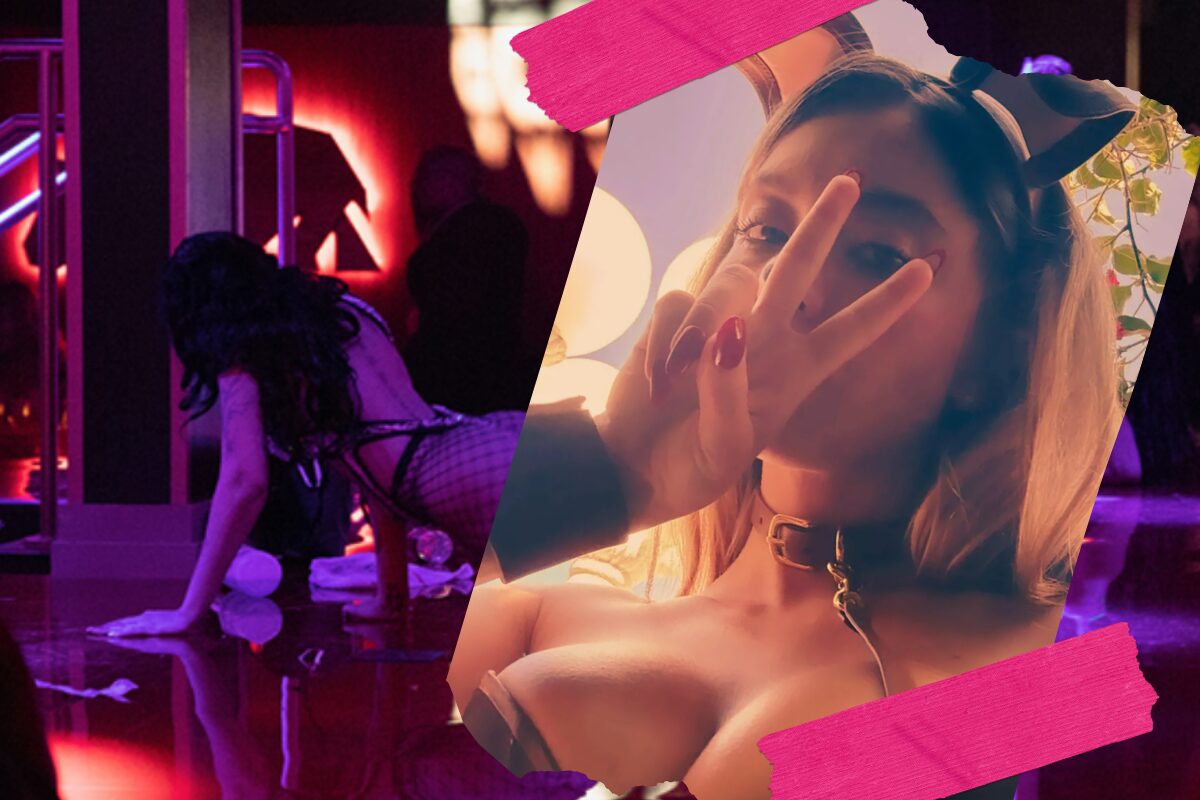
The other character who is most frequently positioned for the purpose of creating a visual spectacle of degradation is Cassie. Sydney Sweeney, who frankly has atrocious politics, has said that she was comfortable with the scenes she shot, but the way they portray sex work is quite alarming. At various points, she is shown portraying a sexy baby, a puppy, or holding gigantic dildos. These moments are played for comedy but serve to show sex work as something inherently extreme and degrading. Sometimes it is, as a former sex worker myself I can attest to that being a significant aspect of working in the sex industry. What I cannot attest to is that we see Cassie pretty immediately jump into fairly extreme kink play that is not shown with any emotional intelligence, but purely as a porn-brained depiction of OnlyFans content creation. In itself, I don’t think that exploring the extremities of pornography is wrong, but I take issue with the fact that it is depicted with a clear view to satisfy an underlying truth that Levinson seeks to espouse in Euphoria – that sex workers need to be punished.
Strippers are just… props?
Rue’s story arc in this season is largely centred on her working at a strip club, and so naturally we meet a handful of the women who work there. These characters mostly exist as props; only Magick, played by Rosalía and Angel, played by Priscilla Delgado, have any real discernible character traits. Even then they are quite surface level. We know that Angel mourns her friend who dies of a fentanyl overdose and that Magick has a temper. That is basically it. The rest of the strippers we meet do not have so much as even the hint of a back story or any true characterisation. We have seen plenty of stories that portray strippers with nuance and consideration; Euphoria’s third season, despite being largely set in a strip club, does not care to explore that. In place of what could have been a considered exploration of the life of erotic dancers instead places all of the focus on the men that run them. It is a tired and overdone view of strippers as property of pimps. Levinson, no doubt from the way he treats women in his projects, sees himself as a pimp of sorts and wanted to stack the backgrounds of his scenes with beautiful women who exist only as set dressing.
Magick is the most fleshed out of the strippers, and she predominantly exists to shout at Rue in Spanish and expose her for being a double agent in the climax of her story arc. After she has served her narrative purpose, she is never seen again. We do not know where she came from or where she went. Angel only exists to give the viewer the understanding that all is not at it seems at the strip club, giving us a sense of caution around Rue’s new place of work. They are not real three-dimensional characters; instead, they exist as plot devices to be picked up and discarded as Levinson sees fit to drive Rue’s story forward. What is even more frustrating is the fact that the actresses are able to deliver engaging performances with the limited material they have, showing us that if given the opportunity these characters could be dynamic and compelling.

Why does sex work actually exist?
Most evocative of the conversation Euphoria seeks to have about sex work is Cassie’s story arc. She starts making OnlyFans content to pay for expensive floral arrangements for her wedding. Naturally, this is positioned with frivolity and tells the audience that she is an inherently selfish person. Levinson is not interested in having a conversation about the real reasons that people often enter the sex trade: to navigate trauma, to escape poverty, and often because they are coerced. Even if Cassie were still to make her content for the canonical motivations, we never hear from the other sex workers we meet in the show to hear why they have entered the industry. It leaves us with a conversation that does not want to open up the inconvenient truth that sex work is often a means to an ends that the sex worker in question would rather do without.
Cassie is adamant in the show about wanting to be a sex worker; she swears up and down that OnlyFans is something that she finds empowering. We see her make this claim to different people at different points in the story, and while she may not fully believe it, it is held like a talisman by Cassie to rationalise and justify being a sex worker. It is a strategic decision on Levinson’s part to make sure that the most in-depth sex worker in the show is one that we as an audience are predisposed to dislike due to her actions on the previous season, and that she is an enthusiastic participant in her content creation. It is only after financial troubles become insurmountable that her partner is willing to support her decision to make pornography. I feel this choice was made because it is not beneficial to Levinson to place the blame on the men who consume pornography or who encourage reluctant partners to make it for their own financial gain. That would centre the focus away from hating sex workers and onto the men that allow sex work to exist in the first place. This is even the case when we look at Alamo, the strip club owner who drives much of the plot.
Alamo is the self-described ‘king of pussy’, something that earns him adoration from Rue when she meets him. While he is shown, particularly towards the end of the season, to be a violent and unsympathetic man, he is afforded a back story to explain his behaviours. That is something we have already established is not afforded to the women that he employs. Subtextually, it appears that he coerces the women in his clubs, but this is only partially explored. Again, a nuanced conversation about women, particularly women of colour and of immigrant backgrounds who we see working at the strip club, and their motivations for becoming strippers could have been integral to the show. It was not explored.

Levinson does not want to interrogate these topics because to do so would mean he had to treat sex work with more nuance than I believe him to be capable of. This is what lies at the heart of what Euphoria got so wrong about sex work. In the spectacle of a giant Sydney Sweeney with her breasts exposed, crushing masturbating men and strippers grinding on poles, the truth of sex work is lost. That truth is that it is complicated. Sex work is a deeply complex topic that media so often is not willing to afford the time and consideration is so desperately needs. Sex workers in so much media are shown as a mangled collection of broken and bedazzled bodies with no interest in what led a woman to make the heavy decision to sell her body. It is an oversight that I have come to expect and detest equally. Levinson’s particular approach speaks to someone who clearly has a real interest in the consumption of women’s bodies, but is not capable of handling the fact that many sex workers are, in fact, not enthusiastic participants but multifaceted people who are not inherently dirty because they are engaging in sex work.
As a feminist and a former sex worker, I understand that the sex industry is extremely exploitative. Pornography, prostitution, being a sugar baby, and stripping all place participants in a precarious position where they are vulnerable to violence, financial insecurity, and social exclusion. Euphoria only explores these realities with an interest in presenting them as inevitabilities for women who deserve to get smacked down. By the end of this third season, I have to wonder if he actually just plain hates women. He certainly makes it clear that he hates sex workers and had plenty of fun punishing them with his creative decisions.
Women who work, and women who don’t
Levinson seems to have, albeit lesser, criticisms of the career woman in Euphoria too. Lexi (played by Maude Apatow) and Maddy both start the season working long and unfruitful hours at jobs in the entertainment industry. Both are underlings who live and die by the whim of their bosses. At various points in the earlier episodes, both characters are put in situations where their job security is threatened, and they have to grovel to keep their positions. It is a glaring comparison to the sex workers in the show who successfully rake in far more money than the ‘straight-edged’ characters. It creates an undercurrent that to be successful as a woman you have to denigrate yourself in Levinson’s image of hyper-degrading sex work to get ahead. Yes, the world of work is miserable, and the violence of late-stage capitalism is something that does harm women as they strive to advance their careers, but if that fact is acknowledged, in the same breath it is stated that to escape that is to enter sex work, and to be a sex worker is to be Levinson’s punching bag of porn-obsessed misogynistic punishment fantasies. It is a brazenly nihilistic approach to telling stories about women and the work that they do.
Only when Maddy decides to fully pivot to managing Cassie and other OnlyFans creators is she given the green light from Levinson to truly come into her own, and then in the immediate aftermath her storyline gets more uncomfortable and higher stakes – with far more danger. It is the ultimate double bind put to screen: be a good girl and get a career but accept that you will get nothing and deserve nothing. Be a ‘bad’ girl and sell sex, but accept that you deserve to endure humiliation with a plastered smile on your face. Lexi is probably the most ‘respectable’ of the main cast, but her storyline concludes with barely a nod to her career goals. At some point in the middle third of the season, she is thrown a bone to do some television writing, but this is hardly explored. Given the season has only an eight-episode run, I appreciate that not every story beat can be fully explored, but it feels like an intentional oversight to skim over the one main character who has no real proximity to the sex industry.

The most under-explored character is absolutely Jules, played by Hunter Schafer. It is revealed that she dropped out of art school to be a full-time sugar baby, living in a high-rise apartment where she paints and has sex with her sugar daddy. That is pretty much her entire story arc. When challenged by Rue about this arrangement, she barely has an opinion either way. Her entire story arc is reduced to this; in one episode she paints a replication of A Sunday Afternoon on the Island of La Grande Jatte by Georges Seurat with the addition of penises, but that is about the only dynamic thing she does the entire season. While this was likely due to Schafer’s availability, it does carry another discussion about sex work within a show that is clearly very obsessed with it. Her absence and diminished presence feel like a musing on the idea that to be a sex worker like Jules, who is dependent upon a married man keeping her a secret, is to disappear.
That has the potential to be a very interesting story arc, exploring the emotional journey that Jules goes through. Instead, we barely begin to scratch the surface of the dynamic that now defines her life. It feels like Levinson took the opportunity to shoehorn in another aspect of sex work to complement the limited availability he had with Schafer, but I have to ask what was the need? Why introduce the conversation if you don’t have the appropriate time to explore it with any real justice? The conversations between Jules and Rue could have taken place just as easily if she was a university student. What we have instead is an absentee story arc about an often misunderstood and misrepresented aspect of sex work that, particularly given Jules’ identity as a transgender woman, could have been given real care and nuance.
All of that for what… exactly?
Sex work is an often emotionally draining, often difficult way to earn a living. As a former sex worker, that is something I am more aware of than the average Euphoria viewer. I also know that a sensitive and meaningful exploration of it can be portrayed in an entertaining way. Levinson at points nearly achieves this, but his agenda to demonise sex work in the form of punishing the women in his show who engage in it detracts from any meaningful points that Euphoria could have raised. The show suffered from more than just its clear agenda to issue moral judgements about sex work. The season felt disjointed; plot points were introduced and forgotten in quick succession, the cast clearly had conflicting schedules, and the unavoidable time jump resulted in something that feels detached from the earlier seasons, trying to justify its existence through spectacle and shock value over intellectual storytelling. The irresponsible representation of sex work is just the cherry on the cake for a season that began with undeniable promise that quickly coughed and sputtered into a bit of a hot mess.

The concluding message is what I think left the most bitter taste in my mouth. In a mirror of the first episode, we conclude at the Evangelical homestead that Rue encounters in the opening scenes of the season. Welcomed by the family, she is inspired to explore religious beliefs across the season. This is explored with some intrigue, and frankly is one of the more considered aspects of the show. What is so concerning about this is how the family Rue meets, an isolated, heavily Christian family who clearly have never met a form of contraception in their lives are portrayed as the only happy people in the show. From a very limited snapshot of their life, Rue treats their perceived tranquillity as a north star. What the show ignores is that, particularly as a Black lesbian, this environment is not likely to actually deliver on its alleged promise.
Levinson uses this puritanical existence as the ‘answer’ so to speak, for the characters of the show. Hand yourself, mind, body, and soul, over to the clutches of conservative Christianity. Ignore that sexual abuse is rampant in these communities and the social mobility of women is largely non-existent. In the current social climate where Evangelical Christianity casts a Goliath shadow over the political and social fabric of America, it feels like a tone deaf and pretty misguided concluding point to leave the show on. While the show does not really explore this family in any real detail (all we know about them is they are Christians on a remote farm who seem happy), the basal knowledge that the viewer will have of traditionalist Christianity fills in the gaps that Levinson has no interest in filling in. As the final scene of the show concludes with Ali, Rue’s mournful sponsor, leading grace around this family’s crowded table, I had to scoff. Are we really, after this eight-episode degradation fest, supposed to swallow the Kool-Aid that the answer is to submit to patriarchal Evangelicalism? I don’t buy it, and neither should you.