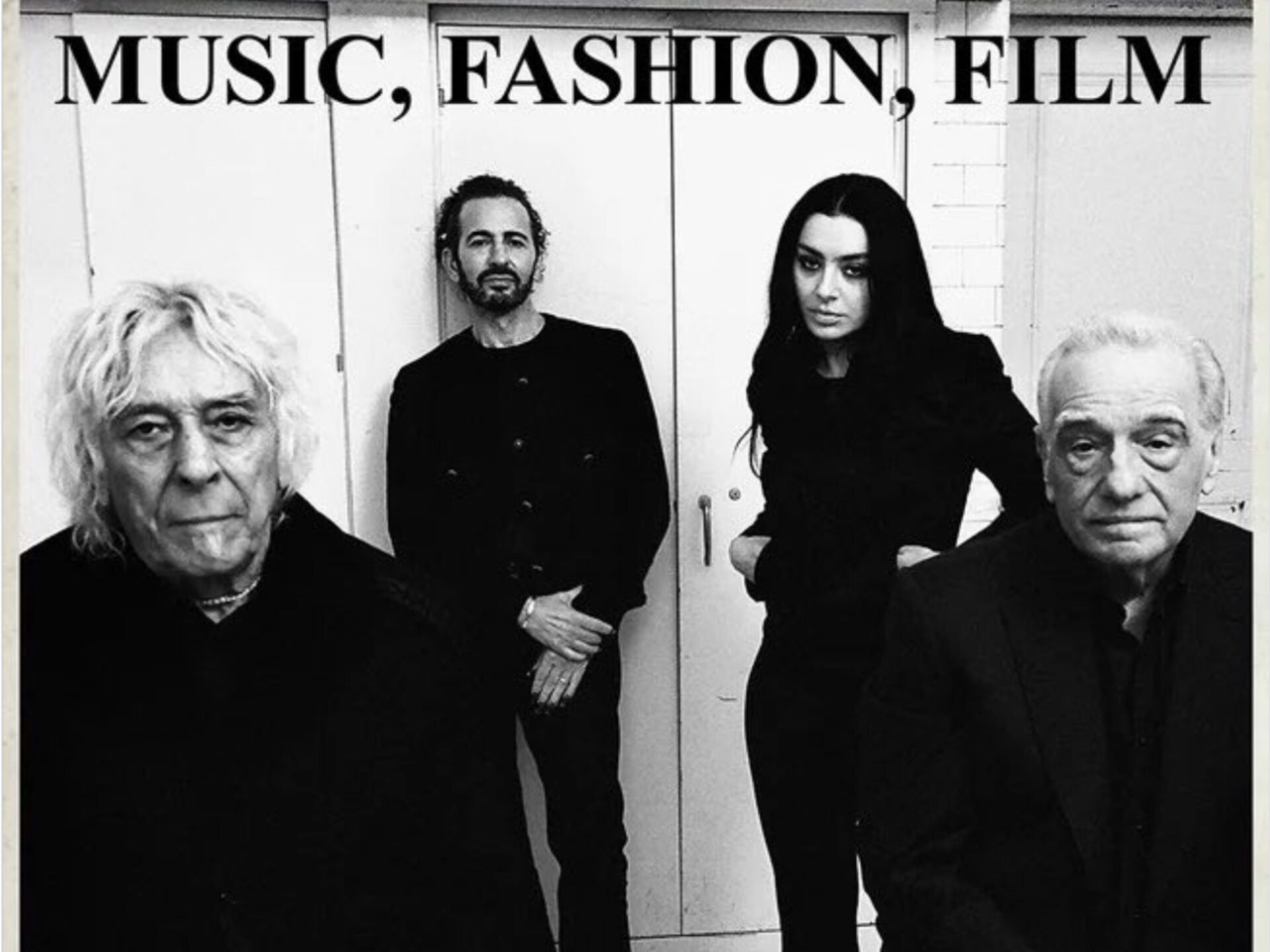
Charli xcx’s new album Music, Fashion, Film is an introspective and sonically experimental project, as it comments on fame, culture, and impermanence.
There is something so bitterly nostalgic when I think back to Brat summer. The world was an altogether more vibrant place; we were yet to have another four years of Donald Trump inflicted on us, and the slime green fingerprints of Charli xcx were all over every facet of pop culture. In the aftermath, her fans, both new and old, have watched her closely, even speculatively, to see what she might do to follow up Brat. The album was such a runaway success, propelling her from the fringe of pop culture right into the epicentre of it. Her creative return initially came in the form of Wuthering Heights, an album to accompany Emerald Fennel’s remake of the Brontë classic. Charli has the singular honour of producing the only unambiguously successful aspect of the film. Perhaps then, the fact that she makes her following album, the first to truly stand as a follow-up to Brat, is Music, Fashion, Film.
The album is a brutalist exploration of Charli’s reality as a creative following the monumental impact of Brat. It is a project that feels like a hangover from the success she experienced. At various points in its 11-track run, I found myself feeling like this album could not have existed without the context that comes with understanding who Charli is as an artist, and where she has been. Before the locals got to know her in 2024, she existed as a darling of the hyperpop scene, pushing the needle forward with what pop music could be and shaping culture from a more obscured place. That requires an intellectualism that is sometimes missed in the hedonism that came with Brat, but is at the forefront on Music, Fashion, Film.

A sonic departure
Music, Fashion, Film marks a sonic departure from Brat. Don’t get me wrong, both albums feel equally authentic to Charli, but this album has a far grittier and more acoustic basis with electronic distortion. It is a move that I feel has suited her well, flexing her creative versatility that may be unknown to her newer fanbase. The use of electric guitars, drums, and mid-tempo beats does give one a hint of the possible influence of time spent around the 1975. She has taken a sound that would maybe be atypical of what people would have expected and manipulated it to feel as natural to her as her previous hyperpop and electronic projects. This contributes to the more understated and grounded approach that she has taken to Music, Fashion, Film. I believe that this leaves us with an album that is a step forward, and a step left for Charli.
The production is sharp, as one would expect from Charli and longtime creative partner AG Cook. Each song has its own personality, with tracks like Wink Wink feeling more decidedly radio-friendly, and songs like Card Declined having a far more experimental direction. Amidst these sometimes competing energies, the album is cohesive, possibly aided by the fact that it has only 11 tracks in total. So often now, albums by artists who have experienced significant success, like Charli, are released with mammoth track lists, going on and on for well over an hour. Sometimes a longer album is sensical for the sonic world an artist wants to welcome you into, but so often that is clearly not the case. Music, Fashion, Film is a perfect example of why condensing and editing your work into a consolidated collection of stronger and more impactful songs is often the more creatively beneficial path to take.
Her most introspective work yet
What stands out the most to me about Music, Fashion, Film is just how deeply introspective it is. In a 30-minute run, Charli addresses and muses on a variety of topics that are more intimate than I feel we have ever seen her. Previous works like So I, I Think About It All The Time, and I Finally Understand have shown us Charli’s ability to be self-reflective and vulnerable, but on Music, Fashion, Film, it feels like a central focus. Notably, I found the discussion she has about fame, impermanence, and freedom on the songs Camera and No One Lasts Forever to be particularly telling. On Camera, she is analysing the relationship she has with being the artist and the subject, musing on the way that being in the public eye feels both exhilarating and exposing – asking if she really wants to be in the spotlight but recognising the ways she feels in front of the camera.

To see her arc as an artist, being thrust from the role of an alt-pop critical darling into a mainstream cultural force, the decision to speak about this dichotomy now feels at its most apt. This is only furthered with the closing track No One Lasts Forever, which reflects on the impermanence of being in the public eye. She discusses how, since her commercial centrality, life is more fun, but also that she knows the moment is not permanent. The closing bridge, a spoken word discussion of a near-death experience from David Cronenberg, sends us off with a sense that Charli is pragmatic about her success, and is perhaps on the precipice of an ego death of sorts. She is unafraid to speak bluntly about how her fame is something that she revels in, but that it is a fleeting thing. In the end, she knows that her life will not be defined by the impressive things she has done, but the people in her life.
In Cronenberg’s monologue, he speaks about the fact that there are artists who have created work that has far outlived them, sometimes by hundreds of years. The rub is that the artist in question is not present to witness the success themself. While it is a virtue to create and to have your work exceed your own life, when one is on the verge of death, this is irrelevant.
Charli xcx, the person and the persona
No One Lasts Forever also touches on another key theme of Music, Fashion, Film, the dichotomy between how the public perceives Charli and how she feels she actually is. She talks about how, thanks to the persona of Brat, the general public has used her name as a shorthand for cocaine addiction – no doubt not helped by Taylor Swift’s incredibly thinly veiled swipe at Charli on her most recent album. She speaks to how she is seen as ‘having a problem’, as irresponsible and rude, which she ultimately feels is a harsh judgement. As she sings that nothing will last forever immediately after the verse that touches on this, it feels like she may be trying to convince herself that the negative perception of her is impermanent, just as fame is.
This theme also persists on Wink Wink and Persona, which take this subject matter from very different angles. Wink Wink is inherently playful (as the title would suggest); she sings about how she is a reformed character, promising she is no longer a ‘bad girl’. This was a highlight for me; the song is fun and infectious, but has teeth like the rest of the album. She is aware of the way she is perceived, but she is at least on Wink Wink unimpacted by it. In the song, she makes various statements about things she has changed and does differently now; she is a reformed person, and the satirical nature of the song is an undeniable strength of her lyricism and her enduring persona as an artist. The video shows her in various domestic settings, inverting the image of a reformed housewife by performing numerous sensual acts. It is a musing on the gendered expectations of her as a recently married woman, and as a public figure who has experienced a degree of scrutiny due to her artistic output.
Persona, on the other hand, is a cutting conversation with herself, exploring the dichotomy of her outward expression as a public figure and her internal frustrations with how she presents herself. It is not inherent that she is addressing herself, but it feels inherently introspective as a song. She speaks to the persona in question with a scalpel in hand, unafraid to call out ego and performative traits. While this song could be read to be about someone else, I don’t feel like, in an album where so much of its lyrical content is about the nature of fame, of being inherently linked to music, fashion, and film, that this track can only be read as a conversation between Charlotte the person and Charli the cultural force. Given it is immediately after Wink Wink in the run of the album, it represents mirror sides of the same conversation, pushing back against public perception while toiling with private doubt. I think that the track I’m Afraid, which discusses her fears that her marriage will break apart due to her nature and her drive to create, is presenting a version of herself that is fearful that her stardom is as much an inherent part of herself as it may be the thing that destroys her. It is a reflective songwriting approach that is gripping.
A very 2026 album
Music, Fashion, Film feels very cognisant of the times, with references to consumerism and the dystopian feeling that emanates from 2026 pop culture; she creates an album that is, as her work often is, hot on the pulse of culture. SS26 may be the most emblematic of this, as she references exploiting her heritage and her political beliefs for public clout and to progress her career forward. Contrast this with the desire to consume fashion and remain on trend as it feels the world is on an inevitable ‘runway that goes straight to hell’, and I think the album feels the most of the moment of any that have been released this year. Music, Fashion, Film, and other mediums like literature and television are vehicles for escapism, but they are also the mirrors of the times that we live in. Charli is aware of that, and she wants to project a liminal message about how the artistic output of the moment sets the tone for it.

Card Declined continues this idea and zeroes in on it. The track is a brutalist approach to the current hyperconsumerist nature of fashion. She discusses how the desire to define ourselves through the vehicle of clothing and adhering to the micro-trend cycle as it continues to grind forward at a breakneck speed is hollow. The song discusses how people would rather spend all their limited money to be en vogue than to live a more holistic lifestyle. As it currently stands, the drive to consume is greater than ever. It is not contingent upon personal desire but rather social pressure to have the status that consumption brings. She identifies this and, in not so subtle a way, calls out how problematic this is. Quite cuttingly, the chorus talks about how items are bought in the desire for a new personality, one that will change as soon as the must-have of the month is swapped out for something equally ephemeral. As a constant critic of capitalism, I nodded in agreement as the song played.
Thinning the herd
While I don’t think this was intentional, the creative choices made with Music, Fashion, Film feel like they will thin the herd of TikTok locals who only know Charli for the Apple dance and popularising slime green everything. I think that this is a good thing for her; artists like Charli who are driven by shaping culture are rarely at the centre of it for long and are often more comfortable with a consolidated fan base while they set trends ahead of the curve. I think that Music, Fashion, Film will ultimately do this – it will be an album that, as we have already seen, will not have the same mainstream success as Brat but will still be influential on the culture. It is a cerebral project that demands a more discerning ear to appreciate.
The album does contain a myriad of cinematic and fashion-related elements and motifs that warrant the title; I feel it is such that the choice to make a body of work that is so decidedly based in these mediums is indicative of Charli as an artist. She has said in numerous interviews in the build-up to its release that she is always looking for the next innovation in music, and I feel that the further integration of music and artists into film and fashion, as modelled by her work for the Wuthering Heights companion album, is one such innovation. I also feel that this album warranted the approach she has taken to consolidate her rollout strategy to be more contingent on space and imagery, a departure from the memeification that buoyed Brat and other previous works.
Music, Fashion, Film is a singular album in Charli’s discography. It is by far her most introspective and vulnerable work, but it is also work that feels ambitious and even hopeful. Through its introspection, we see Charli as the intellectual and culture-defining artist that she has always been, pushing the envelope in ways that we did not expect. I think that the album will prevail in the long run as a perhaps overlooked but respected and referenced body of work that shows a generational artist stepping in a different direction creatively to make songs that are internal and intimate, alongside songs that are commenting on the state of the world and the media with a Wink (Wink).