A proposed North Carolina bill could make it ‘legal to kill women who have an abortion’. From changing bans to contradictory internet advice, American author Elaine Lawless writes about what getting an abortion in post-Roe America really involves.
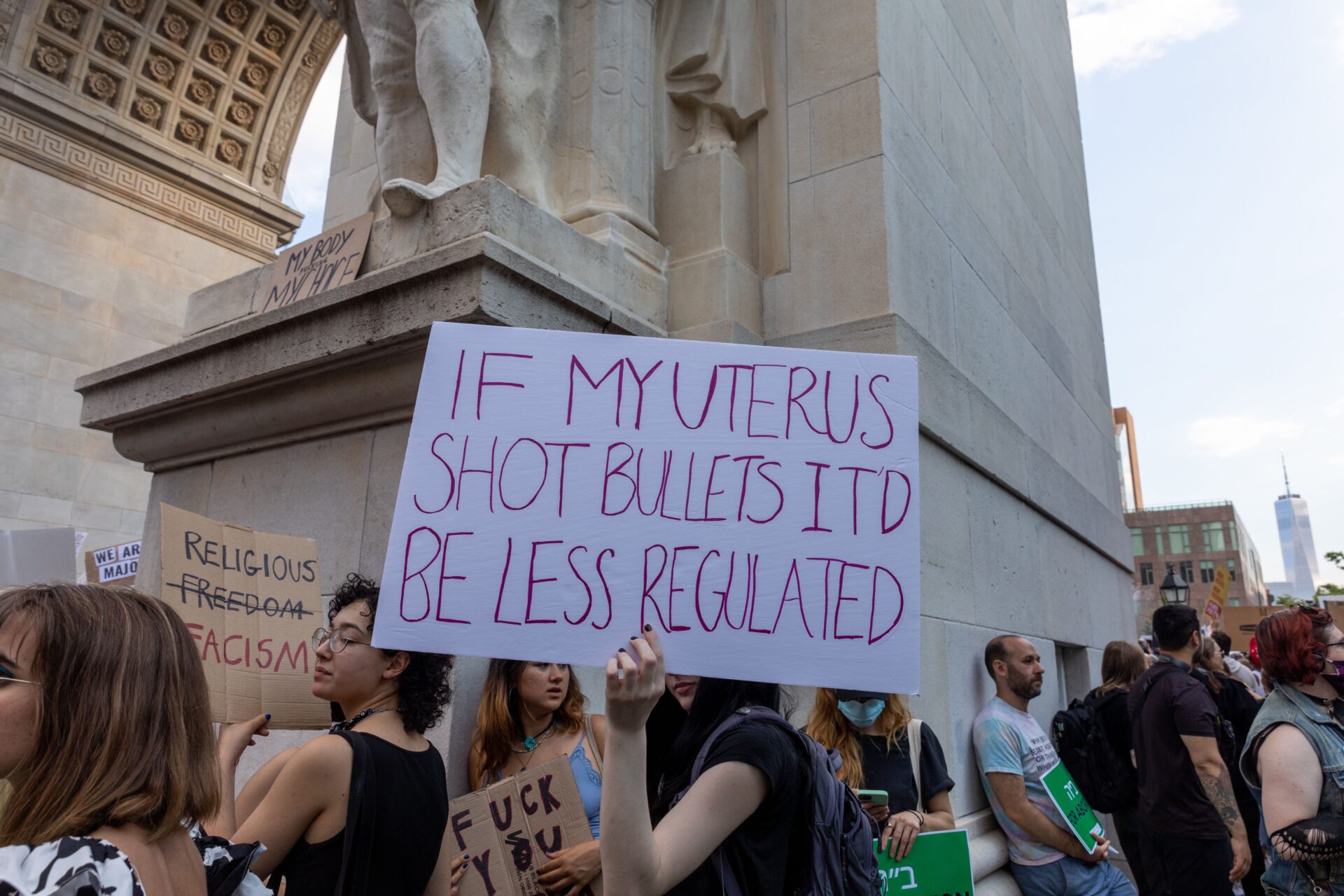
Last week, just as my publicist asked me to write a piece on the difficulties of access to abortion in the US post-Roe for The New Feminist, I read this headline on their website: ‘Activists warn that a new North Carolina bill could make it legal to kill women who have an abortion’. I might add, this irresponsible proposal also states that anyone can use “deadly force” to stop an abortion from happening or to stop someone from “otherwise harming or threatening to harm a fertilised embryo, which is viewed as a legal person with personhood rights in the state, through contraception or IVF”. It would also classify abortion as “first-degree murder” for the patient, as well as for the medical provider. The premise and the implications of this proposed bill boggle the mind and should make every person who can become pregnant both very angry and equally terrified.
Ironically, I currently live in North Carolina, having moved here during the pandemic, at the exact moment when the US Supreme Court rescinded Roe v Wade and removed the legal right to abortion for all women in the United States, reverting all laws and restrictions on pregnancy and abortion to the control of state legislatures. When I first read about this proposed bill in North Carolina, I thought it must be a mistake, or possibly a joke. It is not, and although those who object to the bill hold out hope that it will not pass the state general assembly, these days it cannot be discounted as frivolous or unlikely to gain support. Margaret Atwood might warn us that stranger laws have been put in place to control the bodies and lives of women, and we must remain alert to all possibilities, or be caught off guard when it passes.
When Roe v Wade was rescinded by the Supreme Court in 2022, I lived in Missouri, which I thought at the time was a more conservative state than North Carolina. These days I’m not so sure. While still in Missouri, I was already hearing stories about what might happen if abortion were banned throughout America. The anticipated decision had been leaked months earlier, and fear was in the air. I began to hear stories about reproductive clinics closing, difficulties getting prenatal screenings, locating doctors who could (or would) perform abortions or prescribe pills, and I heard many stories about mothers seeking help for their very young pregnant daughters.
Because Missouri is one of the most conservative states in the US, the state legislature was poised to pass restrictive laws and bans as soon as the Supreme Court decision was published. It was the first state to pass “trigger laws” that made abortion a prosecutable offence, made it more difficult for doctors to perform abortions without hospital privileges, removed funding from clinics that primarily assisted low-income and disadvantaged women, and threatened abortion “helpers” who aided those crossing state lines for abortions.
Once the state’s trigger ban went into effect, Missouri became a perfect example of what is happening across the country. There are 50 states in the US, and that means that at this moment, they all have different and often conflicting laws and restrictions that affect women’s bodies.

Allow me to illustrate what you would have faced, until very recently, once you realised you were carrying an unwanted pregnancy in Missouri. The state officially had a total ban on abortion and strictly enforced new “trigger laws” passed to prosecute those seeking abortion, those providing abortion care, as well as those who might assist you to cross state borders for an abortion. Missouri itself borders eight other states: Iowa, Illinois, Kentucky, Tennessee, Arkansas, Oklahoma, Kansas and Nebraska. Where would you travel if you wanted to get an abortion in a different state?
If you lived in the southern part of the state, where I was raised, an isolated region far from the cities and from any kind of reproductive resources for women, you would be four hours and 30 minutes from Nashville, Tennessee, the biggest city outside the state. But an internet search will reveal that Tennessee also has a total ban on abortion, and you will be advised to “travel to another state to seek an abortion”.
Should you choose to travel to Kentucky from Missouri, you will find there is no bridge across the Mississippi River into Kentucky, and why would you even bother, as that state strictly enforces its total abortion ban as well. If you check the law in Illinois, you will find that this state does allow for an abortion up to the point of fetal viability, but if you travel to southern Illinois from southern Missouri, you may not find any open clinics, as that part of the state is more conservative and offers little or no reproductive care.
If you travel north to East St Louis, you can get an abortion, but the clinics there do not accept Medicaid or private insurance for the procedure; only out-of-pocket services are provided. Abortion pills will cost you $350, and a medical procedure will cost from $550 to $800, depending on gestation weeks, and the internet will warn you that East St Louis is “a very unsafe and dangerous area with high crime and drug use. Visitors are cautioned not to walk the streets at night and know exactly where you are going.” If you travel further north, about six hours to Chicago, you can access an abortion for $350 or more, but travel and lodging costs are much higher, and it may be more difficult to schedule an abortion in a short amount of time in such a congested urban area.
If you wish to travel north out of state to Iowa for an abortion, which would be a seven-hour drive from southern Missouri, be aware that the state has a strict ban on abortion after “six weeks and 0 days”, requires state-mandated counselling and a 24-hour waiting period before an abortion, and at least two in-person appointments. If you are under 18, you must have written permission from a parent, a legal guardian or a judge for an abortion. By this point, you could be running out of time. In Nebraska, west of northern Missouri, if you are “past 12 weeks, 0 days” pregnant, you will need to travel out of the state to get an abortion. There are exceptions in the case of rape or incest, but it is unclear how you advocate for these. To get there, it will take you eight hours to drive to Omaha, the largest city in Nebraska, to find a clinic.

In Kansas, also to the west, you will find abortions are legal up to 22 weeks, although the state also asserts that “life begins at fertilisation”, without explaining how that affects access to abortion and the law. The state prohibits D&X procedures, but abortions are offered at Planned Parenthood for $580 to $800, depending on gestation. Both abortion pills and surgical abortions are performed in Kansas by licensed providers.
While all of these different laws and restrictions are already confusing to a person who has just learned she is pregnant and may not wish to carry her pregnancy to term, internet resources are often contradictory with their information. For example, when researching abortion law in the state of Oklahoma, just south of Missouri, one will learn “Abortion is completely banned in Oklahoma”, yet “you can get an in-clinic abortion during the first trimester at a Planned Parenthood in Oklahoma for $580-$800”. Further, the internet states “the penalty for performing or attempting to perform an abortion in Oklahoma shall be guilty of a felony punishable by a fine not to exceed $100,000, or by confinement by the Dept. of Corrections for a term not to exceed (10) years”. Tricky, to say the least.
Most abortion information on the internet by state stresses the importance of calling clinics before travelling anywhere to seek an abortion and making an appointment for services. For states that have a strict six-week ban on abortion, if you don’t know you’re pregnant until you are four or five weeks along, getting an appointment and travelling to a different state may mean you will not be able to access an abortion at all, because you are already past the gestation period.
Missouri’s ban has since fallen: voters approved a constitutional amendment protecting abortion in November 2024, and in June this year, a state court struck down the trigger laws, restoring access up to the point of viability. Even so, Missourians will be asked to vote on a new ban this November.
By the time Roe v Wade was rescinded, I had already published several scholarly books on women’s lives and their stories, but I realised I needed to use what I had learned through research and study to write a novel about the dangers of abortion bans in post-Roe America. The news reports are still everywhere, but no statistic or new law can possibly portray the devastation for women and girls to face the ever-changing abortion laws and travel for help. I wanted to imagine how such a story might unfold and illustrate the difficulties women and girls face when we try to control our own bodies and shape our own stories. This called for a compelling story that would grab readers and make them care.
My novel, Only Girls Bleed, is the fictionalised story of a young mother, Alice, and her 10-year-old pregnant daughter, Molly. Alice and her good friend, Barb, have long conversations that mirror those I have heard in my research in women’s shelters and women-only communities, stories about raising girls and the difficulties of being female in a male-dominated world. Barb is there when Alice’s husband abandons his family; she is there, too, when Alice discovers Molly is pregnant. Later, when Alice locates a long-lost sister of her mother in a different town, her aunt and her friends embrace her and Molly and promise to escort them across state lines, at the risk of their own safety. Only Alice is sentenced to prison, because the judge does not believe her story and gives her the harshest sentence possible for her “crimes”.

The frame of my novel is the story Alice is writing, while she sits in prison following Molly’s abortion. She and the other women in the prison, have been encouraged to write their own stories by a visiting writing teacher. In these classes, the women learn to appreciate each other as people, rather than as convicted prisoners, and they come to trust the value of the stories they share in the safe space of the class.
My novel is not an easy read, and it reveals deeply held and often conflicting beliefs about pregnancy and abortion, about betrayal and vulnerability, and about the power (and the consequences) of female community to fight back and refuse the role of victim. It is my hope that readers will engage with the story, and the book will provide a better understanding of the burden only women bear in the midst of the abortion wars in America today, or anywhere else that access to abortion is threatened.
Only Girls Bleed by Elaine Lawless is published 14 July 2026 by The Book Social, price £9.99 in paperback original. Find out more at elainelawless.com.